
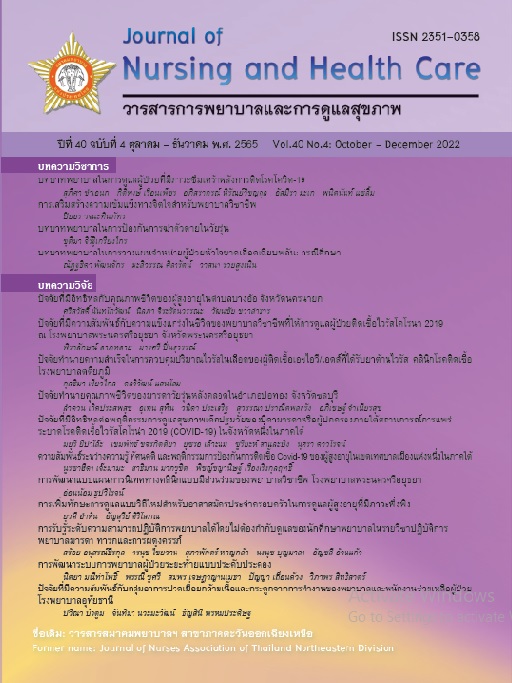
Factors Related to the Resilience of Registered Nurses Providing Care to COVID-19 Patients at Phra Nakhon Si Ayutthaya Hospital, Phra Nakhon Si Ayutthaya Province, Thailand
Keywords:
resilience in registered nurses, COVID-19, caring for patients with COVID-19Abstract
This descriptive research study aimed to investigate the relationships between age, self-esteem, emotional quotient, relationships with friends, and social support with resilience in registered nurses. Participants were 70 registered nurses providing care for care to COVID-19 patients at Phra Nakhon Si Ayutthaya hospital in Phra Nakhon Si Ayutthaya province, Thailand. The research instruments used for data collection included a demographic data questionnaire and the Resilience Inventory, Rosenberg Self-Esteem Scale, Emotional Quotient Questionnaire, Peer Relationship Questionnaire, and Personal Resource Questionnaire. The validity of the research instruments was assessed by performing a preliminary trial with 30 registered nurses with characteristics similar to the sample to determine the confidence levels via the Cronbach’s alpha coefficients of the Resilience Inventory, Rosenberg Self-Esteem Scale, Emotional Quotient Questionnaire, Peer Relationship Questionnaire, and Personal Resource Questionnaire, which were .90, .88, .90 and .80, respectively. Descriptive statistics and Spearman’s rank-order correlations were used to analyze the data.
The results revealed that age, self-esteem, emotional quotient, and relationships with friends were positively statistically significantly related to resilience at p < .05 (rs=.283; p=.037; rs=.343; p=.015; rs=.277; p=.020 และ rs=.499; p=.001 respectively), while social support was not statistically significantly related to resilience (rs=.145; p=.232). Results from this study provides important data that can be applied to promoting resilience among registered nurses caring for COVID-19 patients.
Downloads
References
Department of Disease Control. Corona Virus Disease (COVID-19) [Internet]. 2020. [cited 14 September 2022]. Available from: https://data. go.th/dataset/covid-19-daily.
Ministry of Interior Centre for the Administration of the Situation due to the Outbreak of the Communicable Disease Coronavirus (COVID-19). Guidelines based on Regulation Issued under Section 9 of the Emergency Decree on Public Administration in Emergency Situations B.E.2548 (2005) [Internet]. 2020. [cited 14 January 2022]. Available from: https://www.krisdika.go.th/regulation.
Center for Disease Control and Prevention. Reducing Stigma [Internet]. 2020. [cited 14 September 2022]. Available from: https://www.cdc. gov/coronavirus/2019-ncov/symptomstesting/re¬ducing-stigma.html.
Thaweekoon T, Nintachan P, Sangon S. Factors Predicting Stress in Graduate Nursing Students Nursing. Journal of the Ministry of Public Health. 2013; 22(3): 1-11. (in Thai)
Sun J, Stewart D. Age and gender effects on resilience in children and adolescents [Internet]. 2007. [cited 1 January 2021]. Available from: http:// hdl.handle.net/10072/16324.
Nintachan P, Vanaleesin S, Sanseeha L, Thummathai K, Orathai P. Resilience and Thai Youth Risk Behavior. Rama Nurs J. 2013; 17(3): 430-443. (in Thai)
Fincham DS, Altes LK, Stein DJ, Seedat S. Post-traumatic stress disorder symptoms in adolescents: risks factors versus resilience moderation. Compr Psychiatry. 2009; 50: 193-9.
Armstrong AR, Galligan RF, Critchley CR. Emotional intelligence and psychological resilience to negative life events. Pers. Individ. Differ. 2011; 51(3): 331-6.
Zakeri H, Jowkar B, Razmjoee M. Parenting styles & resilience. Procedia Soc Behav Sci 2010; 5:1067-70.
Collishaw S, Pickles A, Messer J, Rutter M, Shearer C, Maughan B. Resilience to adult psychopathology following childhood maltreatment: Evidence from a community sample. Child Abuse Negl. 2007; 31(3): 211-29.
Orozco, Veronica. “Ethnic identity, perceived social support, coping strategies, university environment, cultural congruity, and resilience of Lanina/o college students.” Doctoral dissertation, Ohio State University [Internet]. 2007. [cited 6 February 2020]. Available from: http://rave.ohiolink.edu/etdc/ view?acc_num=osu1186609917.
Krasaesat W, Deoisres N, Watchrasin C. Relationships between family rituals, family connectedness and adolescents’ resilience Ayutthaya province. The Public Health Journal of Burapha University. 2012; 6(2): 59-68. (in Thai)
Khuannet P, Dangdomyout P, Upasen R. The Effect of Resilience Enhancement Program on Self-Esteem Patients with Major Depressive Disorders. Journal of Psychiatric and Mental Health. 2018; 32(2): 39-51. (In Thai)
Kawsaard N, Arpanantikul M, Putwatana P. Selected Variables Related to Nursing Students’ Happiness. Thai Journal of Nursing Council. 2013; 28(1): 19-33. (in Thai)
Altundag Y, Bulut S. Prediction of resilience of adolescents whose parents are divorced. Psychology. 2014; 5(10): 1215-23.
Choochom O, Tanachanan S, Thongpukdee T. Antecedents and Consequences of Youths’ Psychological Immunity. JBS. 2012; 18(2): 1-15. (in Thai)
Grotberg EH. A guide to promoting resilience in children: Strengthening the human spirit. The Hague: The Bernard van Leer Foundation. 1995.
Soleimani S, Rahimi MA. Sepasi N. Investigating the relationship between emotional intelligence and psychological self-resiliency in Athletes. IJMHS. 2013; 2(1): 53-8.
Veselska Z, Geckova AM, Orosova O, Gajdosova B, Dijk JP, Reijneveld SA. Self-esteem and resilience: The connection with risky behavior among adolescent. Addict. Behav. 2008; 34: 287-91.
Ritklar L, Wattana C, Kitipawong P. Effect of a self-management Program on management, behaviors, dyspnea, activities of daily living and quality of life among patients with congestive heart failure. Nursing Journal. 2012; 39(1): 64-74. (in Thai).
Department of Mental Health. Emotional Quotient: EQ (18-60-year-old) [Internet]. [cited 14 January 2021]. Available from: https://dmh-elibrary.org/ items/show/42.
Liu Y, Wang Z, Lu W. Resilience and affect balance as mediators between trait emotional intelligence and life satisfaction. Pers. Individ. Differ. 2013; 54(7): 850-5.
Scudder L, Sullivan K, Copeland-Linder N. Adolescent Resilience: Lesson for primary care. The Journal for Nurse Practitioners. 2008; 4(7): 535-43.
Salami SO. Moderating effects of resilience, self-esteem and social support on adolescents’ reactions to violence. Asian Soc. Sci. 2010; 6(12): 101-10.
Cohen J. Statistical power analysis for the behavioral sciences (2nd ed.). New Jersey: Lawrence Erlbaum Associates; 1988.
Erdfelder E, Faul F, Buchner A. G POWER: A general power analysis program. Behav Res Methods Instrum Comput. 1996; 28(1): 1-11.
Rosenberg, M. Rosenberg self-esteem Scale [Internet]. 1965. [cited 14 January 2020]. Available from: https://yorku.ca/rokada/psyctest/rosenbrg. pdf.
Srisaeng P. Self-esteem, stressful life events, social support and postpartum depression in adolescent mothers in Thailand (Doctoral disserta¬tion). Case West Reserve University, Cleveland, USA [Internet]. 2003. [cited 12 January 2020]. Available from: http:// search.proquest.com/ docview/305270514.
Wongpiromsarn Y, Lotrakul P, Wanitrommanee K, Inseeyoung V, Sukmak K, Usaha S, et al. The development of the emotional intelligence screening test for the Thai population aged 12 to 60 years. Journal of the Psychiatric Association of Thailand. 2002; 47(4): 267-80. (in Thai)
Ranasinghe P, Wathurapatha WS, Mathangasinghe Y, Ponnamperuma G. Emotional intelligence, perceived stress and academic performance of Sri Lankan medical undergraduates. BMC Med Educ, 2017;17: 41.
Brandt PA, Weinert C. The PRQ-A social support measure. Nursing Research, 1981; 30(5): 277-280.
Apiromrat RA. Promotion of quality of life among patients with congestive heart failure. Thai Journal of Cardio-Thoracic Nursing. 2017; 28(2): 2-15. (in Thai)
Nakorn NS, Nintachan P, Sangon S, Ekathikhomkit N. Relationships between gender, age, negative life event, friendship intimacy, and perceived social support and resilience in Thai disadvantaged adolescents in a province in the central region. The Journal of Psychiatric Nursing and Mental Health. 2020; 34(2): 77-97. (in Thai)
Madrigal CR. Acculturation, ethnic identity, resilience, self-esteem and general well-being: a psychosocial study of Columbians in the United Stages (Doctoral dissertation, The University of Texas at Arlington [Internet]. 2008. [cited 6 January 2020]. Available from: https://www.proquest.com/ openview/17b3265ccc81622b0b62f4538dcb6d3f/ 1?pq-origsite=gscholar&cbl=18750.
Mehrotra S, Chadda U. A Co relational study of protective factors, resilience and self-esteem in pre medical dropouts. Int. j. humanit. soc. sci. invent. 2013; 9(2): 103-6.
Wright MO, Masten AS, Narayan AJ. Resilience processes in development: Four waves of research on positive adaptation in the context of adversity [Internet]. 2013. [cited 12 January 2014]. Available from: http://www. springer.com/978-1-4614-3660-7.
DiFabio A, Saklofske DH. Promoting individual resources: The challenge of trait emotional intelligence. Pers. Individ. Differ. 2014; 65: 19-23.
Schneider TR, Lyons JB, Khazon S. Emotional intelligence and resilience. Pers. Individ. Differ. 2013; 55: 909-14.
Downloads
Published
How to Cite
Issue
Section
License
Copyright (c) 2022 Journal of Nursing and Health Care

This work is licensed under a Creative Commons Attribution-NonCommercial-NoDerivatives 4.0 International License.


