
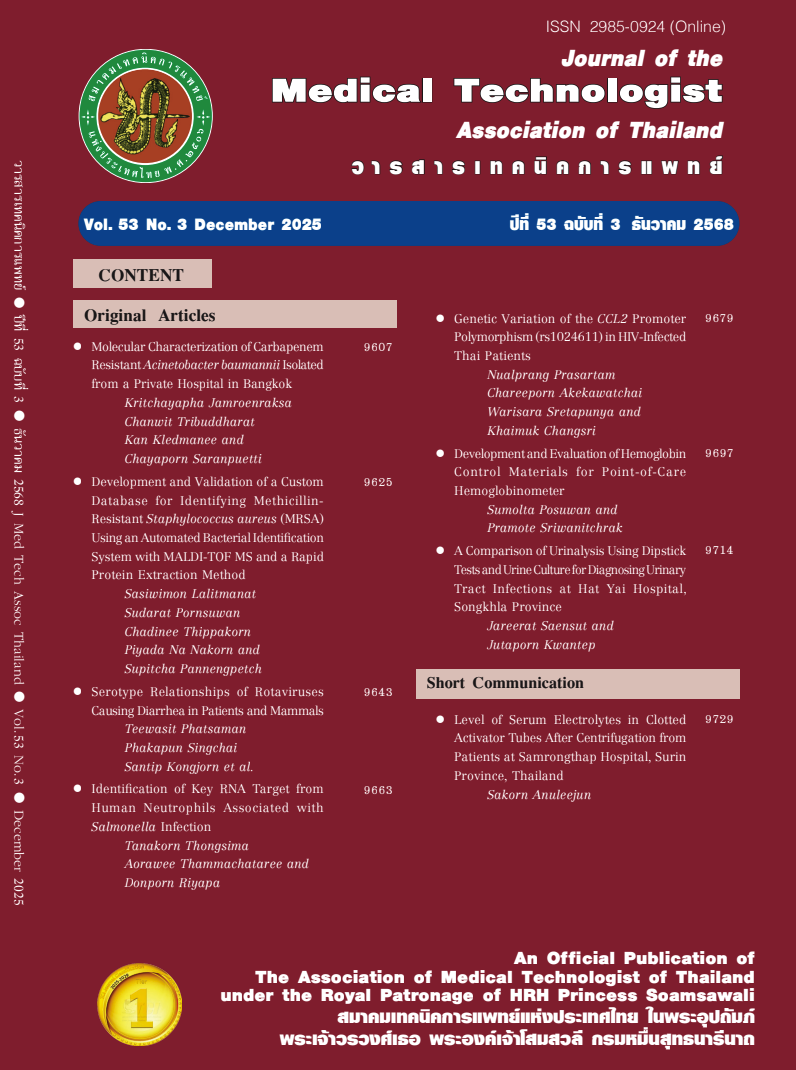
ลักษณะระดับโมเลกุลของเชื้อ Acinetobacter baumannii ดื้อยาคาร์บาพีเนมที่แยกได้จากโรงพยาบาลเอกชนแห่งหนึ่งในกรุงเทพมหานคร
คำสำคัญ:
A. baumannii , blaOXA-23-like , blaOXA-58-like , อินทิกรอน , การดื้อยาบทคัดย่อ
Acinetobacter baumannii (A. baumannii) เป็นแบคทีเรียแกรมลบรูปร่างท่อนสั้น ไม่หมักย่อยน้ำตาล พบได้ทั่วไปทั้งในน้ำและดิน จัดเป็นแบคทีเรียก่อโรคหนึ่งในกลุ่ม ESKAPE มีศักยภาพในการดื้อยาต้านจุลชีพ ในการจัดลำดับแบคทีเรียดื้อยาปฏิชีวนะขององค์การอนามัยโลกเพื่อการใช้ยาอย่างมีประสิทธิภาพ พบว่า A. baumannii ดื้อยาคาร์บาพีเนม (carbapenem-resistant A. baumannii, CRAB) เป็นเชื้อก่อโรคที่มีความสำคัญในระดับวิกฤต การศึกษาแบบย้อนหลังนี้มีวัตถุประสงค์เพื่อศึกษาลักษณะระดับโมเลกุลของเชื้อ CRAB ที่แยกได้จากโรงพยาบาลเอกชนแห่งหนึ่งในกรุงเทพมหานคร ระหว่างปี พ.ศ. 2564-2565 พบ A. baumannii 244 ไอโซเลท จากสิ่งส่งตรวจของผู้ป่วย 166 คน เป็น CRAB 171 ไอโซเลท (ร้อยละ 70.1) พบอัตราการดื้อยากลุ่มคาร์บาพีเนมของเชื้อ A. baumannii เพิ่มขึ้นจากร้อยละ 64.4 ในปี 2563 เป็นร้อยละ 73.8 ในปี 2564 ลดลงเป็นร้อยละ 66.4 ในปี 2565 และร้อยละ 61.5 ในปี 2566 การบริโภคยากลุ่มคาร์บาพีเนม (defined daily doses (DDD) ต่อ 1,000 วันนอนที่ศึกษาต่อปี) สูงถึงร้อยละ 63.71 ในปี 2564 ลดลงเป็นร้อยละ 37.41 ในปี 2566 จากแนวโน้มในช่วงปี 2563-2566 พบความสอดคล้องกันระหว่างการบริโภคยาคาร์บาพีเนมและอัตราการดื้อยา กลุ่มคาร์บาพีเนมของเชื้อ A. baumannii มีรูปแบบความไวต่อยาต้านจุลชีพจำนวน 19 รูปแบบ คัดเลือกเชื้อ CRAB จำนวน 30 ไอโซเลทมาตรวจหายีนดื้อยาคาร์บาพีเนมและยีน integron-integrase ด้วยปฏิกิริยาลูกโซ่โพลีเมอเรส พบยีนดื้อยา blaOXA-23-like 28 ไอโซเลท (ร้อยละ 93.3) ยีน blaOXA-58-like 3 ไอโซเลท (ร้อยละ 10.0) และ intI1 28 ไอโซเลท (ร้อยละ 93.3) โดยสรุปจากการศึกษาพบร้อยละ 2.3 ของ CRABไอโซเลทเป็นแบคทีเรียที่ดื้อยาทุกกลุ่ม และการพบยีนดื้อยา blaOXA-23-like, blaOXA-58-like และอินทิกรอนชนิดที่ 1 แสดงถึงเชื้อที่ดื้อยาสูงและสามารถถ่ายทอดยีนดื้อยาไปสู่รุ่นลูกและแบคทีเรียอื่น ๆ ได้ การค้นพบนี้เน้นย้ำความสำคัญของการเฝ้าระวัง และการใช้ยาปฏิชีวนะที่มีประสิทธิภาพ เป็นมาตรการที่เข้มงวดในการป้องกันและควบคุมการแพร่กระจายของ CRAB ในสถานพยาบาล
เอกสารอ้างอิง
Suwantarat N, Carroll KC. Epidemiology and molecular characterization of multidrug-resistant Gram-negative bacteria in Southeast Asia. Antimicrob Resist Infect Control 2016; 15: 1-8. doi: 10.1186/s13756-016-0115-6
Wareth G, Linde J, Nguyen NH, et al. WGS-based analysis of carbapenem resistant Acinetobacter baumannii in Vietnam and molecular characterization of antimicrobial determinants and MLST in Southeast Asia. Antibiotics 2021; 10: 563. doi: 10.3390/antibiotics10050563
Appanea HJ, Lopes VV, LaPlante KL, Caffreya AR. Treatment, Clinical outcomes, and predictors of mortality among a National cohort of admitted patients with Acinetobacter baumannii Infection. Antimicrobial Agents and Chemotherapy Antimicrob Agents Chemother 2022; 66: 1-10. doi: org/10.1128/aac.01975-21
Xiao D, Wang L, Zhang D, XIANG D, LIU Q, XING X. Prognosis of patients with Acinetobacter baumannii infection in the intensive care unit: A retrospective analysis. Exp Ther Med 2017; 13: 1630-3. doi: 10.3892/etm.2017.4137
Hsueh PR, Teng LJ, Chen CY, et al. Pandrug-resistant Acinetobacter baumannii causing nosocomial infections in a university hospital, Taiwan. Emerg Infect Dis 2002; 8: 827-32. doi: 10.3201/eid0805.020014.
Nordmann P, Dortet L, Poirel L. Carbapenem resistance in Enterobacteriaceae: here is the storm!. Trends Mol Med 2012; 764: 1-10. doi.org/10.1016/j.molmed.2012.03.003
National Antimicrobial Resistant Surveillance Center, Thailand. Antimicrobial resistance 2000-2021 (12M) [Internet] 2022 [cited 2022 April 29]. Available from: http://narst.dmsc.moph.go.th/
Nasr P. Genetics, epidemiology, and clinical manifestations of multidrug-resistant Acinetobacter. J Hosp Infect 2019; 104: 4-11. doi: 10.1016/j.jhin.2019.09.021
Thadtapong N, Chaturongakul S, Soodvilai S, Dubbs P. Colistin and carbapenem-resistant Acinetobacter baumannii Aci46 in Thailand: Genome analysis and antibiotic resistance profiling. Antibiotics 2021; 10: 1-16. doi: 10.3390/antibiotics10091054
CDC Centers for Disease Control and Prevention, U.S. [Internet] 2025 [cited 2025 March 30]. Available from: http://www.cdc.gov/acinetobacter/about/index.html
Paiboonvong T, Tedtaisong P, Montakantikul P, Gorsanan S, Tantisiriwat W. Correlation between carbapenem consumption and carbapenems susceptibility profiles of Acinetobacter baumannii and Pseudomonas aeruginosa in an academic medical center in Thailand. Antibiotics 2022; 11: 2-11. doi: 10.3390/antibiotics11020143
Zeng S, Xu Z, Wang X, et al. Time series analysis of antibacterial usage and bacterial resistance in China: observations from a tertiary hospital from 2014 to 2018. Infect Drug Resist 2019; 12: 2683-91. doi: 10.2147/IDR.S220183
Khuntayaporn P, Kanathum P, Houngsaitong J, Montakantikul P, Thirapanmethee K, Chomnawang MT. Predominance of international clone 2 multidrug-resistant Acinetobacter baumannii clinical isolates in Thailand: a nationwide study. Ann Clin Microbiol Antimicrob 2021; 20: 1-11. doi: 10.1186/s12941-021-00424-z
Yungyuen T, Chatsuwan T, Plongla R, , et al. Nationwide surveillance and molecular characterization of critically drug-resistant Gram-negative bacteria: results of the research university network Thailand study. Antimicrob Agents Ch 2021; 65: 1-12. doi: 10.1128/AAC.00675-21
Koeleman JGM, Stoof J, Van der bijl MW, Vandenbroucke-Grauls CMJE, Savelkoul PHM. Identification of epidemic strains of Acinetobacter baumannii by integrase gene PCR. J Clin Microbiol 2001; 39: 8-13. doi: 10.1128/jcm.39.1.8-13.2001
WHO Collaborating Centre for Drug Statistics Methodology, Norway. Use of ATC/DDD [Internet] 2022 [cited 2023 August 12]. Available from: https://www. whocc.no/use_of_atc_ddd/
Klein EY, Impalli I, Poleon S, et al. Global trends in antibiotic consumption during 2016–2023 and future projections through 2030. Proc Natl Acad Sci 2024; 121: e2411919121. doi: 10.1073/pnas.2411919121
Poku E, Cooper K, Cantrell A, Harnan S, Sin MA, Zanuzdana A, et al. Systematic review of time lag between antibiotic use and rise of resistant pathogens among hospitalized adults in Europe. JAC-Antimicrob Resist 2022; 5: 1-14. doi: 10.1093/jacamr/dlad001
Tan SY, Khan RA, Khalid KE, Chong CW, Bakhtiar A. Correlation between antibiotic consumption and the occurrence of multidrug-resistant organisms in a Malaysian tertiary hospital: a 3-year observational study. Sci Rep 2022; 12: 1-9. doi: 10.1038/s41598-022-07142-2
Azimzadeh M, Bahador A, Shiralizadeh S, et al. A single-center analysis of clonal transmission of carbapenem-resistant Acinetobacter baumannii among intensive care unit patients during the COVID-19 pandemic. Sci Rep 2024; 14: 1-14. doi: 10.1038/s41598-024-77238-4
Liu H, Moran RA, Doughty EL, , et al. Longitudinal genomics reveals carbapenem-resistant Acinetobacter baumannii population changes with emergence of highly resistant ST164 clone. Nat Commun 2024; 15: 1-13. doi: 10.1038/s41467-024-53817-x
Thet KT, Lunha K, Srisrattakarn A, et al. Colistin heteroresistance in carbapenem resistant Acinetobacter baumannii clinical isolates from a Thai university hospital. World J Microb Biot 2020; 36: 1-7. doi: 10.1007/s11274-020-02873-8
Boonsilp S, Homkaew A, Wongsuk T, Thananon K, Oonanant W. Correlation of RND efflux pump expression and AdeRS mutations in tigecycline-resistant Acinetobacter baumannii from Thai clinical isolates. Eur J Microbiol Immunol 2024; 14: 280-8. doi: 10.1556/1886.2024.00070
Ezadi F, Jamalia A, Heidaric A, Javida N, Ardebili A. Heteroresistance to colistin in oxacillinase-producing carbapenem-resistant Acinetobacter baumannii clinical isolates from Gorgan, Northern Iran. J Glob Antimicrob Resist 2020; 21: 380-5. doi: 10.1016/j.jgar.2019.11.010
Kim YA, Jeong SH, Shin JH, et al. Four genotypes of carbapenem-resistant Acinetobacter baumannii strains lacking OXA-23 production in Korea. Ann Clin Microbiol 2024; 27(2): 143-7. doi: 10.5145/ACM.2024.27.2.8
Xiu Y, Dai Y, Yin S, Wei Q. Analysis of the class 1 integrons, carbapenemase genes and biofilm formation genes occurrence in Acinetobacter baumannii clinical isolates. Polish Journal of Microbiology Pol J Microbiol 2024; 73: 189-97. doi: 10.33073/pjm-2024-017
Su PW, Yang EC, Moi SH, Yang CH, Chuang LY. Prevalence of Carbapenem resistance genes among Acinetobacter baumannii isolated from a teaching hospital in Taiwan. Antibiotics 2023; 12: 1-14. doi: 10.3390/antibiotics12091357
Alzaidi JR. Prevalence of OXA Genes Responsible for Carbapenem-Resistance among Acinetobacter baumannii isolated from clinical samples in Iraq. Medical Journal of Babylon 2023; 20: 632-7. doi: 10.4103/MJBL.MJBL_828_23
Lee Y, Ko W, Hsueh P. Geographic patterns of Acinetobacter baumannii and carbapenem resistance in the Asia-Pacific region: results from the antimicrobial testing leadership and surveillance (ATLAS) program, 2012-2019. Int J Infect Dis 2023; 127: 48-55. doi: 10.1016/j.ijid.2022.12.010
Jeon JH, Jang K-M, Lee JH, Kang L-W, Lee SH. Transmission of antibiotic resistance genes through mobile genetic elements in Acinetobacter baumannii and gene-transfer prevention. Sci Total Environ 2023; 857: 1-15. doi: 10.1016/j.scitotenv.2022.159497
Anane YA, Apalata T, Vasaikar S, Okuthe GE, Songca S. Molecular detection of carbapenemase-encoding genes in multidrug-resistant Acinetobacter baumannii clinical isolates in South Africa. Int J Microbiol Res 2020; 13: 1-10. doi: 10.1155/2020/7380740
Hashemi B, Afkhamib H, Khaledib M, , et al. Frequency of metalo beta lactamase genes, bla IMP1, INT 1 in Acinetobacter baumannii isolated from burn patients North of Iran. Gene Reports 2020; 21: 1-5. doi: 10.1016/j.genrep.2020.100800
Ali N, Ali I, Din AU, Akhtar K, He B, Wen R. Integrons in the age of antibiotic resistance: evolution, mechanisms, and environmental implications: a review. Microorganisms 2024; 12: 2579. doi: 10.3390/ microorganisms12122579
ดาวน์โหลด
เผยแพร่แล้ว
รูปแบบการอ้างอิง
ฉบับ
ประเภทบทความ
สัญญาอนุญาต
ลิขสิทธิ์ (c) 2025 วารสารเทคนิคการแพทย์

อนุญาตภายใต้เงื่อนไข Creative Commons Attribution-NonCommercial-NoDerivatives 4.0 International License.


