
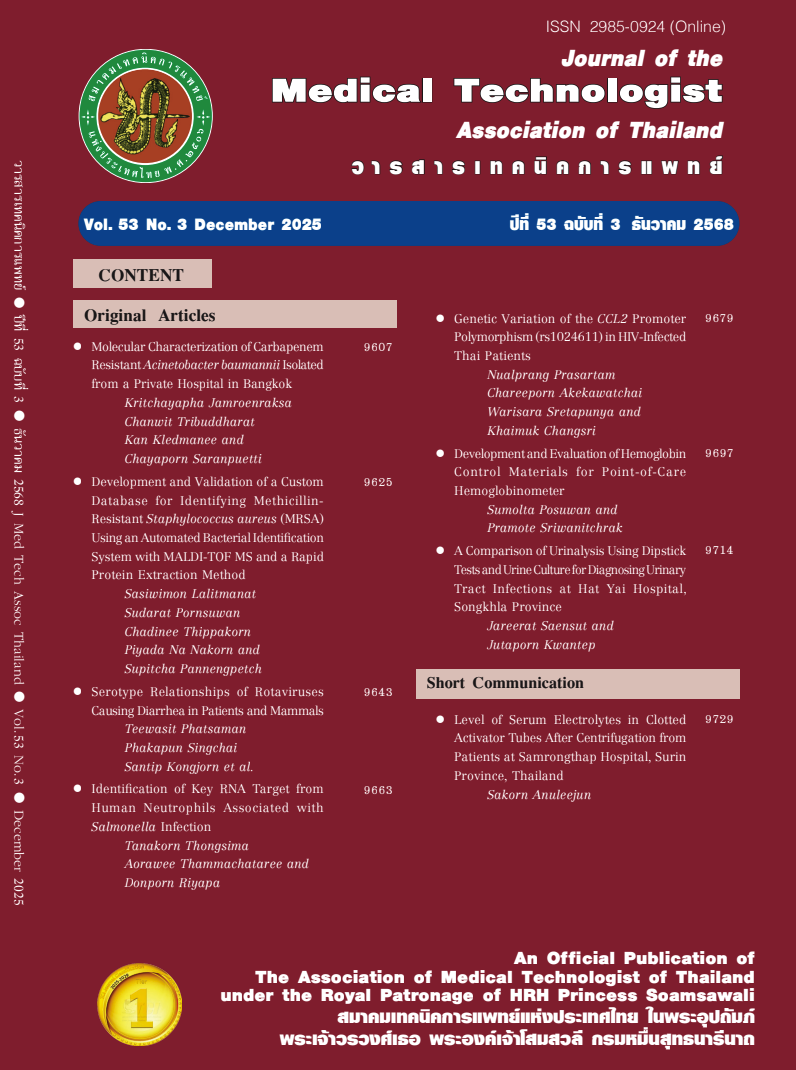
การพัฒนา และตรวจสอบความถูกต้องในการสร้างฐานข้อมูลสำหรับใช้จำแนก Methicillin-Resistant Staphylococcus aureus (MRSA) ด้วยเครื่องจำแนกชนิดแบคทีเรียอัตโนมัติในระบบแมสสเปกโทรเมตรีชนิด Matrix-Assisted Laser Desorption/Ionization Time-of-Flight Mass Spectrometry (MALDI-TOF MS) ที่ใช้วิธีการสกัดโปรตีนอย่างรวดเร็ว
คำสำคัญ:
ClinProTools, Flex Analysis, MALDI-TOF MS, MRSA, วิธีสกัดโปรตีนอย่างรวดเร็วบทคัดย่อ
เชื้อ Staphylococcus aureus ที่ดื้อต่อยา methicillin (MRSA) เป็นสาเหตุสำคัญของการติดเชื้อในโรงพยาบาลและเป็นอันตรายต่อชีวิตผู้ป่วย การระบุชนิดเชื้อ MRSA อย่างรวดเร็วจึงมีความสำคัญต่อการรักษาที่มีประสิทธิภาพ และลดอัตราการตายในผู้ป่วย ปัจจุบันมีการนำเครื่องจำแนกแบคทีเรียอัตโนมัติในระบบแมสสเปกโทรเมตรีชนิด Matrix-Assisted Laser Desorption/Ionization Time-of-Flight Mass Spectrometry (MALDI-TOF MS) มาใช้ในการจำแนกแบคทีเรียในโรงพยาบาลมากขึ้น เป็นวิธีที่ทันสมัย น่าเชื่อถือ มีศักยภาพในการระบุเชื้อได้ใน 2-3 นาที แต่ฐานข้อมูลที่ติดตั้งมากับซอฟต์แวร์ของเครื่องยังไม่ครอบคลุมการจำแนกเชื้อดื้อยา การศึกษานี้จึงต้องการสร้างฐานข้อมูลของเชื้อดื้อยา MRSA ด้วยวิธีการสกัดโปรตีนอย่างรวดเร็ว (rapid protein extraction method ) โดยนำตัวอย่างเชื้อ MRSA และเชื้อ Staphylococcus aureus ที่ไวต่อยา methicillin (MSSA) ที่ยืนยันชนิดเชื้อด้วยวิธีมาตรฐานมาวิเคราะห์รูปแบบมวลเปปไทด์ด้วยเครื่องจำแนกแบคทีเรียอัตโนมัติ MALDI-TOF MS เพื่อระบุมวลเปปไทด์ที่ใช้แยกเชื้อทั้งสองชนิดอย่างมีนัยสำคัญ (p<0.0001) ด้วยโปรแกรม Flex Analysis และ ClinProTools โดยมีมวลเปปไทด์สำคัญ 5 มวล ดังนี้ 3041.07, 4310.12, 4857.34, 5527.09 และ 6553.92 จากนั้นนำรูปแบบมวลเปปไทด์ทั้งหมดเข้าสู่ฐานข้อมูลของเครื่องจำแนกแบคทีเรียอัตโนมัติ MALDI-TOF MS ทดสอบฐานข้อมูลกับตัวอย่างเชื้อที่แยกจากผู้ป่วย ซึ่งผ่านการระบุชนิดด้วยวิธีมาตรฐานแล้ว ผลการทดสอบพบว่าฐานข้อมูลนี้สามารถจำแนกเชื้อ MRSA และ MSSA ได้ถูกต้องร้อยละ 100 การพัฒนาฐานข้อมูลนี้เป็นขั้นตอนสำคัญที่ใช้ในการจำแนกเชื้อดื้อยา MRSA ด้วยวิธีการสกัดโปรตีนอย่างรวดเร็ว และระบุชนิดด้วยเครื่องจำแนกแบคทีเรียอัตโนมัติ MALDI-TOF MS นำไปสู่การนำไปใช้ได้จริงเพื่อเพิ่มประสิทธิภาพและลดเวลาการระบุเชื้อดื้อยาในห้องปฏิบัติการจุลชีววิทยาคลินิก
เอกสารอ้างอิง
World Health Organization. Global antimicrobial resistance and use surveillance system (GLASS) report: 2022. [Internet] 2022 [cited 2024 Jan07]. Available from: https://www.who.int/publications/i/item/9789240062702
Chen CJ, Huang YC. New epidemiology of Staphylococcus aureus infection in Asia. Clin Microbiol Infect 2014; 20(7):605-23.
Thunyaharn S, Boonsiri T, Visawapoka U, et al. Prevalence of methicillin-resistant Staphylococcus aureus and Other Staphylococcal nasal carriages among healthcare workers, phramongkutklao hospital. J Southeast Asian Res 2022;6: e0122
Hassoun-Kheir N, Guedes M, Ngo Nsoga MT, et al. A systematic review on the excess health risk of antibiotic-resistant bloodstream infections for six key pathogens in Europe. Clin Microbiol Infect 2024;30 Suppl 1:S14-S25.
Clinical and Laboratory Standards Institute. Quality assurance for commercially prepared microbiological culture media, CLSI document M22-A3. Wayne, Pennsylvania: CLSI; 2004
Sousa AM, Pereira MO. A prospect of current microbial diagnosis methods. Microbial pathogens and strategies for combating them: science, technology and education 2013; 3:1429-38.
Dingle T C, Butler-Wu S M. MALDI-TOF mass spectrometry for microorganism identification. Clin Lab Med 2013; 3: 589-609
Singhal N, Kumar M, Kanaujia PK, Virdi JS. MALDI-TOF mass spectrometry: an emerging technology for microbial identification and diagnosis. Front Microbiol 2015; 6: 791.
Cherkaoui A, Hibbs J, Emonet S, et al. Comparison of two matrix-assisted laser desorption ionization-time of flight mass spectrometry methods with conventional phenotypic identification for routine identification of bacteria to the species level. J Clin Microbiol 2010; 48: 1169-75.
Yu J, Tien N, Liu YC, et al. Rapid identification of methicillin-resistant Staphylococcus aureus using MALDI-TOF MS and machine learning from over 20,000 clinical isolates. Microbiol Spectr 2022;10(2):e00483-22.
Lavigne JP, Espinal P, Dunyach-Remy C, Messad N, Pantel A, Sotto A. Mass spectrometry: a revolution in clinical microbiology? Clin Chem Lab Med 2013;51(2):257-70.
Ba X, Harrison EM, Edwards GF, et al. Novel mutations in penicillin-binding protein genes in clinical Staphylococcus aureus isolates that are methicillin resistant on susceptibility testing, but lack the mec gene. J Antimicrob Chemother 2014; 69(3):594-7
Yamaguchi T, Ono D, Sato A. Staphylococcal cassette chromosome mec (SCCmec) analysis of MRSA. Methods Mol Biol 2020; 2069:59-78.
Jenkins R, Burton N, Cooper R. Proteomic and genomic analysis of methicillin-resistant Staphylococcus aureus (MRSA) exposed to manuka honey in vitro demonstrated down-regulation of virulence markers. J Antimicrob Chemother 2014;69(3):603-15.
Peacock SJ, Paterson GK. Mechanisms of methicillin resistance in Staphylococcus aureus. Annu Rev Biochem 2015; 84:577-601.
Giebel R, Worden C, Rust SM, Kleinheinz GT, Robbins M, Sandrin TR. Microbial fingerprinting using matrix-assisted laser desorption ionization time-of-flight mass spectrometry (MALDI-TOF MS) applications and challenges. Adv Appl Microbiol 2010; 71:149-84.
Schulthess B, Bloemberg GV, Zbinden R, Böttger EC, Hombach M. Evaluation of the Bruker MALDI Biotyper for identification of gram-positive rods: development of a diagnostic algorithm for the clinical laboratory. J Clin Microbiol 2014; 52(4):1089-97.
Krajaejun T, Lohnoo T, Jittorntam P, et al. Assessment of matrix-assisted laser desorption ionization-time of flight mass spectrometry for identification and biotyping of the pathogenic oomycete Pythium insidiosum. Int J Infect Dis 2018; 77:61-7.
Veloo ACM, de Vries ED, Jean-Pierre H, et al. The optimization and validation of the Biotyper MALDI-TOF MS database for the identification of gram-positive anaerobic cocci. Clinical Microbiology and Infection 2016; 22(9):793-8.
Calderaro A, Arcangeletti MC, Rodighiero I, et al. Identification of different respiratory viruses, after a cell culture step, by matrix assisted laser desorption/ionization time of flight mass spectrometry (MALDI-TOF MS). Scientific Reports 2016; 6(1):36082.
Wongprasert K, Pannengpetch S, Kumar T, et al. Effects of cadmium on peptide profiles and Biotyper score value of Escherichia coli O157:h7 identified by matrix-assisted laser desorption/ionization time-of-flight mass-spectrometry (MALDI-TOF/MS). J Med Tech Assoc Thailand 2020; 48:7264-80. (in Thai)
Wang HY, Lien F, Liu TP, Chen CH, Chen CJ, Lu JJ. Application of a MALDI-TOF analysis platform (ClinProTools) for rapid and preliminary report of MRSA sequence types in Taiwan. PeerJ 2018; 6: e5784.
Kwanhian W. The bacteria identification automates in MALDI-TOF mass spectrometry System. J Med Tech Phy Ther 2013; 25(2):120-131. (in Thai)
Scott JS, Sterling SA, To H, Seals SR, Jones AE. Diagnostic performance of matrix-assisted laser desorption ionization time-of-flight mass spectrometry in blood bacterial infections: a systematic review and meta-analysis. Infect Dis 2016; 48(7):530-6.
Dixon P, Davies P, Hollingworth W, Stoddart M, MacGowan A. A systematic review of matrix-assisted laser desorption/ionization time-of-flight mass spectrometry compared to routine microbiological methods for the time taken to identify microbial organisms from positive blood cultures. Eur J Clin Microbiol Infect Dis 2015; 34(5):863-76.
De Carolis E, Vella A, Vaccaro L, et al. Development and validation of an in-house database for matrix-assisted laser desorption ionization-time of flight mass spectrometry-based yeast identification using a fast protein extraction procedure. J Clin Microbiol 2014; 52(5):1453-8.
Sogawa K, Watanabe M, Ishige T, et al. Rapid discrimination between methicillin-sensitive and methicillin-resistant Staphylococcus aureus using MALDI-TOF mass spectrometry. Biocontrol Sci 2017; 22(3):163-9.
Chatreewattanakul T, Thunyaharn S, Samosornsuk W, et al. SCC mec type and antimicrobial susceptibility pattern of MRSA Isolated from blood stream infection in Phramongkutklao hospital. J Med Tech Phy Ther 2015; 27: 152-161. (in Thai)
ดาวน์โหลด
เผยแพร่แล้ว
รูปแบบการอ้างอิง
ฉบับ
ประเภทบทความ
สัญญาอนุญาต
ลิขสิทธิ์ (c) 2025 วารสารเทคนิคการแพทย์

อนุญาตภายใต้เงื่อนไข Creative Commons Attribution-NonCommercial-NoDerivatives 4.0 International License.


