
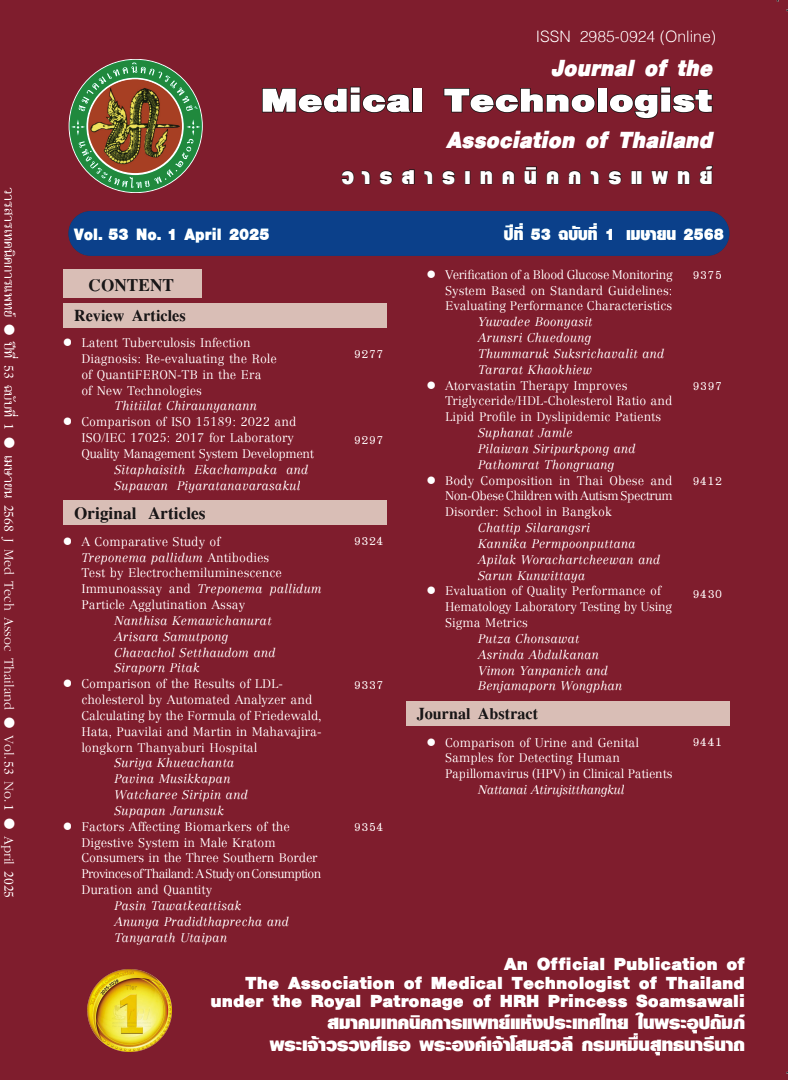
การรักษาด้วย Atorvastatin ช่วยปรับปรุงค่า Triglyceride/HDL-Cholesterol Ratio และค่า Lipid Profile ในผู้ป่วยที่มีภาวะไขมันในเลือดผิดปกติ
คำสำคัญ:
อัตราส่วนไตรกลีเซอไรด์ต่อเอชดีแอลคอเลสเตอรอล, ยาสแตติน, ภาวะไขมันในเลือดผิดปกติ, โรคหัวใจและหลอดเลือด, ลิพิดพารามิเตอร์บทคัดย่อ
ภาวะไขมันในเลือดผิดปกติ (dyslipidemia) เป็นปัจจัยเสี่ยงต่อการเกิดภาวะหลอดเลือดแดงแข็งตีบ (atherosclerosis) และโรคหัวใจและหลอดเลือด (cardiovascular diseases) ยากลุ่มสแตติน (statin) ถูกนำมาใช้เพื่อลดความเสี่ยงดังกล่าว งานวิจัยที่ผ่านมา พบว่าค่า triglyceride/HDL-cholesterol ratio (TG/HDL-C ratio) สามารถนำมาใช้ประมาณค่า small dense LDL (sdLDL) ซึ่งเป็นไลโพโปรตีนที่ก่อให้เกิดภาวะหลอดเลือดแดงแข็งตีบและโรคหัวใจและหลอดเลือดตามมาได้ จุดประสงค์ของงานวิจัยครั้งนี้คือการประเมินประสิทธิภาพของยา atorvastatin ในผู้ป่วยภาวะไขมันในเลือดผิดปกติ จำนวน 104 ราย ที่มีช่วงอายุระหว่าง 28 ถึง 80 ปี จากโรงพยาบาลนครปฐม โดยเก็บข้อมูลย้อนหลังและเปรียบเทียบค่า TG/HDL-C ratio และค่าลิพิดพารามิเตอร์อื่น ๆ ก่อนและหลังการรักษาด้วยยา atorvastatin (40 มิลลิกรัม) เป็นระยะเวลา 3 และ 6 เดือน ผลการศึกษาพบว่าค่าระดับ TG/HDL-C ratio ลดลงอย่างมีนัยสำคัญทางสถิติภายหลังการรักษาทั้งในระยะเวลา 3 และ 6 เดือนเทียบกับค่าก่อนการรักษา (p < 0.05) รวมทั้งค่าลิพิดพารามิเตอร์อื่น ๆ ได้แก่ total cholesterol, triglyceride, LDL-cholesterol, และ non-HDL-cholesterol พบว่ามีค่าลดลงอย่างมีนัยสำคัญทางสถิติ (p < 0.05) หลังการรักษาเช่นกัน นอกจากนี้ยังพบว่าค่า TG/HDL-C ratio มีความสัมพันธ์เชิงบวกกับค่า triglyceride (r = 0.920) และ non-HDL-cholesterol (r = 0.253) (p < 0.05) และพบความสัมพันธ์เชิงลบกับค่า HDL-cholesterol (r = -0.485) (p < 0.05) สรุปผลการศึกษา ยา atorvastatin 40 มิลลิกรัม มีประสิทธิผลในการลดค่า TG/HDL-C ratio ตั้งแต่ระยะเวลา 3 เดือน ซึ่งบ่งชี้ว่ามีการลดลงของ sdLDL-cholesterol และลดความเสี่ยงของการเกิดโรคหัวใจและหลอดเลือดในผู้ป่วยภาวะไขมันในเลือดผิดปกติ
เอกสารอ้างอิง
Bureau of Non-Communicable Diseases, Department of Disease Control, Ministry of Public Health. Annual Report 2022. Bangkok; 2565. (in Thai)
Martone AM, Landi F, Petricca L, et al. Prevalence of dyslipidemia and hypercholesterolemia awareness: results from the Lookup 7+ online project. Eur J Public Health 2022; 32: 402–7.
National Cholesterol Education Program Expert Panel on Detection, Evaluation, and Treatment of High Blood Cholesterol in Adults. Third Report of the National Cholesterol Education Program (NCEP) Expert Panel on Detection, Evaluation, and Treatment of High Blood Cholesterol in Adults (Adult Treatment Panel III) final report. Circulation 2002; 106: 3143–421.
Mingpakanee R. The role of small dense LDL in the pathogenesis of coronary artery disease. J Med Tech Assoc Thailand 2018; 46: 6657–70.
Emadzadeh MR, Alavi MS, Soukhtanloo M, et al. Changes in small dense low-density lipoprotein levels following acute coronary syndrome. Angiology 2013; 64: 216–22.
Sakai K, Koba S, Nakamura Y, et al. Small dense low-density lipoprotein cholesterol is a promising biomarker for secondary prevention in older men with stable coronary artery disease. Geriatr Gerontol Int 2018; 18: 965–72.
Bahadir MA, Oguz A, Uzunlulu M, Bahadir O. Effects of different statin treatments on small dense low-density lipoprotein in patients with metabolic syndrome. J Atheroscler Thromb 2009; 16: 684–90.
Nozue T, Michishita I, Ito Y, Hirano T. Effects of statin on small dense low-density lipoprotein cholesterol and remnant-like particle cholesterol in heterozygous familial hypercholesterolemia. J Atheroscler Thromb 2008; 15: 146–53.
Jacob RF, Walter MF, Self-Medlin Y, Mason RP. Atorvastatin active metabolite inhibits oxidative modification of small dense low-density lipoprotein. J Cardiovasc Pharmacol 2013; 62: 160–6.
Yoshino G. Rosuvastatin reduces plasma small dense LDL-cholesterol predominantly in non-diabetic hypercholesterolemic patients. Pharmacology & Pharmacy 2012; 3: 72–8.
Kosmas CE, Rodriguez Polanco S, Bousvarou MD, et al. The triglyceride/high-density lipoprotein cholesterol (TG/HDL-C) ratio as a risk marker for metabolic syndrome and cardiovascular disease. Diagnostics (Basel) 2023; 13.
Salazar MR, Carbajal HA, Espeche WG, et al. Use of the plasma triglyceride/high-density lipoprotein cholesterol ratio to identify cardiovascular disease in hypertensive subjects. J Am Soc Hypertens 2014; 8: 724–31.
Tani S, Imatake K, Suzuki Y, et al. Triglyceride/high-density lipoprotein cholesterol ratio may be a better index of cardiometabolic risk in women than in men in Japan. Nutr Metab Cardiovasc Dis 2024; 34: 868–81.
Tani S. The ratio of triglyceride to high-density lipoprotein cholesterol as an indicator of risk stratification for atherosclerotic cardiovascular disease in a clinical setting. Intern Med 2020; 59: 2639–40.
Maruyama C, Imamura K, Teramoto T. Assessment of LDL particle size by triglyceride/HDL-cholesterol ratio in non-diabetic, healthy subjects without prominent hyperlipidemia. J Atheroscler Thromb 2003; 10: 186–91.
Yokoyama K, Tani S, Matsuo R, Matsumoto N. Increased triglyceride/high-density lipoprotein cholesterol ratio may be associated with reduction in the low-density lipoprotein particle size: assessment of atherosclerotic cardiovascular disease risk. Heart Vessels 2019; 34: 227–36.
St-Pierre AC, Cantin B, Dagenais GR, et al. The triglyceride/high-density lipoprotein cholesterol ratio, the small dense low-density lipoprotein phenotype, and ischemic heart disease risk. Metab Syndr Relat Disord 2004; 2: 57–64.
Lertthiraphan S. Lipid-lowering drugs for the prevention of coronary artery disease. J Med Health Sci 2020; 27: 147–59.
Committee TNDSD. National essential medicines list and evidence-based medicine, August 2022. Available from: https://ndi.fda.moph.go.th/drug_national/search
Deerochanawong C, Buranakitjaroen P, Nitiyanant W, et al. The atorvastatin Goal achievement across risk levels: (ATGOAL) study in Thailand. J Med Assoc Thai 2007; 90: 72–81.
Miki T, Suruga K, Ichikawa K, et al. Triglyceride to HDL-cholesterol ratio is a predictor of future coronary events: a possible role of high-risk coronary plaques detected by coronary CT angiography. Eur Heart J 2020; 41: ehaa946-2930.
Sahebkar M, Khalilzadeh N, Movahedzadeh J, et al. Comparison of the effect of 40 and 80 mg/day doses of atorvastatin on changes in lipid profiles among acute coronary syndrome patients: a randomized clinical trial study. J Res Med Sci 2023; 28: 24.
Adams SP, Tsang M, Wright JM. Lipid-lowering efficacy of atorvastatin. Cochrane Database Syst Rev 2015; CD008226.
Meor Anuar Shuhaili MFR, Samsudin IN, Stanslas J, et al. Effects of different types of statins on lipid profile: a perspective on Asians. Int J Endocrinol Metab 2017; 15: e43319.
Srisawasdi P, Chaloeysup S, Teerajetgul Y, et al. Estimation of plasma small dense LDL cholesterol from classic lipid measures. Am J Clin Pathol 2011; 136: 20–9.
Moriyama K. The association between the triglyceride to high-density lipoprotein cholesterol ratio and low-density lipoprotein subclasses. Intern Med 2020; 59: 2661–9.
Quispe R, Manalac RJ, Faridi KF, et al. Relationship of the triglyceride to high-density lipoprotein cholesterol (TG/HDL-C) ratio to the remainder of the lipid profile: the very large database of Lipids-4 (VLDL-4) study. Atherosclerosis 2015; 242: 243–50.
Kathiresan S, Otvos JD, Sullivan LM, et al. Increased small low-density lipoprotein particle number: a prominent feature of the metabolic syndrome in the Framingham Heart Study. Circulation 2006; 113: 20–9.
Sposito AC, Chapman MJ. Statin therapy in acute coronary syndromes: mechanistic insight into clinical benefit. Arterioscler Thromb Vasc Biol 2002; 22: 1524–34.
ดาวน์โหลด
เผยแพร่แล้ว
รูปแบบการอ้างอิง
ฉบับ
ประเภทบทความ
สัญญาอนุญาต
ลิขสิทธิ์ (c) 2025 วารสารเทคนิคการแพทย์

อนุญาตภายใต้เงื่อนไข Creative Commons Attribution-NonCommercial-NoDerivatives 4.0 International License.


