
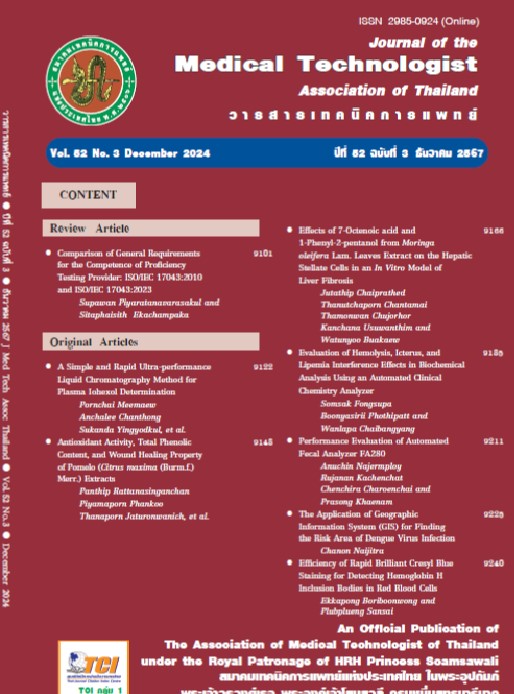
การประยุกต์ใช้ระบบสารสนเทศภูมิศาสตร์ (GIS) เพื่อค้นหาพื้นที่เสี่ยงติดเชื้อไวรัสเดงกี
คำสำคัญ:
ไวรัสเดงกี, สารสนเทศภูมิศาสตร์, การใช้ประโยชน์ที่ดิน, เทคนิคการแพทย์บทคัดย่อ
โรคเดงกี และโรคไข้เลือดออกเดงกี เป็นปัญหาด้านสาธารณสุขที่สำคัญของโลกซึ่งเกิดจากการติดเชื้อไวรัสเดงกี การควบคุมโรคที่มีประสิทธิภาพสูงสุดคือการกําจัดแหล่งเพาะพันธุ์ยุงลายพาหะโดยดูจากอัตราการป่วยของประชากร สำหรับประเทศไทย โรคติดเชื้อไวรัสเดงกีเป็นโรคที่ต้องรายงานจํานวนผู้ป่วยให้กระทรวงสาธารณสุขทราบ เพื่อทำการเฝ้าระวังและควบคุมโรค อย่างไรก็ตามมีผู้ติดเชื้อไวรัสเดงกีจำนวนหนึ่งที่ไม่ได้ถูกวินิจฉัยว่าเป็นผู้ป่วยตามแนวทางการวินิจฉัยของกรมการแพทย์ การศึกษาครั้งนี้จึงมีวัตถุประสงค์เพื่อวิเคราะห์หาการใช้ประโยชน์ที่ดินที่เสี่ยงต่อการติดเชื้อไวรัสเดงกี และเพื่อวิเคราะห์ความสัมพันธ์ระหว่างการใช้ประโยชน์ที่ดินและอัตราการติดเชื้อไวรัสเดงกี โดยทำการศึกษาแบบย้อนหลังจากผลการตรวจคัดกรองการติดเชื้อไวรัสเดงกีของโรงพยาบาลธรรมศาสตร์เฉลิมพระเกียรติ ระหว่างปี 2560-2565 ในผู้เข้ารับบริการเขตจังหวัดปทุมธานี ร่วมกับข้อมูลการใช้ประโยชน์ที่ดินจังหวัดปทุมธานี ปี 2564 ของกรมพัฒนาที่ดิน วิเคราะห์ข้อมูลด้วยโปรแกรมสารสนเทศภูมิศาสตร์และทําการหาความสัมพันธ์ด้วยสัมประสิทธิ์สหสัมพันธ์ ผลการศึกษาพบว่าพื้นที่ที่มีจำนวนการตรวจคัดกรองมากที่สุดคือพื้นที่เขตเมือง พื้นที่ที่มีอัตราผลการทดสอบเป็นบวกสูงที่สุด ได้แก่ พื้นที่การเกษตร การใช้ประโยชน์ที่ดินที่สัมพันธ์กับอัตราการติดเชื้อไวรัสเดงกี ได้แก่ การเกษตรแบบผสมผสานไร่นาสวนผสม (r = 0.2584, p-value = 0.0462) และเหมืองแร่ บ่อขุด (r = 0.4495, p-value = 0.0003) การศึกษาครั้งนี้แสดงให้เห็นว่าสามารถประยุกต์ใช้ระบบสารสนเทศภูมิศาสตร์ร่วมกับข้อมูลทางห้องปฏิบัติการเทคนิคการแพทย์เพื่อค้นหาและประเมินพื้นที่เสี่ยงของการเกิดโรคได้ เพื่อประโยชน์ในการควบคุม ป้องกัน และกำหนดนโยบายสุขภาพร่วมกับสหวิชาชีพอื่น ๆ ต่อไป
เอกสารอ้างอิง
Division of Vector borne Diseases. The handbook of dengue fever and dengue hemorrhagic fever in medical and public health. Nonthaburi: Division of Vector Borne Disease, Ministry of Public Health; 2015. (in Thai)
Kraemer MUG, Reiner RC Jr, Brady OJ, et al. Past and future spread of the arbovirus vectors Aedes aegypti and Aedes albopictus. Nat Microbiol 2019; 4: 854-63.
Department of Disease Control. National Disease Surveillance (Report 506). (in Thai).
Paz-Bailey G, Adams L, Wong JM, et al. Dengue vaccine: recommendations of the advisory committee on immunization practices, United States, 2021. MMWR Recomm Rep 2021; 70: 1-16.
Saita S, Maeakhian S, Silawan T. Temporal variations and spatial clusters of dengue in Thailand: longitudinal study before and during the coronavirus disease (COVID-19) pandemic. Trop Med Infect Dis 2022; 7: 171.
Kesetyaningsih TW, Andarini S, Sudarto, Pramoedyo H. Determination of environmental factors affecting dengue incidence in Sleman district Yogyakarta, Indonesia. Afr J Infect 2018; 12: 13-25.
Faruk MO, Jannat SN, Rahman MS. Impact of environmental factors on the spread of dengue fever in Sri Lanka. Int J Environ Sci Technol (Tehran). 2022; 19: 10637-48.
Adnan RA, Ramli MF, Othman HF, Asha’ri ZH, Ismail SNS, Samsudin S. The impact of sociological and environmental factors for dengue infection in Kuala Lumpur, Malaysia. Acta Trop 2021; 216: 105834.
Li C, Wu X, Sheridan S, et al. Interaction of climate and socio-ecological environment drives the dengue outbreak in epidemic region of China. PLoS Negl Trop Dis 2021; 15: e0009761.
Uchejeso OM, Maduka MK, Obiora ER. Medical laboratory science; the distortion of nomenclature across the globe. New Zeal J Med Lab Sci 2020; 74: 52.
The Medical Technology Council of Thailand. The first step is to become a medical technologist. [Internet]. The Medical Technology Council of Thailand. [cited 31/05/2023]. Available from: https://mtcouncil.org/intro-to-mt/.
Thammasat University Hospital. The medical technologist [Internet]. Thammasat University Hospital. [cited 31/5/2023]. Available from: https://www.hospital.tu.ac.th/hrd/upload/addsome/files/2023010410175987.pdf
Saengnil W, Wongbutdee J. The geography information system in medical and public health. [Internet]. College of Medicine and Public Health, Ubon Ratchathani University. 2007 [cited 27/10/2565]. Available from: http://www.cmp.ubu.ac.th/th/detail_article.php?article=00090&=8334956828a8ec0a5d9e924f6e77d8c9. (in Thai).
Davenhall WF, Kinabrew C. GIS in health and human services: Springer Handbook of Geographic Information 2012: 557-78.
Land Development Department. Soil service and landuse [Internet]. Land Development Department. 2021 [cited 31/05/2023]. Available from:https://dinonline.ldd.go.th/Login.aspx?service=3.
Epidemiology and Emergency Operation Unit. The summary case report for dengue virus infectious disease, 2023. [Internet]. Division of vector borne disease, Ministry of Public Health. 2023 [cited July 12, 2023]. Available from: https://looker-studio.google.com/reporting/dfa7d4e2-b7f5-48ed-b40a-54f1cd4cbdfb/page/cFWgC?s=uJijraAskGk. (in Thai).
Intawong K, Olson D, Chariyalertsak S. Application technology to fight the COVID-19 pandemic: Lessons learned in Thailand. Biochem Biophys Res Commun 2021; 534: 830-6.
Wongtanasarasin W, Srisawang T, Yothiya W, Phinyo P. Impact of national lockdown towards emergency department visits and admission rates during the COVID-19 pandemic in Thailand: A hospital-based study. Emerg Med Australas 2021; 33: 316-23.
Apisarnthanarak A, Apisarnthanarak P, Siripraparat C, Saengaram P, Leeprechanon N, Weber DJ. Impact of anxiety and fear for COVID-19 toward infection control practices among Thai healthcare workers. Infect Control Hosp Epidemiol 2020; 41: 1093-4.
Kamphaeng Phet Provincial Agriculture and Cooperation Extension Office. Diversified farm [Internet]. Kamphaeng Phet Provincial Agriculture and Cooperation Extension Office. [cited 4/1/2024]. Available from: https://www.opsmoac.go.th/kamphaengphet-manual-files-421591791811. (in Thai).
Vanwambeke SO, Lambin EF, Eichhorn MP, Flasse SP, Harbach RE, Oskam L, et al. Impact of land-use change on dengue and malaria in northern Thailand. Ecohealth 2007; 4: 37-51.
Vanwambeke SO, Bennett SN, Kapan DD. Spatially disaggregated disease transmission risk: land cover, land use and risk of dengue transmission on the island of Oahu. Trop Med Int Health 2011; 16: 174-85.
Andrade AC, Falcão LAD, Borges MAZ, Leite ME, Santo MMdE. Land use and cover changes and the occurrence of dengue fever in Minas Gerais State, Brazil: Governing Deforestation for Public Health. Preprints: Preprints; 2023.
Nakhapakorn K, Tripathi NK. An information value based analysis of physical and climatic factors affecting dengue fever and dengue haemorrhagic fever incidence. Int J Health Geogr 2005; 4: 13.
Sarfraz MS, Tripathi NK, Tipdecho T, Thongbu T, Kerdthong P, Souris M. Analyzing the spatio-temporal relationship between dengue vector larval density and land-use using factor analysis and spatial ring mapping. BMC Public Health 2012; 12: 853.
ดาวน์โหลด
เผยแพร่แล้ว
รูปแบบการอ้างอิง
ฉบับ
ประเภทบทความ
สัญญาอนุญาต
ลิขสิทธิ์ (c) 2024 วารสารเทคนิคการแพทย์

อนุญาตภายใต้เงื่อนไข Creative Commons Attribution-NonCommercial-NoDerivatives 4.0 International License.


