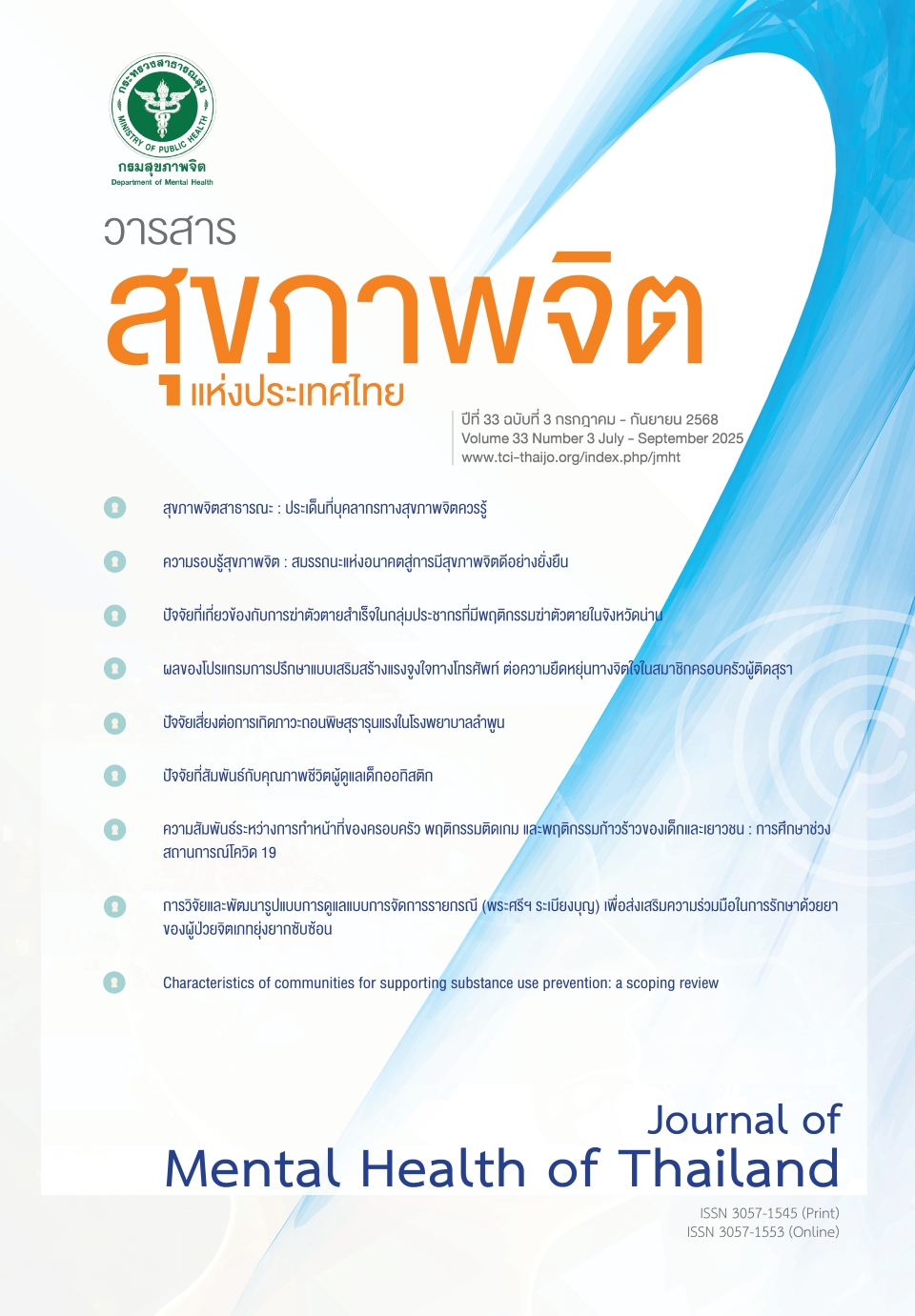
ความสัมพันธ์ระหว่างการทำหน้าที่ของครอบครัว พฤติกรรมติดเกม และพฤติกรรมก้าวร้าวของเด็กและเยาวชน : การศึกษาช่วงสถานการณ์โควิด 19
DOI:
https://doi.org/10.64838/jmht.2025.278046คำสำคัญ:
การทำหน้าที่ของครอบครัว, โควิด 19, เด็กและเยาวชน, พฤติกรรมก้าวร้าว, พฤติกรรมติดเกมบทคัดย่อ
วัตถุประสงค์ : เพื่อสำรวจความสัมพันธ์ระหว่างการทำหน้าที่ของครอบครัว พฤติกรรมติดเกม และพฤติกรรมก้าวร้าวของเด็กและเยาวชน ในช่วงสถานการณ์โควิด 19
วิธีการ : การวิจัยแบบผสมผสาน เก็บข้อมูลเชิงปริมาณแบบภาคตัดขวาง ในผู้ปกครองของเด็กและเยาวชนอายุ 6 - 18 ปี 596 คน จาก 4 ภาค ด้วยแบบสอบถามออนไลน์ ประกอบด้วย ข้อมูลทั่วไป พฤติกรรมเล่นเกม แบบประเมินการปฏิบัติหน้าที่ของครอบครัว แบบทดสอบการติดเกม และแบบประเมินผลพฤติกรรมรุนแรงสำหรับวัยรุ่น วิเคราะห์ข้อมูลด้วยสถิติเชิงพรรณนา การทดสอบไคสแควร์ การถดถอยพหุคูณเชิงเส้น และการวิเคราะห์สหสัมพันธ์ เก็บข้อมูลเชิงคุณภาพด้วยการสัมภาษณ์เชิงลึกในผู้ปกครองของเด็กและเยาวชนที่มีความเสี่ยงภาวะติดเกม 15 คน วิเคราะห์ข้อมูลแบบเรื่องเล่า
ผล : กลุ่มตัวอย่างมีการทำหน้าที่ของครอบครัวในระดับไม่ดีร้อยละ 32.4 เด็กและเยาวชนมีพฤติกรรมเล่นเกมอยู่ในระดับน่าจะดีร้อยละ 26.7 และมีพฤติกรรมก้าวร้าวร้อยละ 4.6 การทำหน้าที่ของครอบครัวมีความสัมพันธ์ทางลบในระดับน้อยกับพฤติกรรมก้าวร้าว (r = -0.332) โดยมีทั้งการส่งผลโดยตรงและส่งผลผ่านพฤติกรรมติดเกม ส่วนพฤติกรรมติดเกมมีความสัมพันธ์ทางบวกระดับน้อยกับพฤติกรรมก้าวร้าว (r = 0.362) กลุ่มตัวอย่างให้ความเห็นว่า ในช่วงการแพร่ระบาด เด็กและเยาวชนติดเกมมากขึ้นเนื่องจากใช้เวลาออนไลน์มากและขาดกิจกรรมสร้างสรรค์ ส่วนกลุ่มตัวอย่างขาดเวลาในการดูแล ไม่สามารถจัดสรรเวลาของตนเอง อีกทั้งอาจเป็นแบบอย่างการใช้สื่อออนไลน์ที่ไม่เหมาะสม
สรุป : สถานการณ์โควิด 19 ส่งผลกระทบเชิงลบต่อการทำหน้าที่ของครอบครัว พฤติกรรมติดเกม และพฤติกรรมก้าวร้าวของเด็กและเยาวชน ควรมีมาตรการส่งเสริมการเลี้ยงดูและบทบาทหน้าที่ในครอบครัว เพื่อป้องกันปัญหาสุขภาพจิตของเด็กและเยาวชนท่ามกลางวิกฤตในสังคม
Downloads
เอกสารอ้างอิง
Han TS, Cho H, Sung D, Park MH. A systematic review of the impact of COVID-19 on the game addiction of children and adolescents. Front Psychiatry. 2022;13:976601. DOI: https://doi.org/10.3389/fpsyt.2022.976601
Trisri S, Woraurai S, Supatchayabhumi T, Lamainil S. A study of preventing and reducing the effects of online gaming addiction among adolescent group [Internet]. Bangkok: Centre for Addiction Studies (CADS); 2022 [cited 2025 Apr 25]. Available from: https://cads.in.th/cads/content?id=327 (in Thai)
Amin KP, Griffiths MD, Dsouza DD. Online gaming during the COVID-19 pandemic in India: strategies for work-life balance. Int J Ment Health Addict. 2022;20(1):296-302. DOI: https://doi.org/10.1007/s11469-020-00358-1
Jayavasu O. Aggressive behavior of mathayom suksa 4-6 male students reading violent comic books and playing violent computer games [master’s thesis]. Bangkok: Chulalongkorn University; 2004.
Mehroof M, Griffiths MD. Online gaming addiction: the role of sensation seeking, self-control, neuroticism, aggression, state anxiety, and trait anxiety. Cyberpsychol Behav Soc Netw. 2010;13(3):313-6. DOI: https://doi.org/10.1089/cyber.2009.0229
Rho MJ, Lee H, Lee TH, Cho H, Jung DJ, Kim DJ, et al. Risk factors for Internet gaming disorder: psychological factors and Internet gaming characteristics. Int J Environ Res Public Health. 2017;15(1):40. DOI: https://doi.org/10.3390/ijerph15010040
Grainara T, Chodpathumwan D, Pantim N. Effect of online game engagement on prosocial behaviour and aggression [senior project]. Bangkok: Chulalongkorn University; 2016. (in Thai)
Trangkasombat U. Family psychotherapy and counseling. Bangkok: Sunta Press; 2001. (in Thai)
Cho IY, Kim JS, Kim JO. Factors influencing adolescents’ self-control according to family structure. J Child Fam Stud. 2018;27(11):3520-30. DOI: https://doi.org/10.1007/s10826-018-1175-4
Rademacher A, Zumbach-Basu J, Duering UV. Parenting style and child aggressive behavior from preschool to elementary school: the mediating effect of emotion dysregulation. Early Child Educ J. 2025;53(1):63-72. DOI: https://doi.org/10.1007/s10643-023-01560-1
Conger RD, Wallace LE, Sun Y, Simons RL, McLoyd VC, Brody GH. Economic pressure in African American families: a replication and extension of the family stress model. Dev Psychol. 2002;38(2):179-93. DOI: https://doi.org/10.1037//0012-1649.38.2.179
Miller IW, Ryan CE, Keitner GI, Bishop DS, Epstein NB. The McMaster approach to families: theory, assessment, treatment and research. J Fam Ther. 2000;22(2):168-89. DOI: https://doi.org/10.1111/1467-6427.00145
World Health Organization. Addictive behaviours: gaming disorder [Internet]. Geneva: World Health Organization; 2020. [cited 2022 Jul 18]. Available from: https://www.who.int/news-room/questions-and-answers/item/addictive-behaviours-gaming-disorder
Mendes-Sousa MM, Perrone MB, de Melo RB, Ribeiro MVV, Chao Q, Torres C, et al. The impact of family stress and resilience on child development: a scoping review. Trends Psychiatry Psychother. 2025;47:e20220556. DOI: https://doi.org/10.47626/2237-6089-2022-0556
Ko CH, Yen JY. Impact of COVID-19 on gaming disorder: monitoring and prevention. J Behav Addict. 2020;9(2):187-9. DOI: https://doi.org/10.1556/2006.2020.00040
Komoltri C. Sample size calculation. Journal of Mental Health of Thailand. 2013;20(3):192-8. (in Thai)
The Bureau of Registration Administration (BORA). Population statistics by age group [Internet]. Pathum Thani: The Bureau of Registration Administration; 2020 [cited 2022 July 18]. Available from: https://stat.bora.dopa.go.th/stat/statnew/statMONTH/statmonth/#/view (in Thai)
Kolkijkovin V, Wisitpongaree C, Techakasem P, Pornnoppadol C, Supawattanabodee B. Computer game addiction: risk and protective factors in students in Dusit district, Bangkok. Vajira Medical Journal: Journal of Urban Medicine0 2016;59(3):1-14. (in Thai)
Trangkasombat U. Family functioning in the families of psychiatric patients: a comparison with nonclinical families. J Med Assoc Thai. 2006;89(11):1946-54.
Pornnoppadol C, Sornpaisarn B, Khamklieng K, Pattana-amorn S. The development of game addiction screening test (GAST). Journal of the Psychiatric Association of Thailand. 2014;59(1):3-14. (in Thai)
Boonyamalik P, Suksawang S, Swangwongsin S, Narakornpijit K. The development and validity testing of assessments for preventing and resolving violence in vocational students. Journal of the Psychiatric Association of Thailand. 2012;57(1):1-18. (in Thai)
Streubert HJ, Carpenter DR. Qualitative research in nursing: advancing the humanistic imperative. 2nd ed. Philadelphia: Lippincott Williams & Wilkins; 1999.
Feinberg ME, Mogle J, Lee JK, Tornello SL, Hostetler ML, Cifelli JA, et al. Impact of the COVID-19 pandemic on parent, child, and family functioning. Fam Process. 2022;61(1):361-74. DOI: https://doi.org/10.1111/famp.12649
Kim HS, Kim HS. The impact of family violence, family functioning, and parental partner dynamics on Korean juvenile delinquency. Child Psychiatry Hum Dev. 2008;39(4):439-53. DOI: https://doi.org/10.1007/s10578-008-0099-4
Skeens MA, Ralph JE, Olsavsky AL, Buff K, Shah N, Akard TF, et al. The impact of the COVID-19 pandemic on the quality of life of children with cancer. J Pediatr Hematol Oncol Nurs. 2024;41(2):85-95. DOI: https://doi.org/10.1177/27527530231194592
Chirawatkul A. An analysis of non-normal data. Journal of Health Science of Thailand. 2015;24(2):198-9. (in Thai)
Muppalla SK, Vuppalapati S, Pulliahgaru AR, Sreenivasulu H. Effects of Excessive Screen Time on Child Development: An Updated Review and Strategies for Management. Cureus. 2023;15(6):e40608. DOI: https://doi.org/10.7759/cureus.40608
Mendes DD, Mari Jde J, Singer M, Barros GM, Mello AF. Estudo de revisão dos fatores biológicos, sociais e ambientais associados com o comportamento agressivo [Study review of biological, social and environmental factors associated with aggressive behavior]. Braz J Psychiatry. 2009;31(Suppl 2):S77-85. DOI: https://doi.org/10.1590/S1516-44462009000600006
Schick A, Cierpka M. Risk factors and prevention of aggressive behavior in children and adolescents. Journal for educational research online. 2016;8(1):90-109.
ดาวน์โหลด
เผยแพร่แล้ว
รูปแบบการอ้างอิง
ฉบับ
ประเภทบทความ
สัญญาอนุญาต
ลิขสิทธิ์ (c) 2025 วารสารสุขภาพจิตแห่งประเทศไทย

อนุญาตภายใต้เงื่อนไข Creative Commons Attribution-NonCommercial-NoDerivatives 4.0 International License.
- ผู้อ่านสามารถนำข้อความ ข้อมูล จากวารสารไปใช้ไปใช้ประโยชน์ทางวิชาการได้ เช่น เพื่อการสอน เพื่อการอ้างอิง แต่การนำไปใช้เพื่อวัตถุประสงค์อื่น เช่น เพื่อการค้า จะต้องได้รับอนุญาตเป็นลายลักษณ์อักษรจากกรมสุขภาพจิตก่อน
- ความคิดเห็น ข้อมูล และบทสรุปต่าง ๆ ที่ลงตีพิมพ์ในวารสารสุขภาพจิตแห่งประเทศไทยเป็นของผู้เขียนบทความและมิได้แสดงว่ากองบรรณาธิการหรือกรมสุขภาพจิตเห็นพ้องด้วย