Perceived Barriers and Needs for Continuing Home-Based Cardiac Rehabilitation Among Post-Open Heart Surgery Patients
A Regional Hospital Context
Keywords:
Perceived barriers and needs, Home-based cardiac rehabilitation, Post-open heart surgery patients, Qualitative research, Regional hospitalAbstract
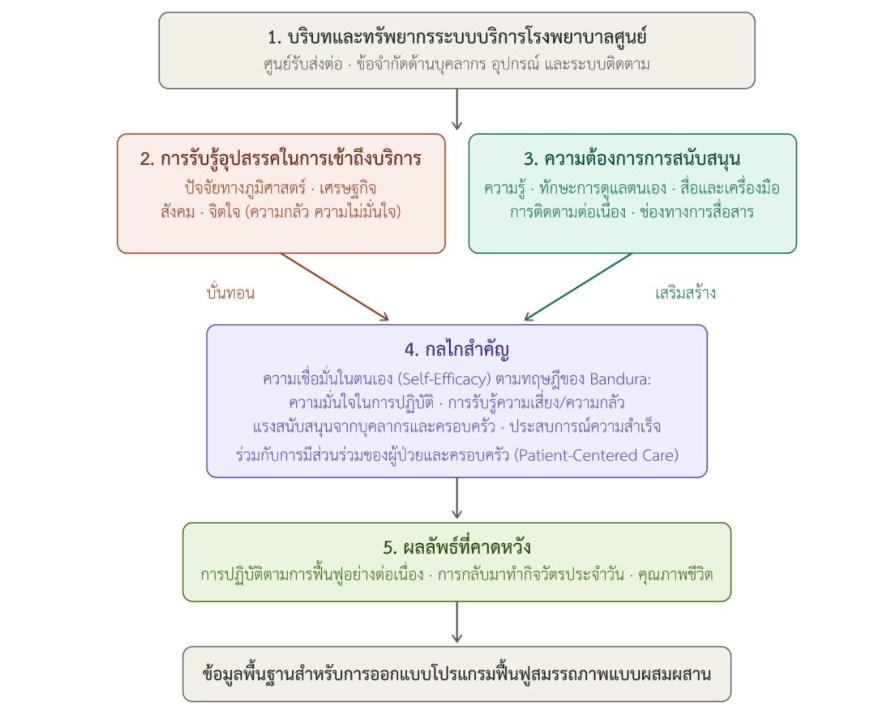
Descriptive qualitative research aims to explain the perception of barriers and needs regarding the rehabilitation of patients post open-heart surgery at home, from the perspectives of patients, caregivers, and medical personnel, within the context of a central hospital. The study uses Bandura's self-efficacy theory combined with the patient-centered care concept as the conceptual framework. Purposeful sampling was conducted, selecting 5 patients post-open-heart surgery, 3 caregivers, and 10 medical personnel, totaling 18 participants. Data were collected through in-depth interviews and focus group discussions between May and July. Prof. In 2025, the research tools included semi-structured interviews, the quality of which was verified by three experts and tested before actual data collection. Data were analyzed using content analysis, and reliability was checked through triangulation and verification with informants.
The research findings identified six main issues: (1) geographical barriers and economic burdens, with patients living 40–80 kilometers from the hospital and travel costs of 300–500 baht per visit; (2) fear of re-injury from exercise; (3) gaps in knowledge and self-care skills; (4) feelings of abandonment after discharge and lack of continuous follow-up; (5) the need for accessible learning materials; and (6) the need for communication channels with medical staff. In summary, a hybrid home rehabilitation program that integrates remote monitoring via phone and Line application with hospital follow-up appointments is necessary. Hospital administrators should establish a remote monitoring system in collaboration with primary care networks. Interdisciplinary teams should develop easily accessible communication channels to reduce barriers to service access and enhance patients' quality of life.
References
Bandura, A. (1997). Self-efficacy: The exercise of control. W. H. Freeman and Company.
Bracewell, N. J., Plasschaert, J., Conti, C. R., Keeley, E. C., & Conti, J. B. (2022). Cardiac rehabilitation: Effective yet underutilized in patients with cardiovascular disease. Clinical Cardiology, 45(11), 1128–1134. https://doi.org/10.1002/clc.23911
Fanget, M., Sayegh, N., Simon, A., & Pavy, B. (2022). Effects of cardiac telerehabilitation during COVID-19 on cardiorespiratory fitness and physical activity in coronary patients. Frontiers in Physiology, 13, 837482. https://doi.org/10.3389/fphys.2022.837482
Gao, Y., Wang, N., Zhang, L., & Liu, N. (2023). Effectiveness of home-based cardiac telerehabilitation in patients with heart failure: A systematic review and meta-analysis of randomised controlled trials. Journal of Clinical Nursing, 32, 7661–7676. https://doi.org/10.1111/jocn.16726
Noor Hanita, Z., Khatijah, L.A., Kamaruzzaman, S., Karuthan, C., & Raja Mokhtar, R. A. (2022). A pilot study on development and feasibility of the ‘MyEducation: CABG application’ for patients undergoing coronary artery bypass graft (CABG) surgery. BMC Nursing, 21, 40. https://doi.org/10.1186/s12912-022-00814-4
Hassanzadeh, A., Baharestani, B., Dizaji, N. N., Shabani, F., Fathollahi, M. S., Goli, R., & Kouhpayeh, M. S. (2024). Comparison of the effect of telephone follow-up with social network follow-up program on self-efficacy and depression in patients undergoing coronary artery bypass graft surgery: A randomized controlled trial. Internet Interventions, 37, 100757. https://doi.org/10.1016/j.invent.2024.100757
Jo, H. S., Kim, H. M., Go, C. H., Yu, H. Y., Park, H. K., & Han, J. Y. (2024). Effectiveness of home-based cardiac rehabilitation with optimized exercise prescriptions using a mobile healthcare app in patients with acute myocardial infarction: A randomized controlled trial. Life, 14(9), 1122. https://doi.org/10.3390/life14091122
Mahfouz Khalil, M. I., El-Monshed, A. H., Shaala, R. S., El-Sherif, S. M., & Mousa, E. F. S. (2024). Home-based transitional cardiac telerehabilitation in older adults post coronary artery bypass grafting: A randomized controlled trial. Geriatric Nursing, 59, 139–149. https://doi.org/10.1016/j.gerinurse.2024.06.044
McDonagh, S. T., Dalal, H., Moore, S., Clark, C. E., Dean, S. G., Jolly, K., Cowie, A., Afzal, J., & Taylor, R. S. (2023). Home-based versus centre-based cardiac rehabilitation. The Cochrane Database of Systematic Reviews, 10(10), CD007130. https://doi.org/10.1002/14651858.CD007130.pub5
Meslet, J. B., Dugué, B., Brisset, U., Pianeta, A., & Kubas, S. (2022). Evaluation of a hybrid cardiovascular rehabilitation program in acute coronary syndrome low-risk patients organised in both cardiac rehabilitation and sport centres: A model feasibility study. International Journal of Environmental Research and Public Health, 19(15), 9455. https://doi.org/10.3390/ijerph19159455
Saensoda, S., Pokpalagon, P., & Chaiviboontham, S. (2025). The effects of a home-based cardiac rehabilitation program via the Line application on functional capacity and quality of life among open-heart surgery patients: A quasi-experimental study. Healthcare, 13(9), 1051. https://doi.org/10.3390/healthcare13091051
Stefanakis, M., Batalik, L., Antoniou, V., & Pepera, G. (2022). Safety of home-based cardiac rehabilitation: A systematic review. Heart & Lung, 55, 117–126. https://doi.org/10.1016/j.hrtlng.2022.04.016
van Mierlo, R. F. R., Houben, V. J. G., Rikken, S. A. O. F., Gómez-Doblas, J. J., Lozano-Torres, J., & van ’t Hof, A. W. J. (2024). Cardiac (tele)rehabilitation in routine clinical practice for patients with coronary artery disease: Protocol of the REHAB+ trial. Frontiers in Cardiovascular Medicine, 11, 1387148. https://doi.org/10.3389/fcvm.2024.1387148
Zhong, W., Fu, C., Xu, L., Sun, X., Wang, S., He, C., & Wei, Q. (2023). Effects of home-based cardiac telerehabilitation programs in patients undergoing percutaneous coronary intervention: a systematic review and meta-analysis. BMC Cardiovascular Disorders, 23, 101. https://doi.org/10.1186/s12872-023-03120-2
Downloads
Published
How to Cite
Issue
Section
License
Copyright (c) 2026 Journal of Boromarajonani College of Nursing, Surin

This work is licensed under a Creative Commons Attribution-NonCommercial-NoDerivatives 4.0 International License.
เนื้อหาและข้อมูลในบทความที่ตีพิมพ์ในราชาวดีสาร วิทยาลัยพยาบาลบรมราชชนนี สุรินทร์ ถือเป็นข้อคิดเห็นและความรับผิดชอบของผู้เขียนบทความโดยตรง ซึ่งกองบรรณาธิการวารสารไม่จำเป็นต้องเห็นด้วย หรือร่วมรับผิดชอบใดๆ
บทความ ข้อมูล เนื้อหา รูปภาพ ฯลฯ ที่ได้รับการตีพิมพ์ในราชาวดีสาร วิทยาลัยพยาบาลบรมราชชนนี สุรินทร์ หากบุคคลหรือหน่วยงานใดต้องการนำทั้งหมดหรือส่วนหนึ่งส่วนใดไปเผยแพร่หรือกระทำการใดๆ จะต้องได้รับอนุญาตเป็นลายลักษณ์อักษรจากราชาวดีสาร วิทยาลัยพยาบาลบรมราชชนนี สุรินทร์ ก่อนเท่านั้น