
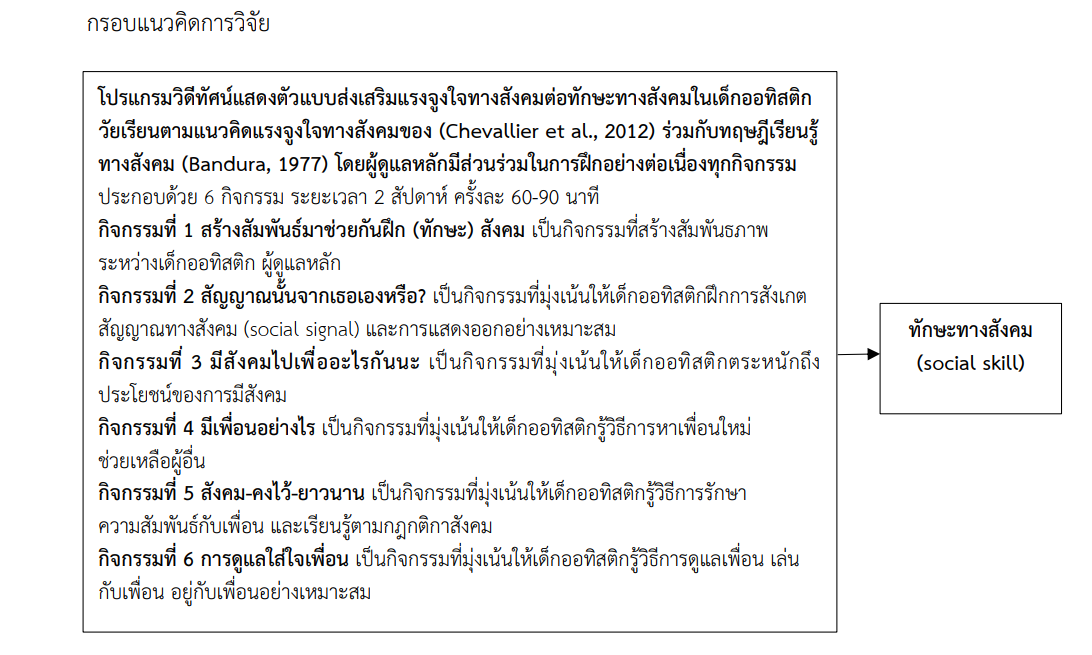
The Effect of Social Motivation Modeling Video Program on Social Skills among School-age with Autistic Spectrum Disorder
Keywords:
Video program, Model to promote social motivation, Social skills, Autistic children, School-age childrenAbstract
This study is a quasi-experimental research with a two-group pretest-posttest design. The objective is to examine the effect of a video modeling program promoting social motivation on the social skills of school-aged autistic children. The sample was specifically selected based on predetermined criteria, consisting of 42 school-aged autistic children with social skill deficits, divided into an experimental group and a control group, each with 21 participants. The research instruments are divided into two parts: 1) the experimental tool, which includes 1. The video modeling program to promote social motivation 2) Data collection instruments include 1. Observation form for social skills of school-aged children with autism 2. The social motivation assessment using the SSDS 1.0 (Stanford Social Dimensions Scale) showed content validity indices of .89 and .98 for the social skills observation and social motivation assessment, respectively. The reliability was .92 and .92. Data were analyzed using descriptive statistics and t-test statistics.
The study found that school-aged autistic children who received the video modeling program to promote social motivation had an average social skills score of 13.81 (SD = 2.63) higher than before participating in the program, which had an average score of 10.24 (SD = 1.89) significantly at the .05 level (t = -8.82). When comparing the average social skills scores after the experiment between the experimental group and the control group, it was found that the group that received the program had an average score of 13.81 (SD = 2.63) higher than the group that received standard care, which had an average score of 9.38 (SD = 1.46) significantly at the .05 level (t = 6.60). Therefore, the video modeling program to promote social motivation can be used as a guideline to enhance the social skills of school-aged children with autism.
References
กรมส่งเสริมและพัฒนาคุณภาพชีวิตคนพิการ. (2567). รายงานข้อมูลสถิติคนพิการประจำเดือน. ระบบงานออกบัตรประจำตัวคนพิการ กรมส่งเสริมและพัฒนาคุณภาพชีวิตคนพิการ (พก.). https://ecard.dep.go.th/nep_all/stat.php
แก้วตา นพมณีจำรัสเลิศ, ประพา หมายสุข, และฒามรา สุมาลย์โรจน์. (2559). การติดตามผลการรักษาเด็กออทิสติกที่ใช้แนวทาง DIR/ฟลอร์ไทม์. วารสารกุมารเวชศาสตร์, 55(4), 284-292.
ณัฐวัฒน์ งามสมุทร, ศิริรัตน์ อุฬารตินนท์, และพราวพรรณราย มัลลิกะมาลย์. (2562). สังคมศึกษา. Kidteracy.
ดารณี อุทัยรัตนกิจ. (2545). การจัดการเรียนรวมสำหรับเด็กออทิสติกในโรงเรียนสาธิตแห่งมหาวิทยาลัยเกษตรศาสตร์. ใน ดารณี อุทัยรัตนกิจ (ประธาน), การประชุมวิชาการระดับชาติ เรื่อง ครู หมอ พ่อแม่ : มิติแห่งการพัฒนาศักยภาพบุคคลออทิสติก ออทิซีมในประเทศไทย:จากตำราสู่ประสบการณ์. โรงเรียนสาธิตแห่งมหาวิทยาลัยเกษตรศาสตร์.
นาถลดา ตะวันกาญจนโชติ. (2559). ทักษะทางสังคมของเด็กออทิสติกวัยเรียน. วารสารการพยาบาลจิตเวชและสุขภาพจิต, 30(2), 1-21.
โรงพยาบาลยุวประสาไวทโยปถัมภ์. (2567). งานบริการผู้ป่วยออทิสติก. https://ycap.go.th/our-services/322-งานบริการผู้ป่วยออทิสติก.
สุภลักษณ์ ประคุณหังสิต, และวิรงรอง อรัญนารถ. (2562). ระดับของทักษะทางสังคมในเด็กกลุ่มอาการออทิซึม. เวชสารแพทย์ทหารบก, 72(4), 247-253.
สุรเชษฐ์ ฆังนิมิตร. (2566). 25 How to อยู่กับคนออทิสติกอย่างเข้าใจ. ไรเตอร์โซล.
อัจจิมา ศิริพิบูลย์ผล. (2552). ทักษะทางสังคมของเด็กปฐมวัยออทิสติกที่ได้รับการจัดกิจกรรมการเลียนแบบร่วมมือ. [ปริญญานิพนธ์การศึกษามหาบัณฑิต ไม่ได้ตีพิมพ์]. มหาวิทยาลัยศรีนครินทรวิโรฒ.
อาริสรา ทองเหม, และประพิมพ์ใจ เปี่ยมคุ้ม. (2560). การมีส่วนร่วมของผู้ปกครองในการส่งเสริมพัฒนาการเด็กออทิสติกที่สถาบันสุขภาพจิตเด็กและวัยรุ่นราชนครินทร์. วารสารวิจัยและพัฒนาการศึกษาพิเศษ, 6(2), 21-36.
Alzyoudi, M., Sartawi, A., & Almuhiri, O. (2014). The impact of video modelling on improving social skills in children with autism. British Journal of Special Education, 42(1), 53-68. https://doi.org/10.1111/1467-8578.12057
American Psychiatric Association. (2022). Diagnostic and statistical manual of mental disorders (5th ed.). https://doi.org/10.1176/appi.books.9780890425787
Bandura, A. (1977). Social learning theory. Prentice-Hall.
Chevallier, C., Kohls, G., Troiani, V., Brodkin, E. S., & Schultz, R. T. (2012). The social motivation theory of autism. Trends in Cognitive Sciences, 16(4), 231–239. https://doi.org/10.1016/j.tics.2012.02.007
Constantino, J. N., & Gruber, C. P. (2012). Social responsiveness scale-second edition (SRS-2). Western Psychological Services.
Hudson, C. C., Hall, L., & Harkness, K. L. (2019). Prevalence of depressive disorders in individuals with autism spectrum disorder: A meta-analysis. Journal of Abnormal Child Psychology, 47(1), 165–175. https://doi.org/10.1007/s10802-018-0402-1
Itskovich, E., Zyga, O., Libove, R.A., Phillips, J.M., Garner, J.P. and Parker, K.J. (2020), Complex interplay between cognitive ability and social motivation in predicting social skill: A unique role for social motivation in children with autism. Autism Research, 14(1), 86-92. https://doi.org/10.1002/aur.2409
Kiep, M. L., Spek, A. A., & Hoeben, L. (2015). Mindfulness-based therapy in adults with an autism spectrum disorder: Do treatment effects last?. Mindfulness, 6, 637-644. https://doi.org/10.1007/s12671-014-0299-x
Martin, A. P. (2022, April 20). The Effects of Parenting on the Behavior of Children with Autism: A Meta-analysis. scholarly commons. https://web.archive.org/web/20240302153813/https://scholarlycommons.obu.edu/cgi/viewcontent.cgi?article=1849&context=honors_theses
Mason, R. A., Rispoli, M., Ganz, J. B., Boles, M. B., & Orr, K. (2012). Effects of video modeling on communicative social skills of college students with Asperger syndrome. Developmental Neurorehabilitation, 15(6), 425–434. https://doi.org/10.3109/17518423.2012.704530
Phillips, J. M., Uljarević, M., Schuck, R. K., Schapp, S., Solomon, E. M., Salzman, E., Allerhand, L., Libove, R. A., Frazier, T. W., & Hardan, A. Y. (2019). Development of the Stanford social dimensions scale: Initial validation in autism spectrum disorder and in neurotypicals. Molecular Autism, 10, 48. https://doi.org/10.1186/s13229-019-0298-9
Quill, K., & Brusnahan, L. S. (2017). Do-watch-listen-say: Social and communication intervention for autism Sspectrum disorder (2nd ed.). Brookes Publishing. https://www.perlego.com/book/500691/dowatchlistensay-pdf
Shkel, J., Geng, A., Pilchak, E., Millan, M. E., Schwartzman, J. M., Schuck, R., Bundang, M. V., Barnowski, A., Slap, D. M., Stratford, S., Hardan, A. Y., Phillips, J. M., & Gengoux, G. W. (2025). A Pilot Randomized Controlled Trial of Motivation-Based Social Skills Group Treatment with Parent Training. Journal of Autism and Developmental Disorders, 55(4), 1215–1228. https://doi.org/10.1007/s10803-024-06302-9
Downloads
Published
How to Cite
Issue
Section
License
Copyright (c) 2026 Journal of Boromarajonani College of Nursing, Surin

This work is licensed under a Creative Commons Attribution-NonCommercial-NoDerivatives 4.0 International License.
เนื้อหาและข้อมูลในบทความที่ตีพิมพ์ในราชาวดีสาร วิทยาลัยพยาบาลบรมราชชนนี สุรินทร์ ถือเป็นข้อคิดเห็นและความรับผิดชอบของผู้เขียนบทความโดยตรง ซึ่งกองบรรณาธิการวารสารไม่จำเป็นต้องเห็นด้วย หรือร่วมรับผิดชอบใดๆ
บทความ ข้อมูล เนื้อหา รูปภาพ ฯลฯ ที่ได้รับการตีพิมพ์ในราชาวดีสาร วิทยาลัยพยาบาลบรมราชชนนี สุรินทร์ หากบุคคลหรือหน่วยงานใดต้องการนำทั้งหมดหรือส่วนหนึ่งส่วนใดไปเผยแพร่หรือกระทำการใดๆ จะต้องได้รับอนุญาตเป็นลายลักษณ์อักษรจากราชาวดีสาร วิทยาลัยพยาบาลบรมราชชนนี สุรินทร์ ก่อนเท่านั้น