
Effectiveness of Innovation to Evaluate Customer Satisfaction with Vichai's 7 Color Balls Model at Sirindhorn College of Public Health Phitsanulok
Keywords:
Satisfaction, Innovation, Vichai's 7 color balls modelAbstract
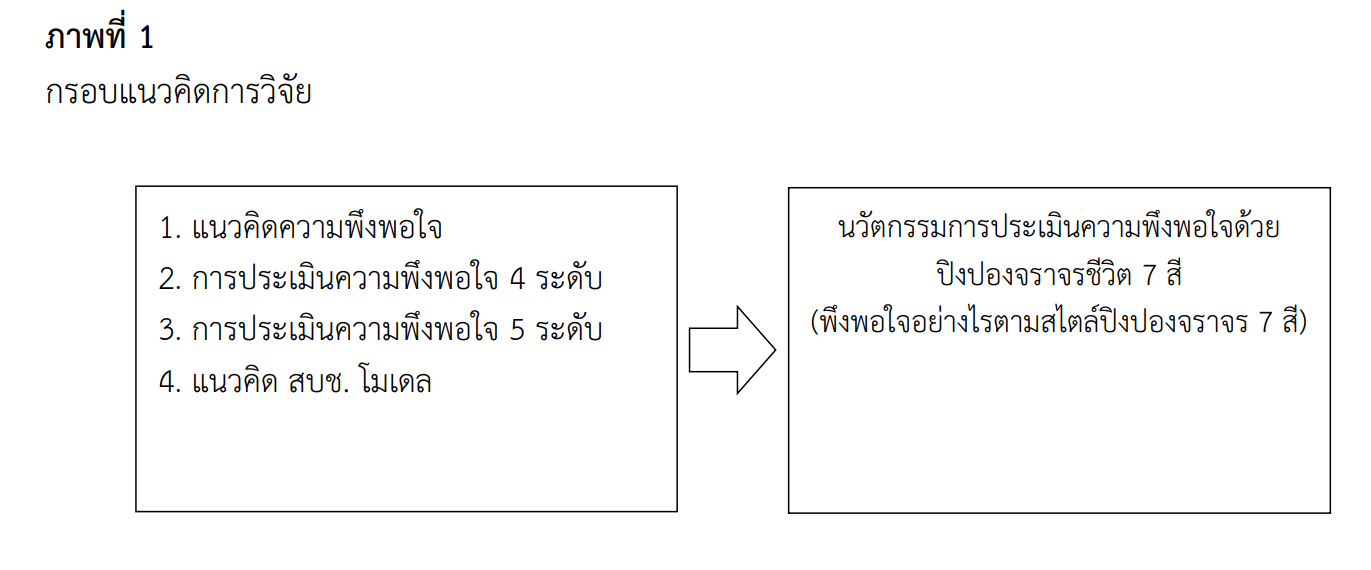
This quasi-experimental study, using a single-group time-series design, aimed to examine the effectiveness of an innovative satisfaction assessment tool, the “7-level Life Traffic Light Ping-Pong,” among service recipients at Sirindhorn College of Public Health, Phitsanulok Province. The sample consisted of 42 participants selected through purposive sampling. Data were collected using a satisfaction assessment administered at three time points. The reliability coefficients for the 4-point, 5-point, and 7-point satisfaction scales were 0.72, 0.84, and 0.94, respectively, and analyzed with descriptive statistics and the Friedman test.
The results showed that the majority of participants were female (54.8%), with a mean age of 57.74 ± 14.00 years. Most were married (71.4%), held a bachelor’s degree (57.2%), were retired government officers (45.2%), and had an average monthly income of 27,542.62 ± 13,770.40 baht. When comparing satisfaction scores across 4-point, 5-point, and 7-point scales over the three measurement periods, no statistically significant differences were found. However, after standardizing the scores, the 7-point satisfaction scale demonstrated significantly higher scores than both the 5-point and 4-point scales at the 0.05 significance level. Therefore, it is recommended to promote the use of the 7-point satisfaction scale in conjunction with the Life Traffic Light Ping-Pong innovation in healthcare settings to enhance the sensitivity in distinguishing levels of satisfaction. Further studies in other contexts are also suggested.
References
กุลชา เลิศสิทธิพันธ์. (2565). การประเมินความพึงพอใจแบบเทียบเคียงภายในองค์กรของพนักงานกลุ่มงานอาคารอทิตยาทร วิทยาลัยนานาชาติ มหาวิทยาลัยมหิดล. วารสารปาริชาต, 35(4), 53–69.
ปราโมทย์ วงศ์สวัสดิ์. (2561). แบบแผนการวิจัยเชิงทดลอง: การประยุกต์ใช้ในงานวิจัยเพื่อพัฒนาพฤติกรรมสุขภาพ. เจริญดีมั่นคงการพิมพ์.
พระราชบัญญัติสถาบันพระบรมราชชนก พ.ศ. 2562. (2562, 5 เมษายน). ราชกิจจานุเบกษา. เล่ม 136 ตอนที่ 43 ก. หน้า 40-65.
วิชัย เทียนถาวร. (2566). แนวคิด สบช.โมเดล. สถาบันพระบรมราชชนก กระทรวงสาธารณสุข.
อัศนี วันชัย, จิตติพร ศรีษะเกตุ, และวิชัย เทียนถาวร. (2566). การประยุกต์ใช้ปิงปองจราจรชีวิต 7 สีในการเฝ้าระวังโรคไม่ติดต่อเรื้อรัง: การทบทวนขอบเขตงานวิจัย. วารสารวิจัยการพยาบาลและวิทยาศาสตร์สุขภาพ, 15(2), e267915.
Browne, R. H. (1995). On the use of a pilot sample for sample size determination. Statistics in Medicine, 14(17), 1933–1940.
Cummins, R. A., & Gullone, E. (2000). Why we should not use 5-point Likert scales: The case for subjective quality of life measurement. In Proceedings of the second international conference on quality of life in cities (pp. 74–93). National University of Singapore.
Kotler, P., & Keller, K. L. (2016). Marketing management (15th ed.). Pearson Education.
Likert, R. (1932). A technique for the measurement of attitudes. Archives of Psychology, 22(140), 1-55.
Malhotra, N. K. (1996). Marketing research: An applied orientation (2nd ed.). Prentice Hall.
Nitko, A. J. (2001). Educational assessment of students (3rd ed.). Merrill Prentice Hall.
Parasuraman, A., Zeithaml, V. A., & Berry, L. L. (1988). SERVQUAL: A multiple-item scale for measuring consumer perceptions of service quality. Journal of Retailing, 64(1), 12–40.
Preston, C. C., & Colman, A. M. (2000). Optimal number of response categories in rating scales: Reliability, validity, discriminating power, and respondent preferences. Acta Psychologica, 104(1), 1-15. https://doi.org/10.1016/S0001-6918(99)00050-5
Schwarz, N. (1999). Self-reports: How the questions shape the answers. American Psychologist, 54(2), 93-105. https://doi.org/10.1037/0003-066X.54.2.93
World Health Organization. (2024). Health systems governance. https://www.who.int/health-topics/health-systems-governance
Downloads
Published
How to Cite
Issue
Section
License
Copyright (c) 2026 Journal of Boromarajonani College of Nursing, Surin

This work is licensed under a Creative Commons Attribution-NonCommercial-NoDerivatives 4.0 International License.
เนื้อหาและข้อมูลในบทความที่ตีพิมพ์ในราชาวดีสาร วิทยาลัยพยาบาลบรมราชชนนี สุรินทร์ ถือเป็นข้อคิดเห็นและความรับผิดชอบของผู้เขียนบทความโดยตรง ซึ่งกองบรรณาธิการวารสารไม่จำเป็นต้องเห็นด้วย หรือร่วมรับผิดชอบใดๆ
บทความ ข้อมูล เนื้อหา รูปภาพ ฯลฯ ที่ได้รับการตีพิมพ์ในราชาวดีสาร วิทยาลัยพยาบาลบรมราชชนนี สุรินทร์ หากบุคคลหรือหน่วยงานใดต้องการนำทั้งหมดหรือส่วนหนึ่งส่วนใดไปเผยแพร่หรือกระทำการใดๆ จะต้องได้รับอนุญาตเป็นลายลักษณ์อักษรจากราชาวดีสาร วิทยาลัยพยาบาลบรมราชชนนี สุรินทร์ ก่อนเท่านั้น