
Development of Nursing Practice Guidelines for the Prevention and Monitoring of Hypersensitivity Reactions in Cancer Patients Receiving Chemotherapy at Nan Hospital
Keywords:
Nursing practice guideline, Hypersensitivity reaction, Chemotherapy, Cancer patients, Evidence-based nursingAbstract
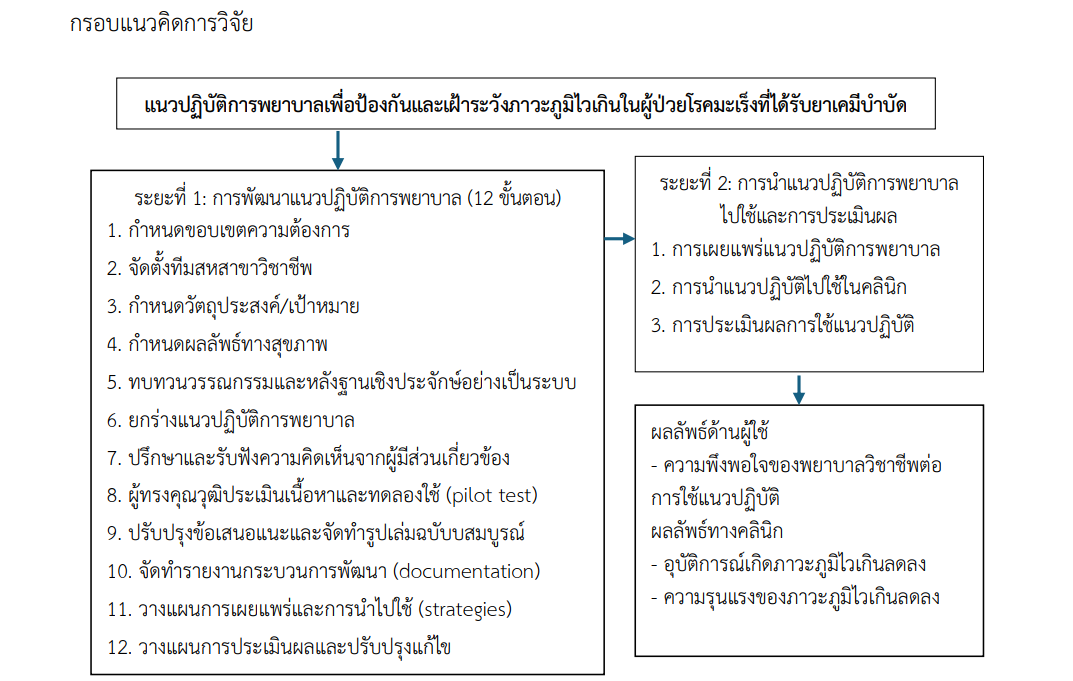
This research and development study aimed to develop a nursing practice guideline and evaluate its implementation for the prevention and surveillance of hypersensitivity reactions in cancer patients receiving chemotherapy at Nan Hospital. The sample consisted of six registered nurses and 200 cancer patients, divided equally into pre-implementation and post-implementation groups of 100 patients each. The study was conducted from August 2024 to May 2025 and comprised two phases: Phase 1, guideline development; and Phase 2, guideline implementation and outcome measurement. Research instruments included the developed nursing practice guideline, a feasibility assessment form, an outcome evaluation form, and a nurse satisfaction questionnaire. All instruments underwent content validity verification, with the index of objective congruence (IOC) ranging from 0.92 to 1.00 and reliability coefficients of 0.95, 0.92, 0.92, and 0.91, respectively. Data were analyzed using descriptive statistics, chi-square test, and independent t-test.
The findings revealed two key results. First, following implementation, registered nurses rated the feasibility of the guideline at the highest level (M = 4.69, SD = 0.48) and reported the highest level of satisfaction with its use (M = 4.67, SD = 0.24). Second, nurses' clinical practice scores in the post-implementation group were markedly higher than those in the pre-implementation group (M = 9.20, SD = 0.62 vs. M = 6.95, SD = 1.05, respectively). Additionally, both the incidence and severity of hypersensitivity reactions decreased significantly following guideline implementation (p< .001). In conclusion, the developed nursing practice guideline proved effective in reducing the incidence and severity of hypersensitivity reactions and in strengthening nursing practice competency. It is therefore recommended that this guideline be adopted as a standard of care in chemotherapy units across hospitals at all levels.
References
โรงพยาบาลน่าน, กลุ่มงานการพยาบาล. (2566). สถิติการให้บริการผู้ป่วยนอก หน่วยเคมีบำบัด. (เอกสารไม่ได้ตีพิมพ์).
สถาบันวิจัยและประเมินเทคโนโลยีทางการแพทย์, กรมการแพทย์. (2556). การประเมินคุณภาพแนวทางเวชปฏิบัติ: Appraisal of guideline for research & evaluation II (AGREE II) ฉบับภาษาไทย. กระทรวงสาธารณสุข.
อัจฉราภรณ์ ม่วงมุลตรี, และศิรินทรา โคตะโน. (2563). การพัฒนาแนวปฏิบัติการพยาบาลผู้ป่วยมะเร็งเพื่อป้องกันภาวะภูมิไวเกินจากการได้รับเคมีบำบัด แผนกผู้ป่วยนอกหน่วยเคมีบำบัด โรงพยาบาลร้อยเอ็ด. วารสารวิจัยและพัฒนานวัตกรรมทางสุขภาพ, 1(2), 115–122.
Adombire, S., Baiden, D., Puts, M., Puchalski Ritchie, L. M., Ani-Amponsah, M., & Cranley, L. (2024). Knowledge, skills, attitudes, beliefs, and implementation of evidence-based practice among nurses in low- and middle-income countries: A scoping review. Worldviews on Evidence-Based Nursing, 21, 542–553. https://doi.org/10.1111/wvn.12734
Barroso, A., Estevinho, F., Hespanhol, V., Teixeira, E., Ramalho-Carvalho, J., & Araújo, A. (2024). Management of infusion-related reactions in cancer therapy: Strategies and challenges. ESMO Open, 9(3), 102922. https://doi.org/10.1016/j.esmoop.2024.102922
Castells, M., Sancho-Serra, M.d.C., & Simarro, M. (2012). Hypersensitivity to antineoplastic agents: Mechanisms and treatment with rapid desensitization. Cancer Immunology, Immunotherapy, 61(9), 1575–1584. https://doi.org/10.1007/s00262-012-1273-x
Faul, F., Erdfelder, E., Buchner, A., & Lang, A. G. (2009). Statistical power analyses using G*Power 3.1: Tests for correlation and regression analyses. Behavior Research Methods, 41(4), 1149-1160. https://doi.org/10.3758/BRM.41.4.1149
Jovisevic, M., Brdar-Zelen, T., & Bogdan, M. (2024). Hypersensitive reactions to chemotherapy. Medicinski Pregled, 77(9-12), 317-323. https://doi.org/10.2298/mpns2412317j
Li, H., Xu, R., Gao, D., Fu, H., Yang, Q., Chen, X., Hou, C., & Gao, J. (2024). Evidence-based practice attitudes, knowledge and skills of nursing students and nurses, a systematic review and meta-analysis. Nurse Education in Practice, 78, 104024. https://doi.org/10.1016/j.nepr.2024.104024
National Cancer Institute. (2017). Common terminology criteria for adverse events (CTCAE) version 5.0. U.S. Department of Health and Human Services, National Institutes of Health. https://dctd.cancer.gov/research/ctep-trials/for-sites/adverse-events/ctcae-v5-5x7.pdf
National Health and Medical Research Council (NHMRC). (1999). A guide to the development, implementation and evaluation of clinical practice guidelines. Commonwealth of Australia.
Neuss, M. N., Gilmore, T. R., Belderson, K. M., Billett, A. L., Conti-Kalchik, T., Harvey, B. E., Hendricks, C., LeFebvre, K. B., Mangu, P. B., McNiff, K., Olsen, M., Schulmeister, L., Von Gehr, A., & Polovich, M. (2016). 2016 updated American society of clinical oncology/oncology nursing society chemotherapy administration safety standards, including standards for pediatric oncology. Journal of Oncology Practice, 12(12), 1262-1271. https://doi.org/10.1200/JOP.2016.017905
Polit, D. F., & Beck, C. T. (2021). Nursing research: Generating and assessing evidence for nursing practice (11th ed.). Wolters Kluwer.
Rocha, M., Ruppen, I., Gesualdo, M., Fernandes, M., De Oliveira Barros, P., Leandro, A., Hellmann, E., Porcinelli, A., Piccoli, L., Gasparotto, G., Barreto, T., Zanini, C., Gois, G., Reis, L., & Perez, H. (2025). Chemotherapy-related toxicities and clinical management: An article review. Journal of Cancer Research Reviews & Reports,7(3), 1-3. https://doi.org/10.47363/jcrr/2025(7)216
Siegel, R. L., Miller, K. D., Fuchs, H. E., & Jemal, A. (2022). Cancer statistics, 2022. CA: A Cancer Journal for Clinicians, 72(1), 7–33. https://doi.org/10.3322/caac.21708
Syrigou, E., Saif, M. W., & Makrilia, N. (2021). Management of hypersensitivity reactions to chemotherapy drugs. Journal of Oncology Practice, 17(5), 229–237.
The Joanna Briggs Institute. (2017). The Joanna Briggs Institute critical appraisal tools for use in JBI systematic reviews checklist for qualitative research. The Joanna Briggs Institute. https://jbi.global/sites/default/files/2019-05/JBI_Critical_Appraisal-Checklist_for_Qualitative_Research2017_0.pdf
Virani, S., Bilheem, S., Chansaard, W., Chitapanarux, I., Daoprasert, K., Khuanchana, S., Leklob, A., Pongnikorn, D., Rozek, L. S., Siriarechakul, S., Suwanrungruang, K., Tassanasunthornwong, S., Vatanasapt, P., & Sriplung, H. (2017). National and subnational population-based incidence of cancer in Thailand: Assessing cancers with the highest burdens. Cancers, 9(8), 108. https://doi.org/10.3390/cancers9080108
Zaikov, S., Lykova, M., Hritsova, N., & Veselovsky, L. (2024). Hypersensitivity to chemotherapeutic drugs for the treatment of neoplasms. Literature review. Infusion & Chemotherapy, 7(4), 35–42. https://doi.org/10.32902/2663-0338-2024-4-35-42
Zhong, D., Wu, Y., Aarons, G. A., Hutchinson, A. M., Wong, W. C., Lv, S., Song, Z., Wu, Y., Bishai, D. M., Chen, K., Yang, N., Chen, Y., Liu, Z., Yan, L., Zhou, P., & Xu, D. R. (2025). Implementability of clinical practice guidelines: the review and development of a comprehensive framework for guideline implementability (CFGI). Implementation Science Communications, 6(1), 106. https://doi.org/10.1186/s43058-025-00780-3
Downloads
Published
How to Cite
Issue
Section
License
Copyright (c) 2026 Journal of Boromarajonani College of Nursing, Surin

This work is licensed under a Creative Commons Attribution-NonCommercial-NoDerivatives 4.0 International License.
เนื้อหาและข้อมูลในบทความที่ตีพิมพ์ในราชาวดีสาร วิทยาลัยพยาบาลบรมราชชนนี สุรินทร์ ถือเป็นข้อคิดเห็นและความรับผิดชอบของผู้เขียนบทความโดยตรง ซึ่งกองบรรณาธิการวารสารไม่จำเป็นต้องเห็นด้วย หรือร่วมรับผิดชอบใดๆ
บทความ ข้อมูล เนื้อหา รูปภาพ ฯลฯ ที่ได้รับการตีพิมพ์ในราชาวดีสาร วิทยาลัยพยาบาลบรมราชชนนี สุรินทร์ หากบุคคลหรือหน่วยงานใดต้องการนำทั้งหมดหรือส่วนหนึ่งส่วนใดไปเผยแพร่หรือกระทำการใดๆ จะต้องได้รับอนุญาตเป็นลายลักษณ์อักษรจากราชาวดีสาร วิทยาลัยพยาบาลบรมราชชนนี สุรินทร์ ก่อนเท่านั้น