The Effects of Self-management Program on Fluid Overload in End-stage Renal Disease Patients Receiving Hemodialysis at Chiangrai Prachanukroh Hospital
Keywords:
End-stage renal disease, Hemodialysis, Fluid overload, Self-management programAbstract
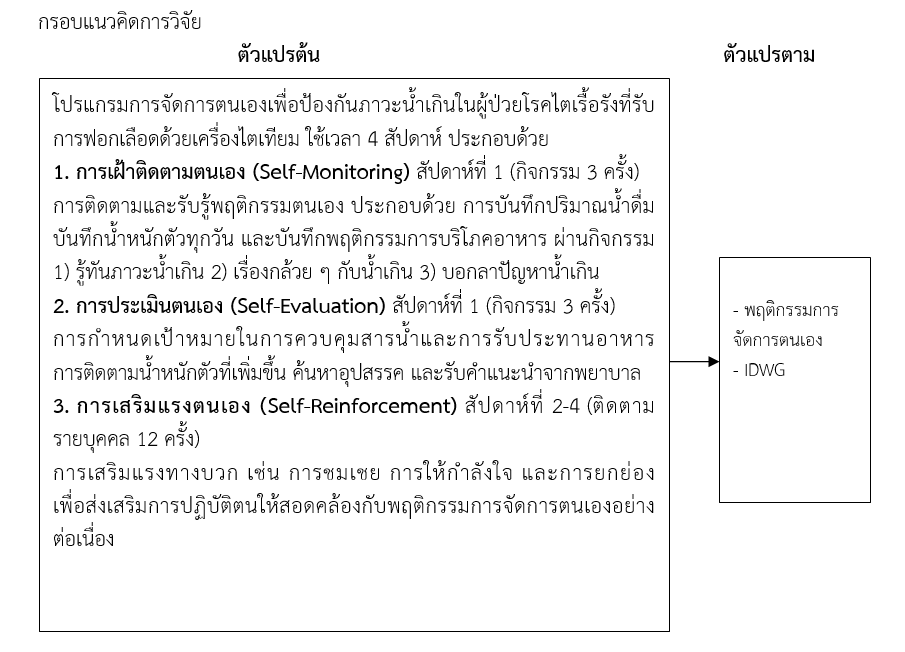
This quasi-experimental research aims to study the effects of a self-management program on fluid overload in end-stage chronic kidney disease patients undergoing dialysis. It compares self-management behaviors related to fluid overload before and after receiving the self-management program in the experimental group, self-management behavior scores between the experimental and control groups, and interdialytic weight gain (IDWG) between the experimental and control groups. The sample consisted of 70 patients aged 18 years and older undergoing hemodialysis, selected through purposive sampling, matched by basic characteristics, and randomly assigned to either the experimental group or the control group, with 35 participants in each group. The experimental group received the self-management program, while the control group received standard nursing care for 4 weeks. Research instruments included the self-management program, general information recording form, fluid overload recording form, and self-management behavior questionnaire. Content validity was confirmed with CVI values of 0.9 and 0.89, and the questionnaire's reliability was 0.90. Data were analyzed using descriptive statistics, paired t-tests, independent t-tests.
The study results showed that after receiving the program, the experimental group had a significantly higher self-management score for fluid overload compared to the control group (t = 22.84, p< .001) and a significantly lower IDWG than the control group (t = 3.19, p=.002, 95% CI =-0.63, -0.15). Self-management behaviors in specific areas revealed that the experimental group had better medication adherence, fluid restriction, and dietary consumption than the control group. In conclusion, the self-management program is effective in managing fluid overload and should be implemented to promote self-care and reduce complications in patients.
References
จินตนา ทองดี, วารินทร์ บินโฮเซ็น, และน้ำอ้อย ภักดีวงศ์. (2568). ผลของโปรแกรมส่งเสริมสมรรถนะแห่งตนร่วมกับแรงสนับสนุนทางสังคมต่อพฤติกรรมควบคุมน้ำ และการเปลี่ยนแปลงน้ำหนักตัวในผู้ป่วยไตเรื้อรังระยะสุดท้ายที่ได้รับการฟอกเลือดด้วยเครื่องไตเทียม. วารสารพยาบาลโรคหัวใจและทรวงอก, 36(1), 47-62.
ธนัยรัตน์ รุ้งพราย, และทัศนา ชูวรรธนะปกรณ์. (2561). ผลของโปรแกรมการจัดการตนเองของบุคคลและครอบครัวต่อภาวะน้ำเกินในผู้สูงอายุที่เป็นโรคไตเรื้อรังระยะสุดท้ายและได้รับการฟอกเลือดด้วย เครื่องไตเทียม. วารสารพยาบาลศาสตร์ จุฬาลงกรณ์มหาวิทยาลัย, 30(1), 96–107.
เพ็ญโพยม สาคร, และเตือนใจ เจริญบุตร. (2568). อิทธิพลของความรอบรู้ด้านสุขภาพและการรับรู้สมรรถนะแห่งตนต่อความสามารถในการจัดการตนเองของผู้ป่วยที่ได้รับการฟอกเลือดด้วยเครื่องไตเทียม. วารสารพยาบาลทหารบก, 26(1), 258-267.
มานะ ปัจจะแก้ว, และขนิษฐา เล็กรุ่งเรืองกิจ. (2567). ผลของโปรแกรมการจัดการตนเองต่อพฤติกรรมการ ดูแลตนเอง เพื่อควบคุมภาวะน้ำเกินในผู้ป่วยโรคไตเรื้อรังที่เข้ารับการบำบัดทดแทนไต โดยการฟอกเลือดด้วยเครื่องไตเทียม โรงพยาบาลสิงห์บุรี. วารสารโรงพยาบาลสิงห์บุรี, 33(2), B130–B139.
วลี กิตติรักษ์ปัญญา, นิภาวรรณ สามารถกิจ, และเขมารดี มาสิงบุญ. (2556). ผลของโปรแกรมการจัดการ ตนเองร่วมกับการจัดการทางคลินิกต่อพฤติกรรมการจัดการตนเอง น้ำหนักที่เพิ่มขึ้น และภาวะความ ดันโลหิตต่ำขณะฟอกเลือดในผู้ป่วยโรคไตเรื้อรังที่ได้รับการฟอกเลือดด้วยเครื่องไตเทียม. วารสารสภาการพยาบาล, 28(2), 109–122.
สมาคมโรคไตแห่งประเทศไทย. (2565). Thailand renal replacement therapy year 2021–2022. https://www.nephrothai.org/wp-content/uploads/2024/10/New-Annual-report-2021-2022.pdf
สายสุนีย์ ภิญโญ, และศิริกาญจน์ จินาวิน. (2566). ผลของโปรแกรมการจัดการตนเองต่อการเกิดภาวะน้ำเกินในผู้ป่วยโรคไตเรื้อรังระยะสุดท้ายที่รับการฟอกเลือดด้วยเครื่องไตเทียม. PMJCS Phrae Medical Journal and Clinical Sciences, 31(2), 48–59.
Alatawi, A. A., Alaamri, M., & Almutary, H. (2024). Social support and adherence to treatment regimens among patients undergoing hemodialysis. Healthcare, 12(19), 1958. https://doi.org/10.3390/healthcare12191958
Bossola, M., Mariani, I., Strizzi, C. T., Piccinni, C. P., & Di Stasio, E. (2025). How to limit interdialytic weight gain in patients on maintenance hemodialysis: State of the art and perspectives. Journal of Clinical Medicine, 14(6), 1846. https://doi.org/10.3390/jcm14061846
Chiang, W. F., Hsiao, P. J., Wu, K. L., Wang, R. L., Chu, C. M., & Chan, J. S. (2024). Impacts of climate warming on the body composition of patients undergoing maintenance hemodialysis. International Journal of Medical Sciences, 21(14), 2759-2769. https://doi.org/10.7150/ijms.101232
Cho, M.-K., & Kang, Y. (2021). Effect of self-care intervention for controlling interdialytic weight gain among patients on hemodialysis: A systematic review and meta-analysis. Nephrology Dialysis Transplantation, 30(15–16), 2348–2365. https://doi.org/10.1111/jocn.15773
Cohen, J. (1988). Statistical Power Analysis for the Behavioral Sciences (2nd ed.). Routledge.
Collister, D., Pyne, L., Bhasin, A. A., Smyth, B., Herrington, W., Jardine, M., Mark, P. B., Badve, S., Rossignol, P., Dember, L. M., Wanner, C., Ezekowitz, J., Devereaux, P. J., Parfrey, P., Gansevoort, R., & Walsh, M. (2025). Heart failure events in randomized controlled trials for adults receiving maintenance dialysis: a meta-epidemiologic study. Nephrology Dialysis Transplantation, 40(2), 371-384. https://doi.org/10.1093/ndt/gfae156
Damas, J., & Fernandes, V. (2022). Assessment of fluid status in dialysis: Clinical importance and diagnostic tools. Portuguese Journal of Nephrology & Hypertension, 36(2), 115-120. https://doi.org/10.32932/pjnh.2022.06.189
Dennison, H. A. (2023). Acute kidney injury and chronic kidney disease. In M. M. Harding, J. Kwong, D. Hagler, C. Reinisch (Eds.), Lewis’s medical-surgical nursing: Assessment and management of clinical problems (12th ed., pp. 1232-1264). Elsevier.
Duan, S., Ma, Y., Lu, F., Zhang, C., Guo, H., Zeng, M., Sun, B., Yuan, Y., Xing, C., Mao, H., & Zhang, B. (2024). High sodium intake and fluid overhydration predict cardiac structural and functional impairments in chronic kidney disease. Frontiers in Nutrition, 11, 1388591. https://doi.org/10.3389/fnut.2024.1388591
Düzalan, O. B., & Pakyuz, S. C. (2018). Educational interventions for improved diet and fluid management in haemodialysis patients: An interventional study. JPMA. The Journal of the Pakistan Medical Association, 68(4), 532-537.
Efe, D., & Kocaöz, S. (2015). Adherence to diet and fluid restriction of individuals on hemodialysis treatment and affecting factors in Turkey. Japan Journal of Nursing Science, 12(2), 113–123. https://doi.org/10.1111/jjns.12055
Fadlilah, S., Nekada, C. D. Y., Lanni, F., Saleha, L., Lestiawati, E., Syafitri, E. N., Faozi, E., & Harnili. (2021). Interdialytic Weight Gain (IDWG) and Complications of Intradialysis among Hemodialized Patients. International Medical Journal, 28(6), 620–624.
Kanfer, H. F., & Gaelick-Buys, L. (1991). Self-management methods. In F. H. Kanfer & A. P. Goldstein (Eds.), Helping people change: A textbook of methods (pp. 305–360). Pergamon Press.
Lambert, K., Neale, E., Nichols, L., Brauer, D., Blomfield, R., Caurana, L., Isautier, J., Jesudason, S., & Webster, A. C. (2022). Interventions for improving adherence to dietary salt and fluid restrictions in people with chronic kidney disease (stage 4 and 5). The Cochrane Database of Systematic Reviews, 2022(10), CD015181. https://doi.org/10.1002/14651858.CD015181
Lopez, T., & Banerjee, D. (2021). Management of fluid overload in hemodialysis patients. Kidney International, 100(6), 1170-1173. https://doi.org/10.1016/j.kint.2021.09.013
Matteson, M. L., & Russell, C. (2010). Interventions to improve hemodialysis adherence: a systematic review of randomized-controlled trials. Hemodialysis International, 14(4), 370–382. https://doi.org/10.1111/j.1542-4758.2010.00462.x
Mayo Clinic. (2024). Hemodialysis. Mayo Foundation for Medical Education and Research. https://www.mayoclinic.org/tests-procedures/hemodialysis/about/pac-20384824
Miyasato, Y., Hanna, R. M., Miyagi, T., Narasaki, Y., Kimura, H., Morinaga, J., Mukoyama, M., & Kalantar-Zadeh, K. (2023). Associations of interdialytic weight gain in the long intervals with mortality and residual kidney function decline. Hemodialysis International, 27(3), 326–338. https://doi.org/10.1111/hdi.13094
National Kidney Foundation. (2023). What is dry weight? https://www.kidney.org/kidney-topics/what-dry-weight
Nadri, A., Khanoussi, A., Hssaine, Y., Chettati, M., Fadili, W., & Laouad, I. (2020). Effect of a hemodialysis patient education on fluid control and dietary. Nephrologie & Therapeutique, 16(6), 353–358. https://doi.org/10.1016/j.nephro.2020.03.011
Othman, M., Elbasha, A. M., Naga, Y. S., & Moussa, N. D. (2022). Early prediction of hemodialysis complications employing ensemble techniques. Biomedical Engineering Online, 21, 74. https://doi.org/10.1186/s12938-022-01044-0
Ozen, N., Cinar, F. I., Askin, D., Mut, D., & Turker, T. (2019). Nonadherence in hemodialysis patients and related factors: A multicenter study. Journal of Nursing Research, 27(4), e36. https://doi.org/10.1097/jnr.0000000000000309
Saran, R., Bragg-Gresham, J. L., Rayner, H. C., Goodkin, D. A., Keen, M. L., Van Dijk, P. C., Kurokawa, K., Piera, L., Saito, A., Fukuhara, S., Young, E. W., Held, P. J., & Port, F. K. (2003). Nonadherence in hemodialysis: Associations with mortality, hospitalization, and practice patterns in the DOPPS. Kidney International, 64(1), 254–262. https://doi.org/10.1046/j.1523-1755.2003.00064.x
Valsaraj, B. P., Bhat, S. M., Prabhu, R., & Kamath, A. (2021). Follow-up study on the effect of cognitive behaviour therapy on haemodialysis adherence: A randomised controlled trial. Sultan Qaboos University Medical Journal, 21(1), e58–e65. https://doi.org/10.18295/squmj.2021.21.01.008
Vr, V., & Kaur Kang, H. K. (2022). The worldwide prevalence of nonadherence to diet and fluid restrictions among hemodialysis patients: A systematic review and meta- analysis. Journal of Renal Nutrition, 32(6), 658–669. https://doi.org/10.1053/j.jrn.2021.11.007
Youngkong, S., Yoopetch, P., Thavorncharoensap, M., Assanatham, M., Chaikledkaew, U., & Sritippayawan, S. (2025). Economic evaluation of dialysis treatment in end-stage renal disease patients with fluid and sodium overload: Evidence from a randomized controlled trial in Thailand. PLoS ONE, 20(11), e0335749. https://doi.org/10.1371/journal.pone.0335749
Zoccali, C., Tripepi, G., Carioni, P., Mallamaci, F., Savoia, M., Usvyat, L. S., Maddux, F. W., & Stuard, S. (2025). Fluid overload trajectories and mortality in hemodialysis patients. Journal of Internal Medicine, 297(2), 201–212. https://doi.org/10.1111/joim.20049
Downloads
Published
How to Cite
Issue
Section
License
Copyright (c) 2026 Journal of Boromarajonani College of Nursing, Surin

This work is licensed under a Creative Commons Attribution-NonCommercial-NoDerivatives 4.0 International License.
เนื้อหาและข้อมูลในบทความที่ตีพิมพ์ในราชาวดีสาร วิทยาลัยพยาบาลบรมราชชนนี สุรินทร์ ถือเป็นข้อคิดเห็นและความรับผิดชอบของผู้เขียนบทความโดยตรง ซึ่งกองบรรณาธิการวารสารไม่จำเป็นต้องเห็นด้วย หรือร่วมรับผิดชอบใดๆ
บทความ ข้อมูล เนื้อหา รูปภาพ ฯลฯ ที่ได้รับการตีพิมพ์ในราชาวดีสาร วิทยาลัยพยาบาลบรมราชชนนี สุรินทร์ หากบุคคลหรือหน่วยงานใดต้องการนำทั้งหมดหรือส่วนหนึ่งส่วนใดไปเผยแพร่หรือกระทำการใดๆ จะต้องได้รับอนุญาตเป็นลายลักษณ์อักษรจากราชาวดีสาร วิทยาลัยพยาบาลบรมราชชนนี สุรินทร์ ก่อนเท่านั้น