
Effects of a Caregiver Capacity-Building Program on Caring for Bedridden Patients in the Community
Keywords:
Bedridden patient caregivers, Caregiver development programs, Supportive and educational nursing systemsAbstract
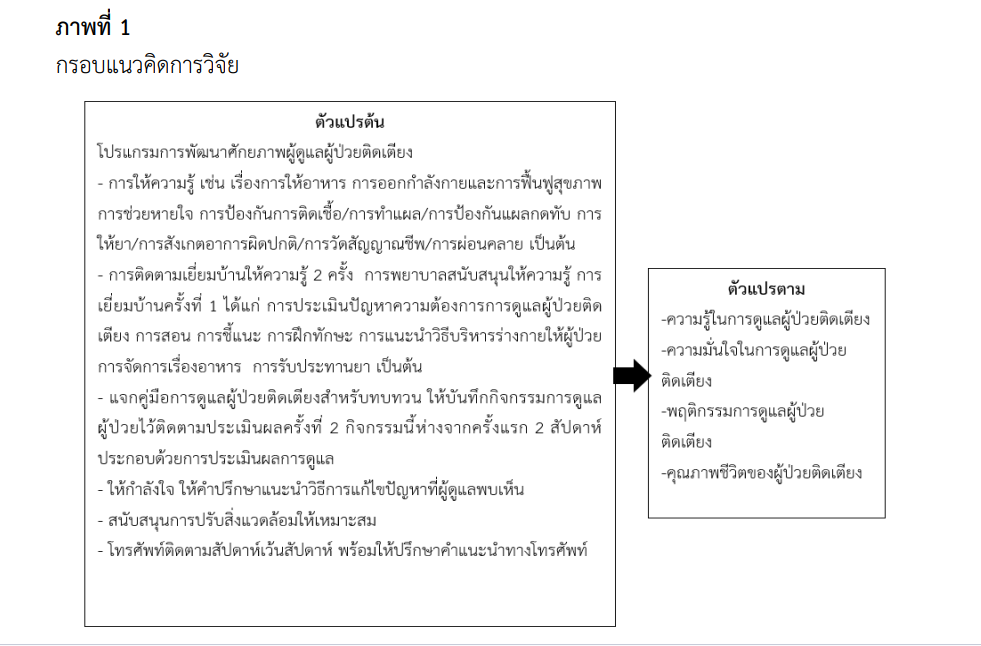
This quasi-experimental study, employing a two-group pre-test/post-test design, aimed to compare caregiver knowledge, confidence, caregiving behaviors, and the quality of life of bedridden patients between experimental and control groups. The sample comprised 70 caregivers, equally and randomly assigned to each group (n = 35). Research instruments included: 1) an 8-week nursing support and education program, and 2) assessment scales for knowledge, confidence, caregiving behavior, and patient quality of life, with Cronbach’s alpha reliability coefficients of 0.82, 0.83, 0.84, and 0.92, respectively. Data were analyzed using descriptive statistics, Chi-square or Fisher’s exact tests, paired t-tests, and independent t-tests.
Results: Following the intervention, the experimental group showed significantly higher mean scores in knowledge, confidence, caregiving behavior, and patient quality of life compared to their pre-test scores (all p< .05). When comparing between groups, the experimental group demonstrated significantly higher scores in knowledge, caregiving behavior, and patient quality of life than the control group (p < .05 and p < .001). However, no significant difference was found in caregiving confidence between the two groups (p = .490). The results suggest that the capacity-building program effectively enhances caregivers' knowledge and behaviors, ultimately improving the quality of life for bedridden patients. Consequently, this program should be integrated into long-term care services within community settings.
References
กรมกิจการผู้สูงอายุ กระทรวงการพัฒนาสังคมและความมั่นคงของมนุษย์. (2565). สังคมผู้สูงอายุใน ปัจจุบันและเศรษฐกิจในประเทศไทย. สืบค้น 10 มีนาคม 2568, จากhttps://www.dop.go.th/th/statistics_page?cat=12&id=2521
กรมกิจการผู้สูงอายุ. (2566). สถิติผู้อายุไทย ปี 2565. https://www.dop.go.th/th/know/side/1/1/1962
ขนิษฐา ก่อสัมพันธ์กุล. (2562). ประสิทธิผลโปรแกรมพัฒนาทักษะผู้ดูแลในการฟื้นฟูสมรรถภาพผู้สูงอายุที่อยู่ในภาวะพึ่งพิง เขตอำเภอแม่สอด จังหวัดตาก. วารสารวิทยาศาสตร์สุขภาพและการสาธารณสุขชุมชน, 2(2), 26–37.
จรัญญา วงษ์พรหม, คีรีบูน จงวุฒิเวศย์, นวลฉวี ประเสริฐสุข, และนิรันดร์ จงวุฒิเวศย์. (2558). การมีส่วนร่วมของชุมชนเพื่อพัฒนาคุณภาพชีวิตผู้สูงอายุ. Veridian E-Journal, Silpakorn University, 8(3), 41-54.
จุฬาวรี ชัยวงค์นาคพันธ์, ศิริกาญจน์ จินาวิน, และวราภรณ์ ยศทวี. (2560). ผลของการพยาบาลระบบสนับสนุนและให้ความรู้ ต่อความเครียดและความสามารถของผู้ดูแลผู้ป่วยที่มีปัญหาในระบบประสาท. วารสารเครือข่ายวิทยาลัยพยาบาลและการสาธารณสุขภาคใต้, 4(3), 203–217.
ณัฐพร มีสุข, วรัญญ์ศิชา ทรัพย์ประเสริฐ, เจนจิรา ทองทับทิม, ดวงลดา บุญประเสริฐ, ธนัญญา ขวัญเมือง, บุพชาติ แสงทอง, ภูมิภาส กัณฑรักษ์, สรัญญา หอมสกุล, และประวิตร ตันแก้ว. (2565). ผลของโปรแกรมพัฒนาสมรรถนะผู้ดูแลผู้สูงอายุติดเตียง ตำบลหนองไม้แดง อำเภอเมือง จังหวัดชลบุรี.วารสารวิชาการมหาวิทยาลัยปทุมธานี, 14(2), 92-106.
ดวงใจ สนิท, อาภาวรรณ หนูคง, ทัศนี ประสบกิตติคุณ, และอรุณรัตน์ ศรีจันทรนิตย์. (2558). ผลของโปรแกรมการพยาบาลระบบสนับสนุนและให้ความรู้ต่อพฤติกรรมการดูแลของผู้ดูแลเด็กสมองพิการ. วารสารเกื้อการุณย์, 22(1), 60–81.
ดุษฎี ไตรยวงศ์. (2562). ผลของโปรแกรมการพยาบาลแบบสนับสนุนและให้ความรู้ต่อความสามารถในการดูแลผู้ป่วยโรคหลอดเลือดสมองที่บ้านของผู้ดูแล. [วิทยานิพนธ์ปริญญามหาบัณฑิต]. บัณฑิตวิทยาลัย มหาวิทยาลัยมหิดล.
ทิพวรรณ เทียมแสน, ปรียาภรณ์ วรรคตอน, และวรรณี นันไชย. (2567). ผลของการพยาบาลระบบสนับสนุนและให้ความรู้ต่อความสามารถในการดูแลตนเองและคุณภาพชีวิตของผู้ป่วยมะเร็งเต้านมที่ได้รับเคมีบำบัด. วารสารเครือข่ายวิทยาลัยพยาบาลและการสาธารณสุขภาคใต้, 11(1), e266875.
เบญจมาศ ทำเจริญตระกูล, และอติพร สำราญบัว. (2567). การพัฒนารูปแบบการป้องกันปอดอักเสบในผู้สูงอายุติดเตียง ในจังหวัดนครราชสีมา. วารสารสุขภาพและการศึกษาพยาบาล, 30(2), 75-96.
รณิดา สารวรางค์กูร, ทีปทัศน์ ชินตาปัญญากุล, และเกสรี เลิศประไพ. (2566). ผลของโปรแกรมการพยาบาลระบบสนับสนุนและให้ความรู้สำหรับผู้ดูแลผ่านแอปพลิเคชันไลน์ต่อความสามารถของผู้ดูแลและความสามารถในการประกอบกิจวัตรประจำวันของผู้ป่วยโรคหลอดเลือดสมองที่บ้าน. วารสารพยาบาลตำรวจ, 15(1), 87-100.
วิมลวัลย์ วโรฬาร, ดวงใจ ลิมตโสภณ, ศรีสุดา สมัดชัย, และพัชรณัฎฐ์ ฤทธิรณกันต์. (2568). ผลของการพยาบาลระบบสนับสนุนและให้ความรู้แก่ผู้ดูแลต่อความรู้และความสามารถในการดูแลเด็กที่มีภาวะไข้. วารสารพยาบาลโรคหัวใจและทรวงอก, 36(1), 97-110.
สำนักงานสาธารณสุขจังหวัดนครราชสีมา เขตสุขภาพที่ 9. (2567). รายงานมาตรฐานสุขภาพ. ระบบคลังข้อมูลด้านการแพทย์และสุขภาพ (HDC). https://hdc.moph.go.th/nma/public/standard-report-detail/09cffb7e4661c662416772d2b0a291df
สุวัฒน์ มหัตนิรันดร์กุล, วิระวรรณ ตันติพิวัฒนสกุล, วนิดา พุ่มไพศาลชัย, กรองจิตต์ วงศ์สุวรรณ, และราณี พรมานะรังกุล. (2545). เครื่องมือชี้วัดคุณภาพชีวิตขององค์การอนามัยโลกชุดย่อ ฉบับภาษาไทย (WHOQOL-BREF-THAI). https://dmh.go.th/test/whoqol/
Corry, M., While, A., Neenan, K., & Smith, V. (2015). A systematic review of systematic reviews on interventions for caregivers of people with chronic conditions. Journal of Advanced Nursing, 71(4), 718–733. https://doi.org/10.1111/jan.12523
Department of Health. (2020). Manual of guideline for care manager curriculum. Sanjan Publishing Co. Ltd.
Glass, G. V. (1996). Statistical methods in education and psychology [Review of the book Statistical methods in education and psychology, by G. V. Glass]. PsycCRITIQUES, 41(12), 1224. https://doi.org/10.1037/004514
International Health Policy Program, Thailand. (2015). Report on the burden of diseases and injuries of the Thai population 2013. International Health Policy Program, Thailand.
Kelly, M., Sahm, L., McCarthy, S., O'Sullivan, R., Mc Gillicuddy, A., & Shiely, F. (2019). Randomised controlled trial of an intervention to improve parental knowledge and management practices of fever. BMC Pediatrics, 19(1), 447. https://doi.org/10.1186/s12887-019-1808-9
Orem, D. E. (1991). Nursing: Concepts of practice (4th ed.). Mosby Year Book.
Orem, D. E., Taylor, S. G., & Renpenning, K. M. (2001). Nursing: Concepts of practice (6th ed.). Mosby.
Polit, D. F., & Hungler, B. P. (1999). Nursing research: Principles and methods (6th ed.). Lippincott.
Siabani, S., Leeder, S. R., & Davidson, P. M. (2013). Barriers and facilitators to self-care in chronic heart failure: A meta-synthesis of qualitative studies. SpringerPlus, 2, 320. https://doi.org/10.1186/2193-1801-2-320
Sullivan, E. J., & Decker, P. J. (2005). Effective leadership & management in nursing (6th ed.). Pearson/Prentice Hall.
Downloads
Published
How to Cite
Issue
Section
License
Copyright (c) 2026 Journal of Boromarajonani College of Nursing, Surin

This work is licensed under a Creative Commons Attribution-NonCommercial-NoDerivatives 4.0 International License.
เนื้อหาและข้อมูลในบทความที่ตีพิมพ์ในราชาวดีสาร วิทยาลัยพยาบาลบรมราชชนนี สุรินทร์ ถือเป็นข้อคิดเห็นและความรับผิดชอบของผู้เขียนบทความโดยตรง ซึ่งกองบรรณาธิการวารสารไม่จำเป็นต้องเห็นด้วย หรือร่วมรับผิดชอบใดๆ
บทความ ข้อมูล เนื้อหา รูปภาพ ฯลฯ ที่ได้รับการตีพิมพ์ในราชาวดีสาร วิทยาลัยพยาบาลบรมราชชนนี สุรินทร์ หากบุคคลหรือหน่วยงานใดต้องการนำทั้งหมดหรือส่วนหนึ่งส่วนใดไปเผยแพร่หรือกระทำการใดๆ จะต้องได้รับอนุญาตเป็นลายลักษณ์อักษรจากราชาวดีสาร วิทยาลัยพยาบาลบรมราชชนนี สุรินทร์ ก่อนเท่านั้น