The Effect of a Low-Sodium Dietary Promotion Program Using Social Support on Knowledge, Sodium Intake Behaviors, and Blood Pressure Levels among Patients with Uncontrolled Hypertension
Keywords:
Uncontrolled hypertension patients, Low-sodium food consumption program, Social supportAbstract
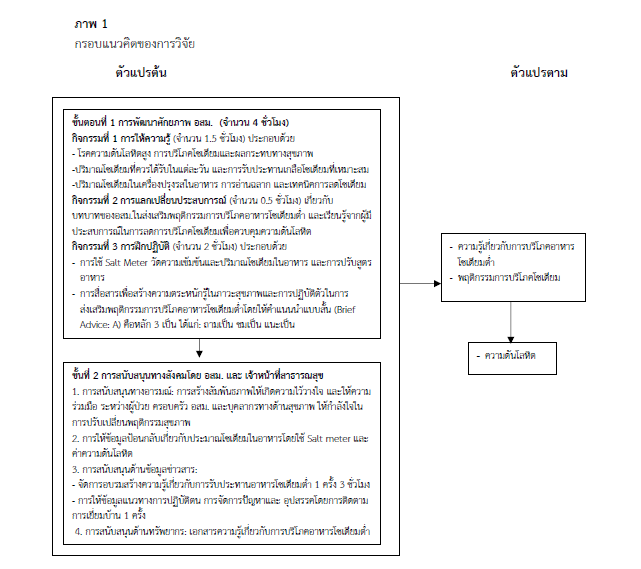
This one-group pre- and post-experimental study aimed to investigate the effects of a low-sodium dietary promotion program using social support on knowledge, sodium consumption behavior, and blood pressure levels in patients with uncontrolled hypertension. The sample consisted of 25 participants selected through purposive sampling. The research instruments were divided into 1) experimental instruments, including the low-sodium dietary promotion program using social support, and 2) data collection instruments, including a knowledge questionnaire about sodium consumption, a sodium consumption behavior questionnaire, and blood pressure level assessment. The content validity of the knowledge questionnaire was evaluated, and all items demonstrated IOC values greater than 0.50, and the CVI for the sodium consumption behavior questionnaire was 0.80. The reliability values were 0.87 and 0.70, respectively. Data were analyzed using descriptive statistics, the Wilcoxon signed-rank test, and the paired t-test.
The research findings indicate that after the intervention, the average knowledge scores of hypertensive patients significantly increased compared to before the program (p = 0.01). Most sodium consumption behaviors were at a moderate level (68%), and after participating in the program, it was found that hypertensive patients with uncontrolled blood pressure had significantly lower average blood pressure values than before the program (systolic blood pressure t = -4.43, p < 0.01; diastolic blood pressure t = -2.15, p = 0.04). In conclusion, the low-sodium food consumption promotion program using social support is effective in increasing knowledge about low-sodium consumption and controlling blood pressure levels in uncontrolled hypertensive patients.
References
เกษศิรินทร์ พุทธวงศ์, ศิวพร อึ้งวัฒนา, และวิลาวัลย์ เตือนราษฎร์. (2565). ผลของโปรแกรมการพัฒนาศักยภาพอาสาสมัครสาธารณสุขประจำหมู่บ้านต่อความรู้และพฤติกรรมการบริโภคโซเดียมในผู้ที่มีภาวะความดันโลหิตสูงที่ควบคุมไม่ได้. พยาบาลสาร มหาวิทยาลัยเชียงใหม่, 49(3), 256-257.
กรมควบคุมโรค. (2566, 11 พฤษภาคม). สคร.9 เตือนประชาชน เนื่องในวันความดันโลหิตสูงโลก “ควบคุมความดันโลหิต ยืดชีวิตให้ยืนยาว”. สำนักงานป้องกันควบคุมโรคที่ 9 จังหวัดนครราชสีมา. https://ddc.moph.go.th/odpc9/news.php?news=34026&deptcode=odpc9&news_views=7222
กรมควบคุมโรค, กองโรคไม่ติดต่อ. (2566). (ร่าง) แนวทางการดำเนินงานลดการบริโภคเกลือและ โซเดียมระดับจังหวัด. กรมควบคุมโรค. https://ddc.moph.go.th/uploads/publish/1394120230302070611.pdf
ชนิดา เตชะปัน. (2561). ผลของโปรแกรมการเสริมสร้างพลังอำนาจของอาสาสมัครสาธารณสุขประจำหมู่บ้าน (อสม.) ในการดำเนินงานด้านสุขศึกษาชุมชน ในเทศบาลตำบลบงป่าไผ่ อำเภอสันทรายจังหวัดเชียงใหม่. [วิทยานิพนธ์ปริญญามหาบัณฑิต ไม่ได้ตีพิมพ์]. มหาวิทยาลัยราชภัฏเชียงใหม่
ดวงดาว ปิงสุแสน. (2557). การพัฒนาพฤติกรรมการดูแลตนเองของผู้ป่วยความดันโลหิตสูงโดยการประยุกต์ใช้ทฤษฎีการกำกับตนเอง และแรงสนับสนุนทางสังคม. วารสารการพยาบาล การสาธารณสุขและการศึกษา, 15(3), 31-43.
ดลรัตน์ รุจิวัฒนากร. (2556). การบริโภคโซเดียมของผู้ที่เป็นความดันโลหิตสูง [วิทยานิพนธ์ปริญญามหาบัณฑิต ไม่ได้ตีพิมพ์]. มหาวิทยาลัยมหิดล.
วรารัตน์ ทิพย์รัตน์, ปรีดา สาราลักษณ์, จันทร์เพ็ญ เลิศวนวัฒนา, และสดศรี ประทุม. (2557). ผลของโปรแกรมการส่งเสริมสมรรถนะแห่งตนและการสนับสนุนทางสังคมต่อพฤติกรรมการบริโภคอาหารเกลือต่ำและระดับความดันโลหิตในผู้สูงอายุที่มีภาวะความดันโลหิตสูง, วารสารการพยาบาลโรคหัวใจและทรวงอก, 25(1), 70-84
สำนักงานสาธารณสุขจังหวัดสุรินทร์. (2567). ร้อยละของผู้ป่วยโรคความดันโลหิตสูงต่อจำนวนประชากร. ระบบบัญชีข้อมูล จังหวัดสุรินทร์. https://surin.gdcatalog.go.th/dataset/dataset_81_08/resource/90477bab-79ae-4d2e-9074-e50d72d4928b
เอกภพ จันทร์สุคนธ์, และปัทมา สุพรรณกุล. (2563). แรงสนับสนุนทางสังคมกับการควบคุมระดับน้ำตาล ในเลือดของผู้ป่วยเบาหวานชนิดที่ 2. วารสารวิชาการมหาวิทยาลัยอีสเทิร์นเอเชียฉบับวิทยาศาสตร์ และเทคโนโลยี,14(2), 1-7.
Centers for Disease Control and Prevention. (2024, December 13). High blood pressure risk factors. U.S. Centers for Disease Control and Prevention. https://www.cdc.gov/high-blood-pressure/risk-factors/index.html
Chailimpamontree, W., Kantachuvesiri, S., Aekplakorn, W., Lappichetpaiboon, R., Sripaiboonkij
Thokanit, N., Vathesatogkit, P., Kunjang, A., Boonyagarn, N., Sukhonthachit, P., Chuaykarn, N., Sonkhammee, P., Khunsaard, P., Nuntapanich, P., Charoenbut, P., Thongchai, C., Uttarachai, A., Kwankhoom, W., Rattanakanahutanon, F., Ruangchai, K., Yanti, N., … Garg, R. (2021). Estimated dietary sodium intake in Thailand: A nationwide population survey with 24-hour urine collections. Journal of Clinical Hypertension (Greenwich, Conn.), 23(4), 744–754. https://doi.org/10.1111/jch.14147
Ettehad, D., Emdin, C. A., Kiran, A., Anderson, S. G., Callender, T., Emberson, J., Chalmers, J., Rodgers, A., & Rahimi, K. (2016). Blood pressure lowering for prevention of cardiovascular disease and death: A systematic review and meta-analysis. The Lancet, 387(10022), 957–967. https://doi.org/10.1016/S0140-6736(15)01225-8
House, J. (1981). Work stress and social support. Addison-Wesley.
Shamsi, S. A., Salehzadeh, M., Ghavami, H., Asl, R. G., & Khadem Vatani, K. (2021). Impact of lifestyle interventions on reducing dietary sodium intake and blood pressure in patients with hypertension: A randomized controlled trial. Turk Kardiyol Dern Ars, 49(2), 143-150. https://doi.org/10.5543/tkda.2021.81669
World Health Organization. (2023, September 19). Global report on hypertension: trace against a silent killer. ReliefWeb. https://reliefweb.int/report/world/global-report-hypertension-race-against-silent-killer?gad_source=1&gclid=CjwKCAjwy8i0BhAkEiwAdFaeGCXudUEgQjdhrW7kW0WELPEXcjfSdatfvx88S8iL1J77IxbGx0fEjRoCS_QQAvD_BwE
World Health Organization. (2025). Effect of longer-term modest salt reduction on blood Pressure. World Health Organization. https://www.who.int/tools/elena/review-summaries/sodium-cvd-adults--effect-of-longer-term-modest-salt-reduction-on-blood-pressure?utm_source=chatgpt.com
Downloads
Published
How to Cite
Issue
Section
License
Copyright (c) 2025 Journal of Boromarajonani College of Nursing, Surin

This work is licensed under a Creative Commons Attribution-NonCommercial-NoDerivatives 4.0 International License.
เนื้อหาและข้อมูลในบทความที่ตีพิมพ์ในราชาวดีสาร วิทยาลัยพยาบาลบรมราชชนนี สุรินทร์ ถือเป็นข้อคิดเห็นและความรับผิดชอบของผู้เขียนบทความโดยตรง ซึ่งกองบรรณาธิการวารสารไม่จำเป็นต้องเห็นด้วย หรือร่วมรับผิดชอบใดๆ
บทความ ข้อมูล เนื้อหา รูปภาพ ฯลฯ ที่ได้รับการตีพิมพ์ในราชาวดีสาร วิทยาลัยพยาบาลบรมราชชนนี สุรินทร์ หากบุคคลหรือหน่วยงานใดต้องการนำทั้งหมดหรือส่วนหนึ่งส่วนใดไปเผยแพร่หรือกระทำการใดๆ จะต้องได้รับอนุญาตเป็นลายลักษณ์อักษรจากราชาวดีสาร วิทยาลัยพยาบาลบรมราชชนนี สุรินทร์ ก่อนเท่านั้น