
Effect of the Motivation Enhancing Program on Knee Osteoarthritis Prevention Behaviors Among Overweight Women in Communities
Keywords:
Prevention behaviors knee osteoarthritis, Motivation enhancing program, Overweight women in communitiesAbstract
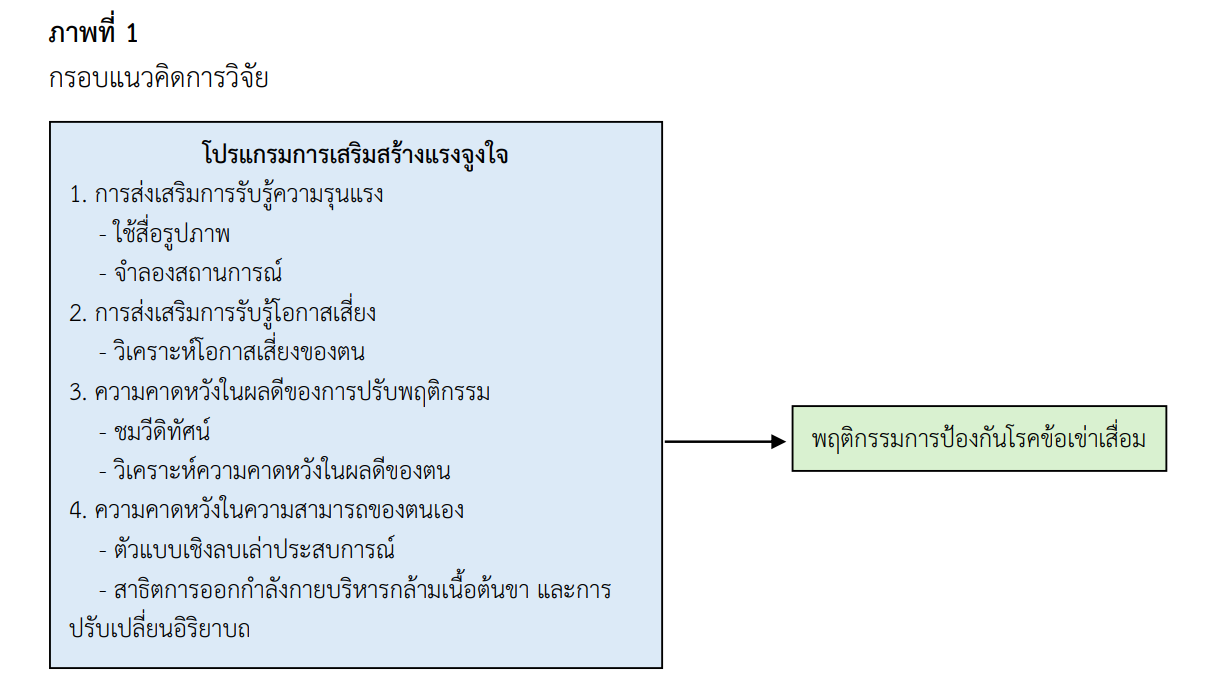
This quasi-experimental study aimed to examine the effects of the motivation enhancing program on knee osteoarthritis prevention behaviors among overweight women in communities. The sample consisted of 52 overweight adult women, divided into an experimental group and a control group, with 26 participants in each. The program was developed based on Rogers’ Protection Motivation Theory and included an activity plan, manual, negative prototype, visual media, video media, LINE application, personal data questionnaire, and knee osteoarthritis prevention behaviors questionnaire. All research instruments were validated by six experts, yielding a content validity index (CVI) of .94 and a reliability coefficient (Cronbach’s alpha) of .96. Data were analyzed using descriptive statistics, the Wilcoxon signed-rank test, and the Mann–Whitney U test.
The results of the study revealed that: 1) the experimental group had a higher score for knee osteoarthritis prevention be viors after receiving the program (median = 76.0, IQR = 2) than before receiving the program (median = 52.0, IQR = 8), with statis alsignificance (Z = -4.461, p< .001), and 2) the experimental group had a higher score for knee osteoarthritis prevention behaviors after receiving the program (median = 76.0, IQR = 2) than the control group which received routine nursing care (median = 49.00, IQR = 8), with statistical significance (Z = -6.208, p< .001). These findings indicate that the motivation enhancing program effectively promotes knee osteoarthritis prevention behaviors among overweight women. The program can be applied to develop health promotion strategies and preventive approaches for knee osteoarthritis in at-risk populations.
References
กรวิชญ์ ศรีประเสริฐ, ศิวพร อึ้งวัฒนา, และเดชา ทำดี. (2566). ผลของโปรแกรมการจัดการตนเองผ่านการพยาบาลทางไกลต่อพฤติกรรมสุขภาพ ของผู้ที่มีภาวะเบาหวานควบคุมไม่ได้ในชุมชน. พยาบาลสาร มหาวิทยาลัยเชียงใหม่, 50(3), 99-115.
กระทรวงสาธารณสุข, กรมการแพทย์. (2563). แนวทางการดูแลรักษาโรคข้อเข่าเสื่อม. กรมการแพทย์
ณัฐชยา ไชยชนะ, สุนีย์ ละกำปั่น, และทัศนีย์ รวิวรกุล. (2561). ผลของโปรแกรมสร้างแรงจูงใจร่วมกับการเสริมแรงจากเพื่อนต่อพฤติกรรมการป้องกันข้อเข่าเสื่อมในที่มีผู้หญิงที่มีน้ำหนักเกิน. วารสารสาธารณสุขศาสตร์, 48(3), 271-283.
พจนีย์ ผาสุขดี, และพุฒิพงศ์ สัตยวงศ์ทิพย์. (2566). ปัจจัยที่มีความสัมพันธ์กับพฤติกรรมการดูแลสุขภาพตนเองเพื่อป้องกันภาวะแทรกซ้อนในผู้ป่วยโรคเบาหวานชนิดที่ 2. วารสารสุขศึกษา, 46(1), 131-142.
พลอย ทรัพย์ไพบูลย์กิจ, ศิวพร อึ้งวัฒนา, และเดชา ทำดี. (2564). ผลของโปรแกรมการสร้างแรงจูงใจต่อพฤติกรรมบริโภคอาหารและระดับน้ำตาลในเลือดในผู้ที่มีภาวะเบาหวานที่ควบคุมไม่ได้. พยาบาลสาร, 48(4), 1-73.
รัตน์ศิริ ทาโต. (2565). การวิจัยทางการพยาบาล: แนวคิดสู่การประยุกต์ใช้ (พิมพ์ครั้งที่ 6). สำนักพิมพ์จุฬาลงกรณ์มหาวิทยาลัย.
วรายุส คตวงค์, และอรรถวิทย์ สิงห์ศาลาแสง. (2566). ผลของโปรแกรมการบริหารข้อเข่าด้วยท่าฤๅษีดัดตนเพื่อชะลอการเกิดโรคข้อเข่าเสื่อมชนิดปฐมภูมิของหญิงวัยกลางคนที่มีน้าหนักเกินมาตรฐาน. วารสารมหาวิทยาลัยนราธิวาสราชนครินทร์, 15(1), 141-156.
อุมาพร นกแพทย์, ศิวพร อึ้งวัฒนา, และนพมาศ ศรีเพชรวรรณดี. (2567). ผลของโปรแกรมการเสริมสร้างแรงจูงใจต่อพฤติกรรมการป้องกันภาวะแทรกซ้อนที่เท้าในผู้ที่มีภาวะเบาหวานที่ควบคุมน้ำตาไม่ได้ในชุมชน. วารสารการพยาบาลและการศึกษา, 17(4), 64-78.
Charoencholvanich, K., & Pongcharoen, B. (2005). Oxford knee score and SF-36: Translation & reliability for use with total knee arthroplasty patients in Thailand. Journal of the Medical Association of Thailand, 88(9), 1194–1202.
Cronbach, L. J. (1951). Coefficient alpha and the internal structure of tests. Psychometrika, 16, 297–334. https://doi.org/10.1007/BF02310555
Hunter, D. J., & Bierma-Zeinstra, S. (2019). Osteoarthritis. The Lancet, 393(10182), 1745–1759. https://doi.org/10.1016/S0140-6736(19)30417-9
Kolasinski, S. L., Neogi, T., Hochberg, M. C., Oatis, C., Guyatt, G., Block, J., Callahan, L., Copenhaver, C., Dodge, C., Felson, D., Gellar, K., Harvey, W. F., Hawker, G., Herzig, E., Kwoh, C. K., Nelson, A. E., Samuels, J., Scanzello, C., White, D., Wise, B., … Reston, J. (2020). 2019 American College of Rheumatology/Arthritis Foundation guideline for the management of osteoarthritis of the hand, hip, and knee. Arthritis Care & Research, 72(2), 149–162. https://doi.org/10.1002/acr.24131
Øiestad, B. E., Juhl, C. B., Eitzen, I., & Thorlund, J. B. (2015). Knee extensor muscle weakness is a risk factor for development of knee osteoarthritis. Osteoarthritis and Cartilage, 23(2), 171–177. https://doi.org/10.1016/j.joca.2014.10.008
Prentice-Dunn, S., & Ronald W. Rogers, R. W. (1986). Protection motivation theory and preventive health: Beyond the health belief model. Health Education Research, 1(3), 153-161. https://doi.org/10.1093/her/1.3.153
Zhang, Y., & Jordan, J. M. (2010). Epidemiology of osteoarthritis. Clinics in Geriatric Medicine, 26(3), 355–369. https://doi.org/10.1016/j.cger.2010.03.001
World Health Organization. (2022, 14 July). Musculoskeletal conditions. https://www.who.int/news-room/fact-sheets/detail/musculoskeletal-conditions
Downloads
Published
How to Cite
Issue
Section
License
Copyright (c) 2026 Journal of Boromarajonani College of Nursing, Surin

This work is licensed under a Creative Commons Attribution-NonCommercial-NoDerivatives 4.0 International License.
เนื้อหาและข้อมูลในบทความที่ตีพิมพ์ในราชาวดีสาร วิทยาลัยพยาบาลบรมราชชนนี สุรินทร์ ถือเป็นข้อคิดเห็นและความรับผิดชอบของผู้เขียนบทความโดยตรง ซึ่งกองบรรณาธิการวารสารไม่จำเป็นต้องเห็นด้วย หรือร่วมรับผิดชอบใดๆ
บทความ ข้อมูล เนื้อหา รูปภาพ ฯลฯ ที่ได้รับการตีพิมพ์ในราชาวดีสาร วิทยาลัยพยาบาลบรมราชชนนี สุรินทร์ หากบุคคลหรือหน่วยงานใดต้องการนำทั้งหมดหรือส่วนหนึ่งส่วนใดไปเผยแพร่หรือกระทำการใดๆ จะต้องได้รับอนุญาตเป็นลายลักษณ์อักษรจากราชาวดีสาร วิทยาลัยพยาบาลบรมราชชนนี สุรินทร์ ก่อนเท่านั้น