
Factors Associated with Self-Protective Behaviors Against Communicable Diseases among Municipal Solid Waste Collection Workers in Thanyaburi District, Pathum Thani Province
Keywords:
Municipal solid waste collection workers, Occupational communicable diseases, Communicable disease preventive behaviorsAbstract
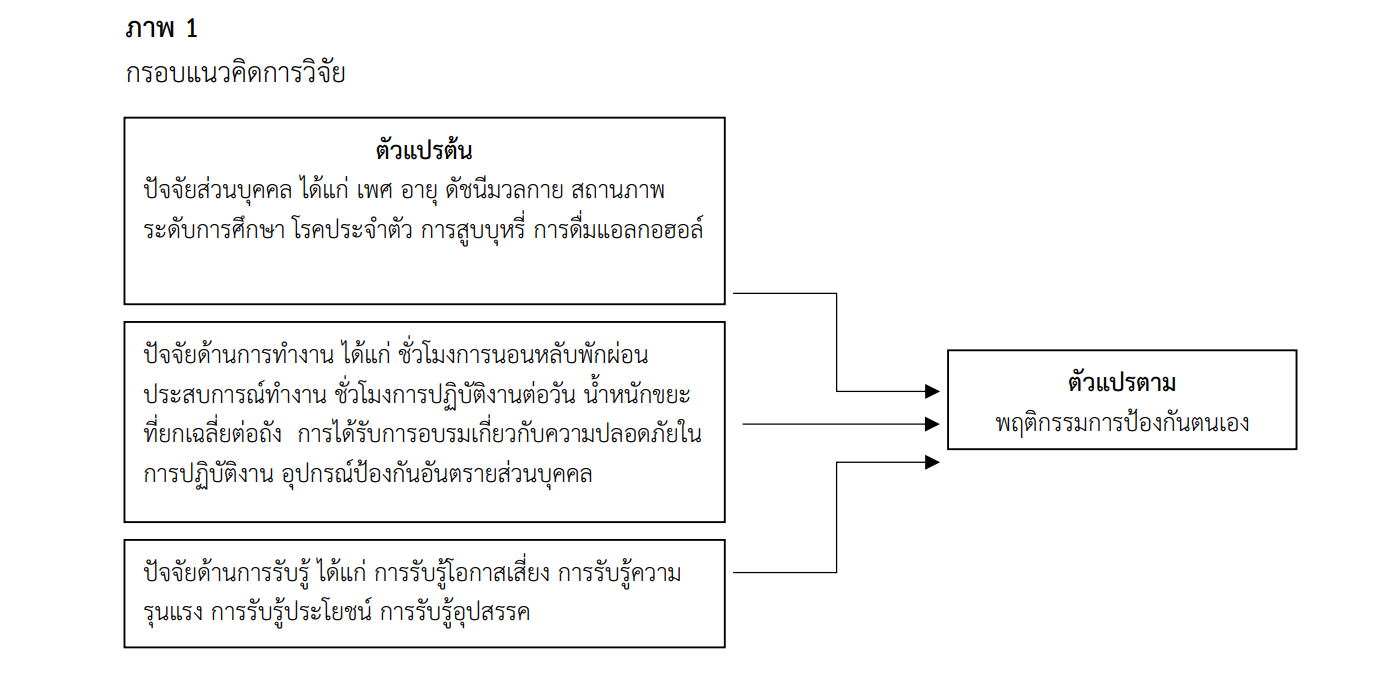
This cross-sectional descriptive study aimed to investigate factors associated with self-protective behaviors against occupational communicable diseases among municipal solid waste collection workers. The sample was specifically selected from those who meet the specified criteria, namely garbage collectors in Thanyaburi District, Pathum Thani Province, totaling 102 individuals. Research tools include a questionnaire on personal information, work-related data, factors related to individual perceptions of infectious diseases, and self-protective behaviors. The reliability was measured using the Cronbach alpha Coefficient, yielding values of 0.83 and 0.89. Data were analyzed using descriptive statistics and chi-square statistics.
The results indicated that the majority of waste collection workers were male (72.5%), with an average age of 43.02 years (±8.97) and an average work experience of 7.14 years (±5.52). Most participants reported a moderate level of perceived risk (52.9%), a moderate level of perceived severity (42.2%), a high level of perceived benefits (51.0%), and a low level of perceived barriers (39.2%). Furthermore, 53.9% of the waste collection workers demonstrated a high level of self-protection behavior. Statistical analysis indicated that work experience, safety training, and perceived benefits were significantly associated with self-protection behaviors against communicable diseases among municipal solid waste collection workers at a significance level of .05. The suggestion is that relevant agencies should provide regular training on communicable disease prevention to mitigate health impacts resulting from occupational activities.
References
กรมควบคุมมลพิษ. (2565). รายงานสถานการณ์สถานที่กำจัดขยะมูลฝอยของประเทศไทย ปี พ.ศ. 2564. https://www.pcd.go.th/publication/26832/
กรมอนามัย. (2562). โรคและอันตรายที่เกิดจากอาหารและน้ำที่ไม่สะอาดปลอดภัย (บุคลากรสาธารณสุข).
กองส่งเสริมความรอบรู้และสื่อสารสุขภาพ กรมอนามัย กระทรวงสาธารณสุข. https://multimedia.anamai.moph.go.th/associates/hp-ebook_03/
กรมอนามัย. (2568). BMI กับ ระยะทางความอ้วน. สื่อมัลติมีเดียกรมอนามัย. https://multimedia.anamai.moph.go.th/infographics/info1123_health_32/
ชลลดา พละราช, บุษยา จูงาม, และดวงเดือน วัฏฏานุรักษ์. (2565). ปัจจัยที่มีความสัมพันธ์ต่อปริมาณเชื้อราและแบคทีเรียในอากาศของห้องโดยสารรถเก็บขยะกับผลกระทบต่อสุขภาพ: กรณีศึกษาเทศบาลแห่งหนึ่ง จังหวัดปทุมธานี. วารสารวิจัยสาธารณสุขศาสตร์ มหาวิทยาลัยขอนแก่น, 15(4), 56-68.
ทิพย์สุดา เอียดเพ็ชร, เพ็ญผกา แซ่คู, และกีรติ นิยมรัตน์. (2566). ปัจจัยที่มีความสัมพันธ์ต่อพฤติกรรมการป้องกันตนเองในการป้องกันการติดเชื้อโควิด 19 (COVID-19) ของบุคลากรสำนักงานป้องกันควบคุมโรคที่ 12 จังหวัดสงขลา. วารสารสำนักงานป้องกันควบคุมโรคที่ 12 จังหวัดสงขลา, 1(1), 1-8.
ปิยะนันท์ เรือนคำ, สุคนธา คงศีล, สุขุม เจียมตน, ยุวนุช สัตยสมบูรณ์, และเพ็ญพักตร์ อุทิศ. (2565). ปัจจัยที่มีความสัมพันธ์กับพฤติกรรมการป้องกันโรคติดเชื้อไวรัสโคโรนา 2019 ของประชากรผู้ใหญ่: กรณีศึกษาเขตจอมทอง กรุงเทพมหานคร. วารสารวิชาการสาธารณสุข, 31(ฉบับเพิ่มเติม 2), S247-S259.
ลัดดาวรรณ์ ดอกแก้ว, ประมุข โอศิริ, เฉลิมชัย ชัยกิตติภรณ์, สมพร กันทรดุษฏี เตรียมชัยศรี, ดุสิต สุจิรารัตน์, และนพกร จงวิศาล. (2559). ความชุกและปัจจัยที่มีความสัมพันธ์กับอาการระบบทางเดินหายใจและสมรรถภาพปอดในกลุ่มพนักงานเก็บขนขยะของกรุงเทพมหานคร. วารสารอนามัยสิ่งแวดล้อม, 18(3), 18-29
วนิษา ผิวนางงาม, สุทิน ชนะบุญ, และลำพึง วอนอก. (2567). ปัจจัยที่มีความสัมพันธ์กับพฤติกรรมป้องกันการติดเชื้อวัณโรคปอดในบุคลากรสาธารณสุข โรงพยาบาลชุมแพ อำเภอชุมแพ จังหวัดขอนแก่น. วารสารวิชาการป้องกันควบคุมโรค สคร.2 พิษณุโลก, 11(1), 14-29.
วรรณา ธนานุภาพไพศาล, และรสสุคนธ์ พิไชยแพทย์. (2565). ปัจจัยบางประการที่มีความสัมพันธ์กับพฤติกรรมการป้องกันตนเองจากโรคโควิด-19 ของบุคลากรวิทยาลัยพยาบาลบรมราชชนนี นครราชสีมา. วารสารวิจัยและพัฒนาด้านสุขภาพ สำนักงานสาธารณสุขจังหวัดนครราชสีมา, 8(1), 135–152.
ศราวุฒิ แสงคำ, และจำลอง อรุณเลิศอารีย์. (2562). สิ่งคุกคามสุขภาพในพนักงานเก็บขนมูลฝอยและแนวทางการป้องกัน. ศรีนครินทร์เวชสาร, 34(6), 649-657.
สุภาภรณ์ วงธิ. (2564). ปัจจัยที่ส่งผลต่อพฤติกรรมการป้องกันโรคติดเชื้อไวรัสโคโรนา 2019 ของอาสาสมัครสาธารณสุขประจำหมู่บ้าน จังหวัดสุโขทัย [วิทยานิพนธ์ปริญญามหาบัณฑิต]. คลังปัญญา มหาวิทยาลัยนเรศวร. https://nuir.lib.nu.ac.th/dspace/handle/123456789/3227
สำนักงานสิ่งแวดล้อมและควบคุมมลพิษที่ 6. (2567). รายงานสถานการณ์คุณภาพสิ่งแวดล้อม พ.ศ. 2566 สำนักงานสิ่งแวดล้อมและควบคุมมลพิษที่ 6. https://epo06.pcd.go.th/th/information/list/1524
อริสรา สุขวัจนี. (2558). ปัจจัยที่มีความสัมพันธ์ต่อพฤติกรรมการป้องกันการติดเชื้อของพยาบาลที่ปฏิบัติงานที่ห้องอุบัติเหตุฉุกเฉิน. วารสารพฤติกรรมศาสตร์เพื่อการพัฒนา, 7(2), 253-266.
Alruqi, W. M., Hoque, M. N., Ahmed, S., & Abudayyeh, O. (2026). The impact of safety training on safety behavior among multinational construction workers: The mediating role of responsibility and the moderating role of nationality. Buildings, 16(1), 94. https://doi.org/10.3390/buildings16010094
Bloom, B. S. (1971). Handbook on formative and summative evaluation of student learning. McGraw-Hill.
Dadras, O., Alinaghi, S. A. S., Karimi, A., MohsseniPour, M., Barzegary, A., Vahedi, F., Pashaei, Z., Mirzapour, P., Fakhfouri, A., Zargari, G., Saeidi, S., Mojdeganlou, H., Badri, H., Qaderi, K., Behnezhad, F., & Mehraeen, E. (2021). Effects of COVID-19 prevention procedures on other common infections: a systematic review. European Journal of Medical Research, 26(1), 67. https://doi.org/10.1186/s40001-021-00539-1
Kawakami, T., & Khai, T. T. (2010). WARM: Work adjustment for recycling and managing waste: Action manual for waste collectors and communities to promote their joint actions in improving safety, health and efficiency in waste collection and management. International Labour Organization.
Krejcie, R. V., & Morgan, D. W. (1970). Determining sample size for research activities. Educational and Psychological Measurement, 30(3), 607–610. https://doi.org/10.1177/001316447003000308
Munni, M. N., Karim, M. R., Haque, M., Khan, S., Khan, M. A. S., & Hossain, I. (2024). Awareness, safety practices and associated factors among e-waste recycling workers in Bangladesh. Environmental Health Insights, 18, 11786302241271555. https://doi.org/10.1177/11786302241271555
Oza, H. H., Lee, M. G., Boisson, S., Pega, F., Medlicott, K., & Clasen, T. (2022). Occupational health outcomes among sanitation workers: A systematic review and meta-analysis. International Journal of Hygiene and Environmental Health, 240, 113907. https://doi.org/10.1016/j.ijheh.2021.113907
Salvaraji, L., Jeffree, M. S., Avoi, R., Atil, A., Mohd Akhir, H., Shamsudin, S. B. B., & Awang Lukman, K. (2020). Exposure risk assessment of the municipal waste collection activities during COVID-19 pandemic. Journal of Public Health Research, 9(4), 1994. https://doi.org/10.4081/jphr.2020.1994
Sangkham, S., Thongtip, S., & Sakunkoo, P. (2021). Occupational health hazard exposure and health problems among solid waste collectors in Phayao Province, Northern Thailand. Journal of Public Health and Development, 19(2), 227–239.
Tsovili, E., Rachiotis, G., Symvoulakis, E. K., Thanasias, E., Giannisopoulou, O., Papagiannis, D., Eleftheriou, A., & Hadjichristodoulou, C. (2014). Municipal waste collectors and hepatitis B and C virus infection: a cross-sectional study. Le Infezioni in Medicina, 22(4), 271–276.
Downloads
Published
How to Cite
Issue
Section
License
Copyright (c) 2026 Journal of Boromarajonani College of Nursing, Surin

This work is licensed under a Creative Commons Attribution-NonCommercial-NoDerivatives 4.0 International License.
เนื้อหาและข้อมูลในบทความที่ตีพิมพ์ในราชาวดีสาร วิทยาลัยพยาบาลบรมราชชนนี สุรินทร์ ถือเป็นข้อคิดเห็นและความรับผิดชอบของผู้เขียนบทความโดยตรง ซึ่งกองบรรณาธิการวารสารไม่จำเป็นต้องเห็นด้วย หรือร่วมรับผิดชอบใดๆ
บทความ ข้อมูล เนื้อหา รูปภาพ ฯลฯ ที่ได้รับการตีพิมพ์ในราชาวดีสาร วิทยาลัยพยาบาลบรมราชชนนี สุรินทร์ หากบุคคลหรือหน่วยงานใดต้องการนำทั้งหมดหรือส่วนหนึ่งส่วนใดไปเผยแพร่หรือกระทำการใดๆ จะต้องได้รับอนุญาตเป็นลายลักษณ์อักษรจากราชาวดีสาร วิทยาลัยพยาบาลบรมราชชนนี สุรินทร์ ก่อนเท่านั้น