
Mental Health Status and Factors Associated with Mental Health among Poor Household Members in the Thung Kula Rong Hai Area, Roi Et Province
Keywords:
Mental health status, Factors, Low-income householdsAbstract
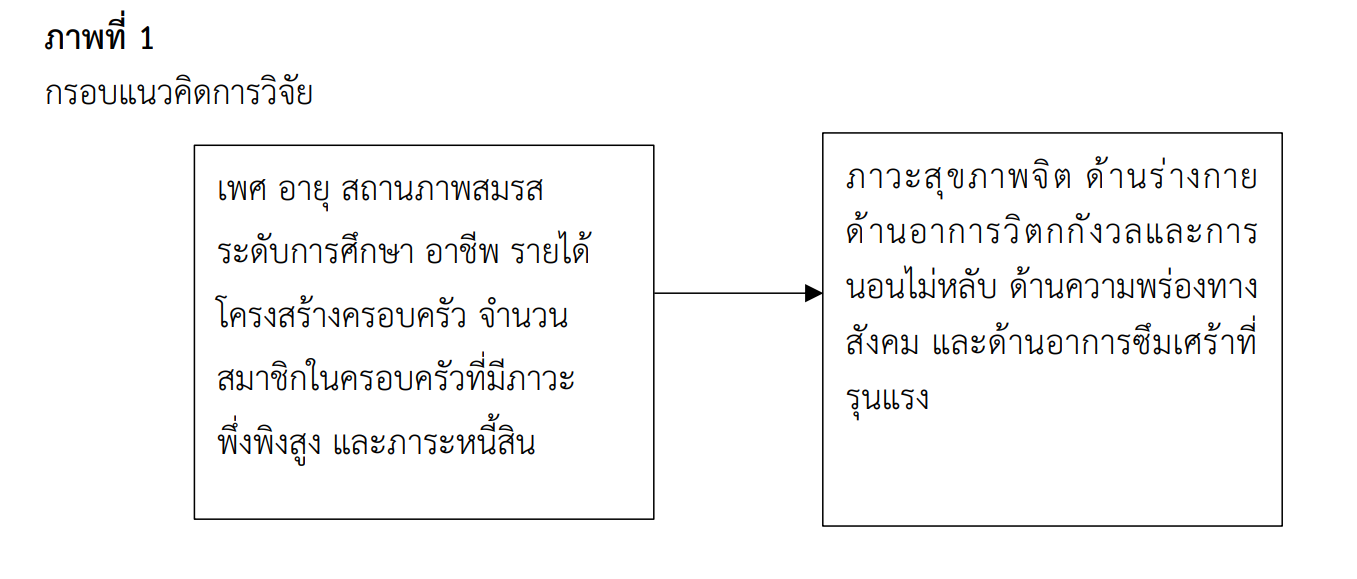
This cross-sectional descriptive research aims to study the mental health status and factors associated with the mental health of poor household members in the Thung Kula Rong Hai area of Roi Et Province. The sample group consisted of 335 poor household members in this area, selected through systematic sampling. The study was conducted from February to March 2024. The research instruments included: 1) a personal information questionnaire and 2) the Thai GHQ-28 mental health questionnaire, which has a reliability coefficient of 0.90. Data were analyzed using frequency, percentage, mean, and chi-square analysis.
The research findings indicated that 53.43% of the sample group of poor household members had no mental health issues, while 46.57% experienced mental health problems. It was found that age and marital status were associated with mental health in terms of anxiety and insomnia. Family income was correlated with mental health regarding anxiety, insomnia, social deprivation, and severe depressive symptoms. Additionally, families with high dependency individuals were associated with mental health concerning anxiety, insomnia, and severe depressive symptoms. The factor of debt burden was significantly related to mental health in terms of anxiety, insomnia, and social deprivation at a statistical significance level of 0.05. Further research is recommended to develop and evaluate mental health support programs and management for individuals experiencing changes in mental health within poor households.
References
กรมสุขภาพจิต. (2565). รายงานประจำปีกรมสุขภาพจิต พ.ศ. 2565. กระทรวงสาธารณสุข.
กรมสุขภาพจิต. (2568). อัตราป่วยรายใหม่และความชุกโรคซึมเศร้าในคนไทยอายุ 15 ปีขึ้นไป ปี พ.ศ. 2565–2567. คลังความรู้สุขภาพจิต กรมสุขภาพจิต.
ธนานิล ชัยโกวิทย์, จักรกฤษณ์ สุขยิ่ง, และชัชวาล ศิลปะกิจ. (2539). ความเชื่อถือได้และความแม่นตรงของ General Health Questionnaire ฉบับภาษาไทย. วารสารสมาคมจิตแพทย์แห่งประเทศไทย, 41(1), 2–17.
ระบบข้อมูลครัวเรือนยากจนระดับจังหวัด. (2566). ระบบข้อมูลครัวเรือนยากจนระดับจังหวัดร้อยเอ็ด. http://www.ppaos.com/ppaos/frontend/web/index.php
Barrantes, N., Cubillos, P., & Vargas, G. (2022). Does multidimensional poverty affect depression? Evidence from a nationwide survey in Chile. Progress in Development Studies, 22(2), 123–139. https://doi.org/10.1177/14649934211059402
Erikson, E. H. (1963). Childhood and society (2nd ed.). W. W. Norton.
Friedli, L., & World Health Organization Regional Office for Europe. (2009). Mental health, resilience and inequalities. WHO Regional Office for Europe. https://iris.who.int/handle/10665/107925
Hassan, M. F., Hassan, N. M., Kassim, E. S., & Said, Y. M. U. (2021). Financial wellbeing and mental health: A systematic review. Estudios de Economía Aplicada, 39(4). https://doi.org/10.25115/eea.v39i4.4590
Lemon, C. (2023). Commentary: Poverty and mental health. International Journal of Social Psychiatry, 69(4), 1055-1056. https://doi.org/10.1177/00207640231160214
Marchi, M., Pain, O., Alkema, A., Xia, C., Thio, C. H. L., Chen, L., Schalkwijk, W., Galeazzi, G. M., Ferrari, D., Pingani, L., Kweon, H., Evan-Lacko, S., Hill, W. D., & Boks, M. P. (2024). Investigating the impact of poverty on mental illness in the UK biobank using mendelian randomization. Nature Human Behaviour, 8, 1771-1783. https://doi.org/10.1038/s41562-024-01919-3
Pengpid, S., & Peltzer, K. (2023). Prevalence and associated factors of incident and persistent loneliness among middle-aged and older adults in Thailand. BMC Psychology, 11, 70. https://doi.org/10.1186/s40359-023-01115-4
World Health Organization. (2022, June 22). World mental health report: Transforming mental health for all. https://www.who.int/publications/i/item/9789240049338
World Health Organization. (2025, July 14). Mental health and social connection in Thailand. https://www.who.int/thailand/news/feature-stories/detail/mental-health-and-social-connection-in-thailand
Wrede, N., Töpfer, N. F., Wilz, G., & Pfeiffer, K. (2025). Caregiver burden and depressive symptoms in family caregivers of older adults: A network analysis. Journal of Affective Disorders, 387, 119547. https://doi.org/10.1016/j.jad.2025.119547
Yamane, T. (1973). Statistics: An introductory analysis (3rd ed.). Harper & Row.
Downloads
Published
How to Cite
Issue
Section
License
Copyright (c) 2026 Journal of Boromarajonani College of Nursing, Surin

This work is licensed under a Creative Commons Attribution-NonCommercial-NoDerivatives 4.0 International License.
เนื้อหาและข้อมูลในบทความที่ตีพิมพ์ในราชาวดีสาร วิทยาลัยพยาบาลบรมราชชนนี สุรินทร์ ถือเป็นข้อคิดเห็นและความรับผิดชอบของผู้เขียนบทความโดยตรง ซึ่งกองบรรณาธิการวารสารไม่จำเป็นต้องเห็นด้วย หรือร่วมรับผิดชอบใดๆ
บทความ ข้อมูล เนื้อหา รูปภาพ ฯลฯ ที่ได้รับการตีพิมพ์ในราชาวดีสาร วิทยาลัยพยาบาลบรมราชชนนี สุรินทร์ หากบุคคลหรือหน่วยงานใดต้องการนำทั้งหมดหรือส่วนหนึ่งส่วนใดไปเผยแพร่หรือกระทำการใดๆ จะต้องได้รับอนุญาตเป็นลายลักษณ์อักษรจากราชาวดีสาร วิทยาลัยพยาบาลบรมราชชนนี สุรินทร์ ก่อนเท่านั้น