
การพัฒนารูปแบบเครือข่ายการดูแลผู้ป่วยโรคจิตเภทในชุมชน
คำสำคัญ:
รูปแบบเครือข่ายการดูแล , ผู้ป่วยโรคจิตเภท , ชุมชนบทคัดย่อ
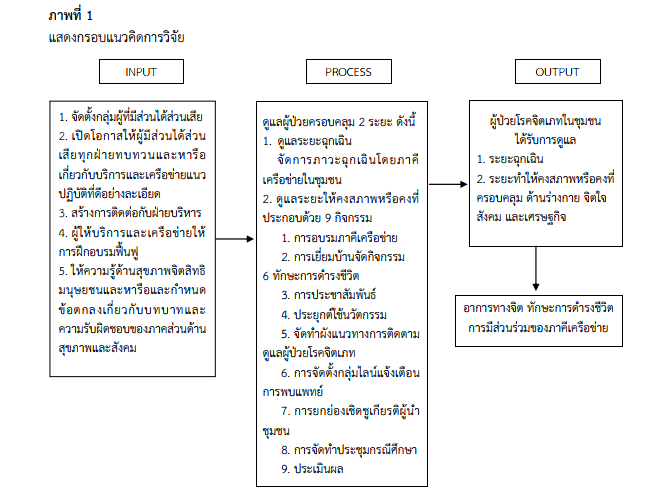
การวิจัยและพัฒนานี้มีวัตถุประสงค์เพื่อ 1) พัฒนารูปแบบเครือข่ายการดูแลผู้ป่วยโรคจิตเภทในชุมชน 2) ศึกษาผลลัพธ์ของรูปแบบเครือข่ายการดูแลผู้ป่วยโรคจิตเภทในชุมชนต่ออาการทางจิต ทักษะการดำรงชีวิตของผู้ป่วยโรคจิตเภท และความร่วมมือของภาคีเครือข่ายในชุมชน การดำเนินการวิจัย แบ่งเป็น 2 ระยะ คือ ระยะที่ 1 พัฒนารูปแบบเครือข่ายการดูแลฯ โดยการสนทนากลุ่ม กลุ่มตัวอย่างคัดเลือกแบบเฉพาะเจาะจง ได้แก่ ผู้ดูแลผู้ป่วยโรคจิตเภท 16 คน และภาคีเครือข่ายในชุมชน 17 คน ระยะที่ 2 ศึกษาผลลัพธ์ของการใช้รูปแบบฯ การวิจัยกึ่งทดลอง แบบกลุ่มเดียววัดก่อนและหลังการทดลอง กลุ่มตัวอย่าง ได้แก่ ผู้ป่วยและครอบครัว 10 คน และภาคีเครือข่ายในชุมชน 45 คน เครื่องมือวิจัย ได้แก่ แบบสัมภาษณ์กึ่งโครงสร้าง แบบประเมินอาการทางจิต ทักษะการดำรงชีวิต และแบบสอบถามการมีส่วนร่วม หาค่าความตรงเชิงเนื้อหา ได้ค่า .90-1.00 ค่าความเชื่อมั่นสัมประสิทธิ์แอลฟาของครอนบาค ได้ค่า .94–.99 วิเคราะห์ข้อมูลใช้สถิติเชิงพรรณนา วิเคราะห์เนื้อหา และสถิติทดสอบ paired t-test
ผลการวิจัยพบว่า 1) รูปแบบเครือข่ายการดูแลผู้ป่วยโรคจิตเภทในชุมชน มี 2 ระยะ (1) ระยะฉุกเฉิน (2) ระยะทำให้คงสภาพหรือคงที่ ภาคีเครือข่าย ได้แก่ ครอบครัว ผู้ใหญ่บ้านหรือผู้ช่วย ตำรวจ พระสงฆ์ บุคลากรสาธารณสุข ปลัดอำเภอ องค์การบริหารส่วนตำบล และหน่วยบริการการแพทย์ฉุกเฉิน ระยะฉุกเฉิน ทำหน้าที่ประเมินปัญหาและส่งต่อรักษา ระยะทำให้คงสภาพหรือคงที่ ทำหน้าที่ตามรูปแบบกิจกรรมที่พัฒนาขึ้น 2) ภายหลังใช้รูปแบบเครือข่ายการดูแลฯ พบว่า ผู้ป่วยโรคจิตเภทมีอาการทางจิตลดลงน้อยกว่าก่อนการใช้รูปแบบ ทักษะการดำรงชีวิตและภาคีเครือข่ายมีส่วนร่วมดีกว่าก่อนการใช้รูปแบบอย่างมีนัยสำคัญทางสถิติที่ระดับ .05 (t=3.32, p=0.009, t=-2.84, p=0.01, t=-27.69, p=0.00) ดังนั้นรูปแบบเครือข่ายการดูแลผู้ป่วยโรคจิตเภทในชุมชนสามารถนำไปขยายผลในพื้นที่อื่นได้
เอกสารอ้างอิง
กนกศรี จาดเงิน, และศิพัฒน์กร เชื่อภักดี. (2563). การพัฒนากระบวนการดูแลผู้ป่วยจิตเวชในชุมชน โดยการมีส่วนร่วมของภาคีเครือข่ายสุขภาพชุมชน ตำบลบางปะกง. วารสารอนามัยสิ่งแวดล้อม และสุขภาพชุมชน, 5(2), 78-85.
กำทร ดานา. (2564). การพัฒนาบทบาทการดูแลผู้ป่วยจิตเวชของครอบครัวและภาคีเครือข่ายในชุมชน. วารสารวิชาการสาธารณสุข, 30(3), 406-414.
ชิดชนก โอภาสวัฒนา (บ.ก.). (2563). คู่มือระบบการดูแลผู้ป่วยจิตเวชที่มีความเสี่ยงสูงต่อการก่อความรุนแรงสำหรับสถาบัน/โรงพยาบาล สังกัดกรมสุขภาพจิต. กรมสุขภาพจิต กระทรวงสาธารณสุข. https://dmh-elibrary.org/items/show/1303
ณัฐ ไกรภัสสร์พงษ์, และธัญลักษณ์ แก้วเมือง (บ.ก.). (2564). เอกสารเวชระเบียนผู้ป่วยจิตเวช สำรับสถาบัน/โรงพยาบาลจิตเวช สังกัดกรมสุขภาพจิต (ฉบับปรับปรุงครั้งที่ 1). กรมสุขภาพจิต กระทรวงสาธารณสุข.
ธัญญลักษณ์ ไชยสุข มอลเลอร์, กานดา ศรีโพธิ์ชัย, และณัฐพร ยี่วาศรี. (2566). การพัฒนารูปแบบการดูแลผู้ป่วยจิตเภทเชิงรุกบูรณาการร่วมกับการให้บริการรูปแบบคลินิกหมอครอบครัวและภาคีเครือข่ายในชุมชน. วารสารอนามัยสิ่งแวดล้อมและสุขภาพชุมชน, 8(2), 521-531.
มยุรี ลัคนาศิโรรัตน์, จารุมน ลัคนาวิวัฒน์, สุวนิตย์ วงศ์ยงค์ศิลป์, และปิยวิทย์ เนกขพัฒน์. (2566). การพัฒนารูปแบบการดูแลต่อเนื่องในผู้ป่วยจิตเภทโดยผู้ดูแลและภาคีเครือข่ายในชุมชน ตามกรอบแนวคิดการวิจัยและพัฒนาเทคโนโลยีสุขภาพจิต แบบบูรณาการอย่างยั่งยืน. วารสารอนามัยสิ่งแวดล้อมและสุขภาพชุมชน, 8(1), 130-142.
รัศมี ชุดพิมาย. (2565). การพัฒนารูปแบบการดูแลผู้ป่วยจิตเวชเรื้อรังกลุ่มเสี่ยงในชุมชนด้วยกระบวนการมีส่วนร่วมของภาคีเครือข่าย อำเภอลำปลายมาศ จังหวัดบุรีรัมย์. วารสารศูนย์อนามัยที่ 9, 16(3), 851-867.
โรงพยาบาลโขงเจียม. (2567). แผนยุทธศาสตร์โรงพยาบาลโขงเจียม จังหวัดอุบลราชธานี.
ศรินรัตน์ จันทพิมพ์, และขนิษฐา นันทบุตร. (2561). การดูแลผู้ป่วยจิตเภทโดยชุมชน. วารสารการพยาบาล และการดูแลสุขภาพ, 36(2), 68–76.
ศูนย์สุขภาพจิตที่ 10. (2565). รายงานสถานะสุขภาพเขตสุขภาพที่ 10 กรมสุขภาพจิต.
สำนักงานสาธารณสุขจังหวัดอุบลราชธานี. (2567). รายงานสถานการณ์โรคจิตเภท จังหวัดอุบลราชธานี.
หทัยกาญจน์ เสียงเพราะ. (2564). การพัฒนารูปแบบการดูแลผู้ป่วยจิตเวชที่กลับมารักษาซ้ำโดยการมีส่วนร่วมของชุมชน. วารสารการแพทย์โรงพยาบาลศรีสะเกษ สุรินทร์ บุรีรัมย์, 36(2), 413-426.
Gowda, G. S., & Isaac, M. K. (2022). Models of care of schizophrenia in the community-an international perspective. Current Psychiatry Reports, 24(3), 195–202. https://doi.org/10.1007/s11920-022-01329-0
World Health Organization. (2021, June 9). Comprehensive mental health service networks: promoting person-centred and rights-based approaches. https://www.who.int/publications/i/item/9789240025844
World Health Organization. (2025, September 2). Mental health atlas 2024. https://www.who.int/publications/i/item/9789240114487
ดาวน์โหลด
เผยแพร่แล้ว
รูปแบบการอ้างอิง
ฉบับ
ประเภทบทความ
สัญญาอนุญาต
ลิขสิทธิ์ (c) 2025 ราชาวดีสาร วิทยาลัยพยาบาลบรมราชชนนี สุรินทร์

อนุญาตภายใต้เงื่อนไข Creative Commons Attribution-NonCommercial-NoDerivatives 4.0 International License.
เนื้อหาและข้อมูลในบทความที่ตีพิมพ์ในราชาวดีสาร วิทยาลัยพยาบาลบรมราชชนนี สุรินทร์ ถือเป็นข้อคิดเห็นและความรับผิดชอบของผู้เขียนบทความโดยตรง ซึ่งกองบรรณาธิการวารสารไม่จำเป็นต้องเห็นด้วย หรือร่วมรับผิดชอบใดๆ
บทความ ข้อมูล เนื้อหา รูปภาพ ฯลฯ ที่ได้รับการตีพิมพ์ในราชาวดีสาร วิทยาลัยพยาบาลบรมราชชนนี สุรินทร์ หากบุคคลหรือหน่วยงานใดต้องการนำทั้งหมดหรือส่วนหนึ่งส่วนใดไปเผยแพร่หรือกระทำการใดๆ จะต้องได้รับอนุญาตเป็นลายลักษณ์อักษรจากราชาวดีสาร วิทยาลัยพยาบาลบรมราชชนนี สุรินทร์ ก่อนเท่านั้น