
Effects of Enhanced Comfort Program on Pain and Abdominal Distention for Postpartum Mothers with Cesarean Section
Keywords:
Comfort, Pain, Abdominal distention, Enhanced comfort programAbstract
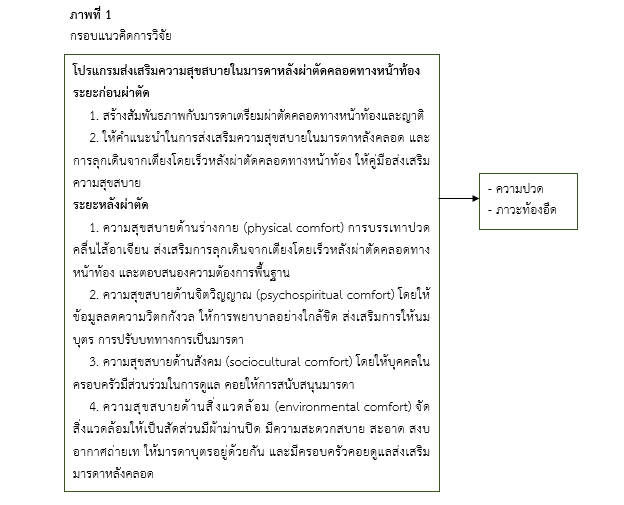
This study is quasi-experimental with a posttest control group design. The research aimed at investigating the effects of a comfort program on pain and abdominal distention in postpartum mothers who underwent cesarean section. The sample was purposive selected from individuals meeting the specified criteria, comprising 118 mothers who had cesarean sections. They were divided into a control group of 59 and an experimental group of 59. The research intervention was the postpartum cesarean section comfort program divided into 2 parts: 1) before cesarean, build relationships and provide advice to promote well-being, and 2) after cesarean, plan to promote physical, spiritual, social, and environmental comfort, as well as a manual to promote comfort after cesarean section. Data collection tools included 1) a personal information questionnaire, 2) a pain record form, and 3) an abdominal distention assessment form. Content validity was assessed and yielded values of 0.84, 0.80, and 0.92. The reliability of the data collection tool was examined by calculating Cronbach's alpha for the abdominal distention assessment form, which yielded a value of 0.87. Test-retest reliability of the pain score record form was 0.80. General data were analyzed using descriptive statistics, and pain between the experimental and control groups was compared using independent
t-tests.
The study results showed that the experimental group had significantly lower average pain scores and average abdominal distention scores at 24 and 48 hours compared to the control group (p < .001). Recommendations, nurses in the postpartum ward should implement the program in the care of mothers after cesarean section to help reduce postoperative complications and serve as a guideline for improving the efficiency of nursing care.
References
กระทรวงสาธารณสุข, กองบริหารการสาธารณสุข. (2566). อัตราผ่าตัดคลอดทางหน้าท้องประเทศไทย. https://cmi.moph.go.th/isp/sp_obs/index?menu_id=6
จัณทร์ปภัสร์ เครือแก้ว. (2557). ผลของโปรแกรมพลังบำบัดทางการพยาบาลต่อความสุขสบายในมารดาหลังผ่าตัดคลอดทารกทางหน้าท้อง [วิทยานิพนธ์ปริญญามหาบัณฑิต]. คลังปัญญามหาวิทยาลัยสงขลานครินทร์. http://kb.psu.ac.th/psukb/handle/2010/9872
ณัชชารินทร์ วรโชติทวีวัฒน์, พัชรี จำเนียร, ศุภานัน ทองทวีโภคิน, และนลินี เกิดประสงค์. (2566). ผลของโปรแกรมการกระตุ้นลุกจากเตียงโดยเร็วภายหลังผ่าตัดในผู้ป่วยหลังผ่าตัดช่องท้องของแผนกศัลยกรรมโรงพยาบาลพิจิตร. วารสารแพทย์เขต 4-5, 42(4), 583-592.
เพ็ญศรี เรืองศรี. (2564). การพัฒนาแนวปฏิบัติการลดความปวดในสตรีผ่าตัดคลอด โรงพยาบาลเกาะสมุย. วารสารมหาจุฬานาครทรรศน์, 8(9), 144-160.
มาวศรี มานุช, และสุนันทา ศรีมาคำ. (2562). ความสุขสบายท่ามกลางความปวดในระยะคลอด: แนวคิดสู่การปฏิบัติ. วารสารพยาบาลกระทรวงสาธารณสุข, 29(2), 1-11.
ยุทธนา จันวะโร. (2565). การศึกษาประสิทธิภาพของการเคี้ยวหมากฝรั่งต่อการกระตุ้นการทำงานของลำไส้หลังการผ่าตัดคลอดบุตรทางหน้าท้อง โรงพยาบาลพุทธโสธร. ศรีนครินทร์เวชสาร, 37(6), 596-601.
สิริอร ข้อยุ่น, วริศรา ภู่ทวี, และอาภา ศรีสร้อย. (2562). ผลของการใช้โปรแกรมการฟื้นตัวหลังผ่าตัดร่วมกับเครื่องพยุงเดินหลังผ่าตัด เพื่อป้องกันภาวะแทรกซ้อนหลังผ่าตัดในผู้ป่วยหลังผ่าตัดช่องท้อง. ศรีนครินทร์เวชสาร, 34(4), 386-392.
ศุภรดา มั่นยืน, วรวุฒิ แสงทอง, และอรอนงค์ เพชรงาม. (2563). ผลของการนวดกดจุดสะท้อนฝ่าเท้าต่อคะแนนความปวด และความพึงพอใจของผู้ป่วยหลังผ่าตัดไส้ติ่ง. วารสารเครือข่ายวิทยาลัยพยาบาลและการสาธารณสุขภาคใต้, 7(3), 86-98.
สุพรรษา จิตสม, บานเย็น แสนเรียน, และพรผกาย์ ต้นทอง. (2565). การจัดการความปวดหลังผ่าตัดคลอดบุตร. วารสารศูนย์อนามัยที่ 9, 16(3), 868-881.
หนูเพียร ชาทองยศ. (2550). ผลของการเคี้ยวหมากฝรั่งเพื่อลดอาการท้องอืดในผู้ป่วยผ่าตัดนิ่วในไต โรงพยาบาลขอนแก่น. [วิทยานิพนธ์ปริญญามหาบัณฑิต]. มหาวิทยาลัยขอนแก่น.
Akgün, Ö., & Aksoy, Ö. D. (2020).Determination of mothers’ postpartum comfort levels and affecting factors. Journal of Contemporary Medicine, 10(3), 385-393.
Aksoy Derya, Y., & Pasinlioğlu, T. (2017). The effect of nursing care based on comfort theory on women's postpartum comfort levels after caesarean sections. International Journal of Nursing Knowledge, 28(3), 138-144. https://doi.org/10.1111/2047-3095.12100
Kolcaba, K. (2010). An introduction to comfort theory. http://www.thecomfortline.com
Kolcaba K. (2015). Katherine Kolcaba’s comfort theory. In Smith M. C., Parker M. E. (Eds.), Nursing theories and nursing practice (pp. 381-391). F.A. Davis.
El-Sayed, H. E. M., Elmashad, H. A. M., & Kandeel, H. A. M. (2020). Effect of early progressive bed exercise and movement on recovery after caesarean section. IOSR Journal of Nursing and Health Science, 9(1), 47–56. DOI: 10.9790/1959-0901114756
McCaffery, M., & Beebe, A. (1993) Pain: Clinical manual for nursing practice. V.V. Mosby Company, Baltimore.
Melzack, R., & Wall, P. D. (1965). Pain mechanisms: A new theory. Science (New York, N.Y.), 150(3699), 971–979. https://doi.org/10.1126/science.150.3699.971
Polit, D. F., & Beck, C. T. (2022). Essential of nursing research: Appraising evidence for nursing practice (10th ed.). Wolters Kluwer.
World Health Organization. (2021, 16 June). Caesarean section rates rising globally, though unequally, with increases projected to continue. https://www.who.int/news/item/16-06-2021-caesarean-section-rates-continue-to-rise-amid-growing-inequalities-in-access
Downloads
Published
How to Cite
Issue
Section
License
Copyright (c) 2025 Journal of Boromarajonani College of Nursing, Surin

This work is licensed under a Creative Commons Attribution-NonCommercial-NoDerivatives 4.0 International License.
เนื้อหาและข้อมูลในบทความที่ตีพิมพ์ในราชาวดีสาร วิทยาลัยพยาบาลบรมราชชนนี สุรินทร์ ถือเป็นข้อคิดเห็นและความรับผิดชอบของผู้เขียนบทความโดยตรง ซึ่งกองบรรณาธิการวารสารไม่จำเป็นต้องเห็นด้วย หรือร่วมรับผิดชอบใดๆ
บทความ ข้อมูล เนื้อหา รูปภาพ ฯลฯ ที่ได้รับการตีพิมพ์ในราชาวดีสาร วิทยาลัยพยาบาลบรมราชชนนี สุรินทร์ หากบุคคลหรือหน่วยงานใดต้องการนำทั้งหมดหรือส่วนหนึ่งส่วนใดไปเผยแพร่หรือกระทำการใดๆ จะต้องได้รับอนุญาตเป็นลายลักษณ์อักษรจากราชาวดีสาร วิทยาลัยพยาบาลบรมราชชนนี สุรินทร์ ก่อนเท่านั้น