The Effects of Learning Module for Smoking Cessation and Development of Self-Efficacy to Smoking Behavior and Smoke-Free Family of Nursing Students
Keywords:
Smoke-free family, Smoking behavior, self-efficacy theory, Smoking cessationAbstract
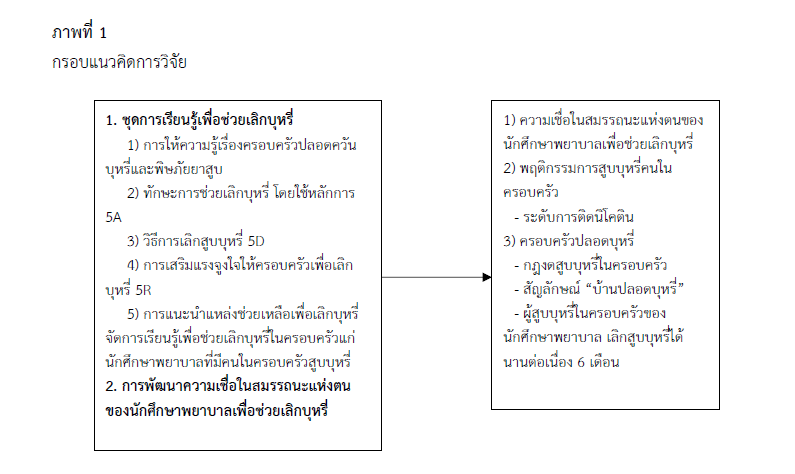
A one-group pre- and post-experimental study aimed to investigate the effects of a smoking cessation learning package and self-efficacy development on smoking behavior and smoke-free families among nursing students. The sample was selected by simple random sampling using a lottery, consisting of 52 nursing students and 52 family members who smoke. The research tools were divided into 1) research implementation tools, including a smoking cessation learning package using the 5A, 5R, and 5D principles for smoking cessation, and data collection tools, including a smoking behavior assessment form and a self-efficacy belief questionnaire. Content validity was assessed, with a content validity index ranging from .67 to 1.00. The reliability of the self-efficacy belief questionnaire was .94, and the reliability of the smoking behavior assessment form using the standard Fagerstrom test for Nicotine Dependence was .94. Data were analyzed using descriptive statistics and paired t-tests.
The research findings showed that after the intervention, all families had a no-smoking rule and displayed a smoke-free family symbol, representing 100%. 9.6% of participants successfully quit smoking. Family smokers had a significantly lower average nicotine dependence score after the intervention (p < 0.05). Nursing students had a significantly higher average self-efficacy score after the intervention (p < 0.05). In conclusion, the learning package designed to help quit smoking, utilizing the 5A, 5R, and 5D principles, and aimed at developing self-efficacy beliefs in nursing students, resulted in a decrease in smoking behavior and an increase in smoke-free families.
References
จารุวรรณ ศุภศรี, และไพจิตร พุทธรอด. (2567). ผลของการช่วยเลิกบุหรี่ด้วยเทคนิค 5A5R5D โดยนักศึกษาพยาบาลต่อความรุนแรงของการติดบุหรี่และความตั้งใจเลิกบุหรี่. วารสารพยาบาล, 73(1), 10-18.
เตือนใจ หล้าอ่อน, และศิริพร พัฒนาราช. (2561). ผลของโปรแกรมการช่วยเลิกบุหรี่ต่อพฤติกรรมการเลิกบุหรี่ของประชาชน ตำบลหนองกุงธนสาร อำเภอเวียง จังหวัดขอนแก่น: กรณีศึกษาหมู่ 4 ตำบลหนองกุงธนสาร อำเภอเวียง จังหวัดขอนแก่น. ใน ผ่องศรี ศรีมรกต (บ.ก.), รวมเล่มรายงานวิจัย Routine to research พยาบาลไทยกับการควบคุมยาสูบ (น. 123-132). อัพทรูยู.
ธิดารัตน์ คณึงเพียร, กรวรรณ ผมทอง, อรนุช ประดับทอง, และนิสากร เห็มชนาน, (2565). ผลของกิจกรรมส่งเสริมสมรรถนะอาสาสมัครสาธารณสุขต่อความรู้และการรับรู้สมรรถนะตนเองในการช่วยเลิกบุหรี่. วารสารคณะพยาบาลศาสตร์ มหาวิทยาลัยบูรพา, 30(3), 73-83.
นริสา วงศ์พนารักษ์, และอภิญญา วงศ์พิริยโยธา. (2565). ผลของโปรแกรมส่งเสริมการรับรู้สมรรถนะแห่งตนสำหรับนิสิตพยาบาลต่อความรู้เกี่ยวกับบุหรี่และการรับรู้สมรรถนะแห่งตนในการส่งเสริมการเลิกบุหรี่. พยาบาลสาร มหาวิทยาลัยเชียงใหม่, 49(2), 139-152.
พีรยา สุธีรางกูร. (2565). สรุปผลสำรวจพฤติกรรมการใช้ยาสูบในครอบครัวของนักศึกษาพยาบาล หลักสูตรพยาบาลศาสตรบัณฑิต. [เอกสารที่ไม่ได้ตีพิมพ์]. คณะพยาบาลศาสตร์ มหาวิทยาลัยอีสเทิร์นเอเชีย.
พีรยา สุธีรางกูร, และทัศนีย์ รวิวรกุล. (2565). คู่มือปฏิบัติการพยาบาลเพื่อบ้านปลอดบุหรี่. สำนักงานกองทุนสนับสนุนการสร้างเสริมสุขภาพ (สสส.).
มูลนิธิรณรงค์เพื่อการไม่สูบบุหรี่. (2563). คู่มือเลิกบุหรี่...คุณทำได้. (พิมพ์ครั้งที่ 6). สำนักงานกองทุนสนับสนุนการสร้างเสริมสุขภาพ (สสส.).
ศรัณยพิชญ์ ปาประลิต, สุรินธร กลัมพากร, และจุฑาธิป ศีลบุตร. (2559). ผลของโปรแกรมการให้ความรู้เพื่อช่วยเลิกบุหรี่แบบกระชับร่วมกับการใช้โทรศัพท์ติดตามผลการเลิกบุหรี่ ของพนักงานอุตสาหกรรมผลิตภัณฑ์หลังคา จังหวัดสระบุรี. วารสารพยาบาล, 65(1), 28-38.
สมบูรณ์ ขอสกุล. (2564). ประสิทธิผลของโปรแกรมป้องกันการสูบบุหรี่ในวัยรุ่นชายในสถานศึกษาระดับอุดมศึกษา. วารสารวิชาการ สถาบันวิทยาการแห่งแปซิฟิค สาขามนุษยศาสตร์และสังคมศาสตร์, 7(3), 161-173.
สาธกา พิมพ์รุณ, ฤดี ปุงบางกะดี่, ยุพา จิ๋วพัฒนกุล, และธิราวรรณ เชื้อตาเล็ง. (2564). ปัจจัยที่มีอิทธิพลต่อการปฏิบัติเพื่อควบคุมยาสูบของพยาบาลวิชาชีพที่เคยเป็นแกนนำของชมรมนักศึกษาพยาบาลสร้างสังคมไทยปลอดบุหรี่. วารสารพยาบาลทหารบก, 22(1), 216-225.
สุปาณี เสนาดิสัย, กรองจิต วาทีสาธกกิจ, และสุรินธร กลัมพากร (บ.ก.). (2555). การบูรณาการเนื้อหาการควบคุมบริโภคยาสูบเข้าสู่หลักสูตรการศึกษาพยาบาลระบบปกติ: บทเรียนจากสถาบันนำร่อง. อัพทรูยู ครีเอทนิว.
สุปาณี เสนาดิสัย, และสุรินธร กลัมพากร. (2563). บุหรี่กับสุขภาพ: พยาบาลและการควบคุมการบริโภคยาสูบ. (พิมพ์ครั้งที่ 3). สำนักพิมพ์สื่อตะวัน จำกัด.
Bandura, A. (1997). Self-efficacy: The exercise of control. W. H. Freeman.
Centers for Disease Control and Prevention. (2024). Tobacco-Related Motality. https://archive.cdc.gov/www_cdc_gov/tobacco/data_statistics/fact_sheets/health_effects/tobacco_related_mortality/index.htm
Ghasemi, A., & Zahediasl, S. (2012). Normality tests for statistical analysis: A guide for non-statisticians. International Journal of Endocrinology and Metabolism, 10(2), 486–489. https://doi.org/10.5812/ijem.3505
Kleier, J. A., Mites-Campbell, M., & Henson-Evertz, K. (2017). Children's exposure to secondhand smoke, parental nicotine dependence, and motivation to quit smoking. Pediatric Nursing, 43(1), 35-39.
Krejcie, R. V., & Morgan, D. W. (1970). Determining sample size for research activities. Educational and Psychological Measurement, 30(3), 607-610. https://doi.org/10.1177/001316447003000308
Kumar, R., & Prasad, R. (2014). Smoking cessation: An update. The Indian Journal of Chest Diseases & Allied Sciences, 56(3), 161-169.
Mak, Y. W., Loke, A. Y., & Wong, F. K. Y. (2018). Nursing intervention practices for smoking cessation: A large survey in Hong Kong. International Journal of Environmental Research and Public Health, 15(5), 1046. https://doi.org/10.3390/ijerph15051046
National Cancer Institute. (2018, December 4). Secondhand Smoke and Cancer. https://www.cancer.gov/about-cancer/causes-prevention/risk/tobacco/second-hand-smoke-fact-sheet
Phetphum, C., & Noosorn, N. (2020). Prevalence of secondhand smoke exposure at home and associated factors among middle school students in Northern Thailand. Tobacco Induced Diseases, 18, 11. https://doi.org/10.18332/tid/117733
Suteerangkul, P., Lagampan, S., Auemaneekul, N., & Kalampakorn, S. (2019). Thai community perspectives on suburban smoke-free homes: Qualitative findings from a mixed method study. Pacific Rim International Journal of Nursing Research, 23(2), 106-117.
Suteerangkul, P., Lagampan, S., Kalampakorn, S., & Auemaneekul, N. (2021). The effects of community participation program on smoke-free homes in a suburban community of Thailand. Tobacco Induced Diseases, 19, 35. https://doi.org/10.18332/tid/133876
World Health Organization. (2025, June 25). Tobacco: Key facts. https://www.who.int/news-room/fact-sheets/detail/tobacco
Downloads
Published
How to Cite
Issue
Section
License
Copyright (c) 2025 Journal of Boromarajonani College of Nursing, Surin

This work is licensed under a Creative Commons Attribution-NonCommercial-NoDerivatives 4.0 International License.
เนื้อหาและข้อมูลในบทความที่ตีพิมพ์ในราชาวดีสาร วิทยาลัยพยาบาลบรมราชชนนี สุรินทร์ ถือเป็นข้อคิดเห็นและความรับผิดชอบของผู้เขียนบทความโดยตรง ซึ่งกองบรรณาธิการวารสารไม่จำเป็นต้องเห็นด้วย หรือร่วมรับผิดชอบใดๆ
บทความ ข้อมูล เนื้อหา รูปภาพ ฯลฯ ที่ได้รับการตีพิมพ์ในราชาวดีสาร วิทยาลัยพยาบาลบรมราชชนนี สุรินทร์ หากบุคคลหรือหน่วยงานใดต้องการนำทั้งหมดหรือส่วนหนึ่งส่วนใดไปเผยแพร่หรือกระทำการใดๆ จะต้องได้รับอนุญาตเป็นลายลักษณ์อักษรจากราชาวดีสาร วิทยาลัยพยาบาลบรมราชชนนี สุรินทร์ ก่อนเท่านั้น