
Digital Competencies Among Nursing Administrators in a Tertiary Hospital
Keywords:
Digital competency, Digital nursing, Nursing administrators, Tertiary hospitalAbstract
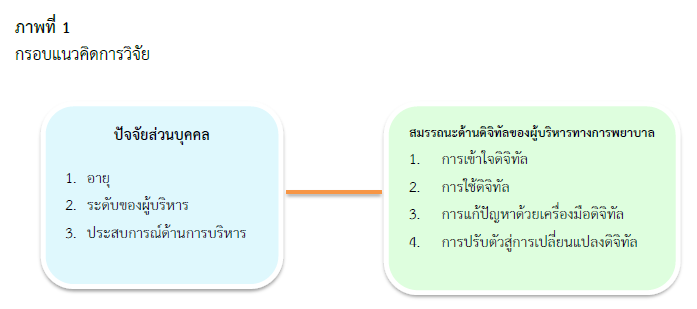
This cross-sectional descriptive survey research aimed to study digital competencies among nursing administrators in four dimensions: digital literacy, digital skills, problem-solving with digital tools, and adaptive digital transformation. The sample consisted of 66 nursing administrators, including nursing department heads, division heads, and ward head nurses with at least one year of administrative experience at Buriram Hospital. The research instrument was a digital competency questionnaire with a reliability coefficient of 0.85. Data were analyzed using descriptive statistics.
The results revealed that the overall digital competency of nursing administrators was at a high level (M = 3.71, SD = 0.78). When considering each dimension, digital literacy had the highest mean score (M = 3.93, SD = 0.79), followed by adaptive digital transformation (M = 3.69, SD = 0.69), problem-solving with digital tools (M = 3.61, SD = 0.84), and digital nursing skills (M = 3.59, SD = 0.79), respectively. Interestingly, it was found that the groups with higher digital competencies than others were the 40-45 year old age group (M = 3.80, SD = 0.71), the nursing division heads (M = 3.80, SD = 0.67), and the group with 1-2 years of administrative experience (M = 3.74, SD = 0.63). These findings provide foundational insights for designing compentcy development programs and enchnaing the integration of digital technologies in nursing leadership.
References
กระทรวงสาธารณสุข. (2564). ยุทธศาสตร์สุขภาพดิจิทัล กระทรวงสาธารณสุข (2564 - 2568). https://ict.moph.go.th/upload_file/files/97c2287c8f04e13f81fec13e431e7a5e.pdf
ปราโมทย์ ถ่างกระโทก, อารี ชีวเกษมสุข, และสุภมาส อังศุโชติ. (2562). สมรรถนะดิจิทัลของพยาบาลวิชาชีพไทย: การวิจัยเชิงคุณภาพ. วารสารพยาบาลศาสตร์และสุขภาพ, 42(1), 1-12.
ศิริลักษณ์ ดีเลิศไพบูลย์, จาฬุฎา มาเมืองบน, สกฤษตา ตั้งกูลพิธพร, คัทรียา คุณคุณาเดช, อาภาภรณ์ ธนากรพรสวัสดิ์, จินตนคติ วรรณวิจิตร, และอารีย์วรรณ อ่วมตานี. (2566). การพัฒนาความรอบรู้ด้านดิจิทัลของพยาบาลวิชาชีพ. วชิรสารการพยาบาล, 25(1), 70-79.
สภาการพยาบาล. (2566). ประกาศสภาการพยาบาล เรื่อง นโยบายสภาการพยาบาลเกี่ยวกับกำลังคนในทีมการพยาบาล. https://www.tnmc.or.th/images/userfiles/files/003(1).pdf
สำนักงานคณะกรรมการดิจิทัลเพื่อเศรษฐกิจและสังคมแห่งชาติ. (2562). กรอบสมรรถนะด้านดิจิทัลสำหรับพลเมืองไทย. กระทรวงดิจิทัลเพื่อเศรษฐกิจและสังคม. https://web.parliament.go.th/assets/portals/1/files/digital_competence_framework_for_thai_citizens.pdf
สำนักงานปลัดกระทรวงสาธารณสุข, กองการพยาบาล. (2565). แนวทางการจัดเก็บตัวชี้วัดการพัฒนาคุณภาพบริการพยาบาล ประจำปีงบประมาณ 2565. กระทรวงสาธารณสุข.
อมรทิพย์ อังกูรภัครวัฒน์, พัชราภรณ์ อารีย์, และเพชรน้อย สิงห์ช่างชัย. (2565). สมรรถนะสารสนเทศและดิจิทัลทางการพยาบาล ของผู้บริหารทางการพยาบาลระดับต้นในโรงพยาบาลตติยภูมิ. วารสารคณะพยาบาลศาสตร์ มหาวิทยาลัยบูรพา, 30(1), 113-125.
Alanazi, A. T. (2022). Digital leadership: Attributes of modern healthcare leaders. Cureus, 14(2), e21969. https://doi.org/10.7759/cureus.21969
Best, J. W., & Kahn, J. V. (2014). Research in education (10th ed.). Pearson Education.
Jarva, E., Oikarinen, A., Andersson, J., Tuomikoski, A. M., Kääriäinen, M., Meriläinen, M., & Mikkonen, K. (2022). Healthcare professionals' perceptions of digital health competence: A qualitative descriptive study. Nursing Open, 9(2), 1379-1393. https://doi.org/10.1002/nop2.1184
Krejcie, R. V., & Morgan, D. W. (1970). Determining sample size for research activities. Educational and Psychological Measurement, 30(3), 607-610.
Laukka, E., Hammarén, M., Pölkki, T., & Kanste, O. (2023). Hospital nurse leaders' experiences with digital technologies: A qualitative descriptive study. Journal of Advanced Nursing, 79(1), 297-308. https://doi.org/10.1111/jan.15481
Laukka, E., Pölkki, T., & Kanste, O. (2022). Leadership in the context of digital health services: A concept analysis. Journal of Nursing Management, 30(7), 2763-2780. https://doi.org/10.1111/jonm.13763
Prensky, M. (2001). Digital natives, digital immigrants. On the Horizon, 9(5), 1-6. https://www.marcprensky.com/writing/Prensky%20-%20Digital%20Natives,%20Digital%20Immigrants%20-%20Part1.pdf
Seibert, K., Domhoff, D., Huter, K., Krick, T., Rothgang, H., & Wolf-Ostermann, K. (2020). Application of digital technologies in nursing practice: Results of a mixed methods study on nurses' experiences, needs and perspectives. Zeitschrift fur Evidenz, Fortbildung und Qualitat im Gesundheitswesen, 158-159, 94-106. https://doi.org/10.1016/j.zefq.2020.10.010
Steenkamp, I., Peltonen, L. M., & Chipps, J. (2025). Digital health readiness - insights from healthcare leaders in operational management: A cross-sectional survey. BMC Health Services Research, 25(1), 240. https://doi.org/10.1186/s12913-024-12129-y
Downloads
Published
How to Cite
Issue
Section
License
Copyright (c) 2025 Journal of Boromarajonani College of Nursing, Surin

This work is licensed under a Creative Commons Attribution-NonCommercial-NoDerivatives 4.0 International License.
เนื้อหาและข้อมูลในบทความที่ตีพิมพ์ในราชาวดีสาร วิทยาลัยพยาบาลบรมราชชนนี สุรินทร์ ถือเป็นข้อคิดเห็นและความรับผิดชอบของผู้เขียนบทความโดยตรง ซึ่งกองบรรณาธิการวารสารไม่จำเป็นต้องเห็นด้วย หรือร่วมรับผิดชอบใดๆ
บทความ ข้อมูล เนื้อหา รูปภาพ ฯลฯ ที่ได้รับการตีพิมพ์ในราชาวดีสาร วิทยาลัยพยาบาลบรมราชชนนี สุรินทร์ หากบุคคลหรือหน่วยงานใดต้องการนำทั้งหมดหรือส่วนหนึ่งส่วนใดไปเผยแพร่หรือกระทำการใดๆ จะต้องได้รับอนุญาตเป็นลายลักษณ์อักษรจากราชาวดีสาร วิทยาลัยพยาบาลบรมราชชนนี สุรินทร์ ก่อนเท่านั้น