
The Relationships among Gender, Age, Depression, Perceived Stigma, and Family Relationship with Suicide Risk in Psychiatric Patients
Keywords:
Suicide risk, Depression, Perceived stigma, Family relationship, Psychiatric patientsAbstract
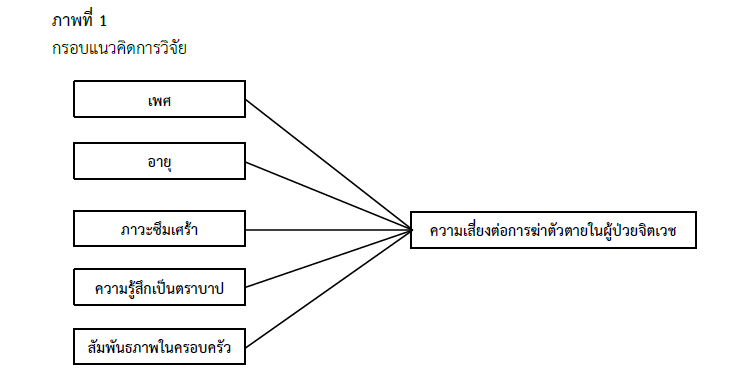
This descriptive correlational study examined relationships among gender, age, depression, perceived stigma, and family relationship with suicide risk in patients with psychiatric problems. The participants were 212 patients who visited the psychiatric outpatient unit of a psychiatric hospital in Northeast Thailand and met the inclusion criteria. Data were collected by interview using five questionnaires, including socio-demographic questionnaires, Family Relationships Questionnaire, Thai Depression Inventory, The Perceived Stigma Questionnaire. The reliability of questionnaires measured by Cronbach's alpha statistics values of .95, .94, and .73, respectively. And Mini International Neuropsychiatric Interview Module C. Suicidality using the split-half coefficient yielding values of .70. Descriptive statistics, Point-biserial correlation, and Spearman's rank-order correlation were used for data analysis.
Results showed that female was positively and significantly related to suicide risk (rpb = .14, p < .05). Depression and perceived stigma had a positively significant relationship to suicide risk (rs = .57, p < .05; rs = .34, p < .05, respectively). Age and family relationship had a negatively significant relationship to suicide risk (rs = -.34, p< .05; rs = -.40, p < .05, respectively). The results of this study can be used as a basic information for the development of planning prevention and protocols for helping psychiatric patients with suicidal problems.
References
กระทรวงสาธารณสุข, กรมสุขภาพจิต. (2562). รายงานอัตราการฆ่าตัวตายของประเทศไทย. ศูนย์ป้องกันการฆ่าตัวตายระดับชาติ โรงพยาบาลจิตเวชขอนแก่นราชนครินทร์.
กระทรวงสาธารณสุข, กรมสุขภาพจิต. (2563). รายงานอัตราการฆ่าตัวตายของประเทศไทย (พ.ศ. 2560-2563). ศูนย์ป้องกันการฆ่าตัวตายระดับชาติ โรงพยาบาลจิตเวชขอนแก่นราชนครินทร์.
กันตพัฒน์ ราชไชยา, และมุทิตา พนาสถิตย์. (2566). ความชุกและปัจจัยที่สัมพันธ์กับความเสี่ยงการฆ่าตัวตายในผู้ป่วยโรคซึมเศร้า โรงพยาบาลเจริญกรุงประชารักษ์. วารสารสมาคมจิตแพทย์แห่งประเทศไทย, 68(4), 380-393.
พันธุ์นภา กิตติรัตนไพบูลย์. (2544). โครงการอบรมแนวทางการสัมภาษณ์และให้คะแนน BPRS ในรูปแบบของ T-PANSS. ใน เอกสารประกอบการบรรยายเรื่องการประเมิน อาการผู้ป่วยจิตเวชโรงพยาบาลสวนปรุง (น. 1-10). โรงพยาบาลสวนปรุง.
พันธุ์นภา กิตติรัตนไพบูลย์, สุวรรณา อรุณพงศ์ไพศาล, สุวัฒน์ มหัตนิรันดร์กุล, ธรณินทร์ กองสุข, กอบโชค จูวงษ์, หทัยชนนี บุญเจริญ, ปทานนท์ ขวัญสนิท, อัจฉรา จรัสสิงห์ และ Thai M.I.N.I. Core Group. (2550). Mini International Neuropsychiatric Interview Thai version 5.0.0-Revised 2007.
มาโนช หล่อตระกูล, และปราโมทย์ สุคนิชย์. (2542). แบบประเมินวัดความรุนแรงของระดับภาวะซึมเศร้าชนิดให้ผู้ป่วยตอบแบบสอบถามเอง. วารสารสมาคมจิตแพทย์แห่งประเทศไทย, 20 (1), 17-19.
รัตนา สำราญใจ. (2541). สัมพันธภาพในครอบครัวและการปรับตัวของสตรีวัยหมดประจำเดือนในหน่วยทหารเรือพื้นที่สัตหีบ จังหวัดชลบุรี. [วิทยานิพนธ์ปริญญามหาบัณฑิต]. มหาวิทยาลัยมหิดล.
สุกัญญา เมืองมาคำ, สมบัติ สกุลพรรณ์, และหรรษา เศรษฐบุปผา. (2563). สัมพันธภาพในครอบครัวและความเสี่ยงต่อการฆ่าตัวตายของผู้มารับบริการที่คลินิกสุขภาพจิตและจิตเวช. พยาบาลสาร, 47(3), 240-252.
อรพิน ยอดกลาง, และมธุรส ทิพยมงคลกุล. (2563). การป้องกันและลดปัญหาการฆ่าตัวตายในประเทศไทย. โรงพยาบาลจิตเวชขอนแก่นราชนครินทร์ กรมสุขภาพจิต.
อรวรรณ วรรณชาติ. (2550). ทักษะชีวิตตามการรับรู้ของผู้ดูแล การสนับสนุนทางสังคมและการรับรู้ตราประทับของผู้ที่เป็นโรคจิตเภท. [วิทยานิพนธ์ปริญญาพยาบาลศาสตรมหาบัณฑิต]. มหาวิทยาลัยเชียงใหม่.
อนุกูล หุ่นงาม, สมบัติ สกุลพรรณ, และภัทราภรณ์ ภทรสกุล. (2566). การสนับสนุนทางสังคม ความรู้สึกมีคุณค่าในตนเอง ความแข็งแกร่งในชีวิตและความเสี่ยงต่อการฆ่าตัวตายซ้ำของผู้ป่วยโรคซึมเศร้า. วารสารไทยเภสัชศาสตร์และวิทยาการสุขภาพ, 18(3), 244-252.
อัญชลี ฐิตะปุระ. (2536). ความสัมพันธ์ระหว่างสัมพันธภาพในครอบครัวกับการปรับตัวของผู้ป่วยโรคลิ้นหัวใจ.[วิทยานิพนธ์ปริญญาวิทยาศาสตรมหาบัณฑิต]. มหาวิทยาลัยมหิดล.
Balhara, Y. P.S., & Verma, R. (2012). Schizophrenia and suicide. East Asian Archives Psychiatry, 22(3), 126-133.
Carlborg, A., Winnerbäck, K., Jönsson, E. G., Jokinen, J., & Nordström, P. (2010). Suicide in schizophrenia. Expert Review of Neurotherapeutics, 10(7), 1153–1164. https://doi.org/10.1586/ern.10.82
Cohen, J. (1988). Statistical Power Analysis for the behavioral sciences (2nd ed.). Routledge.
Edwards, T. M., Patterson, J. E., & Griffith, J. L. (2021). Suicide prevention: The role of families and carers. Asia‐ Pacific Psychiatry, 13(3), e12453. https://doi.org/10.1111/appy.12453
Friedman, P. H. (1982). The multiple roles of the integrative marital psychotherapist. Family Therapy, 9(2), 109.
Hansson, C., Joas, E., Pålsson, E., Hawton, K., Runeson, B., & Landén, M. (2018). Risk factors for suicide in bipolar disorder: a cohort study of 12 850 patients. Acta Psychiatrica Scandinavica, 138(5), 456–463. https://doi.org/10.1111/acps.12946
Lester, D., & Walker, R. L. (2006). The stigma for attempting suicide and the loss to suicide prevention efforts. Crisis, 27(3), 147–148. https://doi.org/10.1027/0227-5910.27.3.147
Listabarth, S., Vyssoki, B., Glahn, A., Gmeiner, A., Pruckner, N., Vyssoki, S., Wippel, A., Waldhoer, T., & König, D. (2020). The effect of sex on suicide risk during and after psychiatric inpatient care in 12 countries-an ecological study. European Psychiatry : The Journal of the Association of European Psychiatrists, 63(1), e85. https://doi.org/10.1192/j.eurpsy.2020.83
Marco, J. H., Pérez, S., & García-Alandete, J. (2016). Meaning in life buffers the association between risk factors for suicide and hopelessness in participants with mental disorders. Journal of Clinical Psychology, 72(7), 689–700. https://doi.org/10.1002/jclp.22285
McQuaid, R. J., Nikolitch, K., Vandeloo, K. L., Burhunduli, P., & Phillips, J. L. (2022). Sex differences in determinants of suicide risk preceding psychiatric admission: An electronic medical record study. Frontiers in Psychiatry, 13, 892225. https://doi.org/10.3389/fpsyt.2022.892225
Morrow, W. R., & Wilson, R. C. (1961). Family relations of bright high-achieving and under-achieving high school boys. Child Development, 32, 501–510.
Nkporbu, A. K., Oti, I. K., & Stanley, P. C. (2023). Determinants of suicide behavior among the mentally ill in a Tertiary Hospital in South-South Nigeria. Journal of Biomedical Research & Environmental Sciences, 4(3), 502-511. doi: 10.37871/jbres1702
Oexle, N., Waldmann, T., Staiger, T., Xu, Z., & Rüsch, N. (2018). Mental illness stigma and suicidality: The role of public and individual stigma. Epidemiology and Psychiatric Sciences, 27(2), 169-175. https://doi.org/10.1017/s2045796016000949
Overall, J. E., & Gorham, D. R. (1962). The brief psychiatric rating scale. Psychological Reports, 10, 799-812. https://doi.org/10.2466/pr0.1962.10.3.799
Pan, C. H., Chen, P. H., Chang, H. M., Wang, I. S., Chen, Y. L., Su, S. S., Tsai, S. Y., Chen, C. C., & Kuo, C. J. (2021). Incidence and method of suicide mortality in patients with schizophrenia: A nationwide cohort study. Social Psychiatry and Psychiatric Epidemiology, 56(8), 1437-1446. https://doi.org/10.1007/s00127-020-01985-8
Qin P. (2011). The impact of psychiatric illness on suicide: Differences by diagnosis of disorders and by sex and age of subjects. Journal of Psychiatric Research, 45(11), 1445–1452. https://doi.org/10.1016/j.jpsychires.2011.06.002
Scoliers, G., Portzky, G., van Heeringen, K., & Audenaert, K. (2009). Sociodemographic and psychopathological risk factors for repetition of attempted suicide: A 5-year follow-up study. Archives of Suicide Research, 13(3), 201–213. https://doi.org/10.1080/13811110902835130
Sheehan, D. V., Lecrubier, Y., Sheehan, K. H., Amorim, P., Janavs, J., Weiller, E., Hergueta, T., Baker, R., & Dunbar, G. C. (1998). The Mini-International Neuropsychiatric Interview (M.I.N.I.): the development and validation of a structured diagnostic psychiatric interview for DSM-IV and ICD-10. The Journal of Clinical Psychiatry, 59 Suppl 20, 22–57.
Sheldon, K. M., & Kasser, T. (2001). Getting older, getting better? Personal strivings and psychological maturity across the life span. Developmental Psychology, 37(4), 491-501. https://doi.org/10.1037/0012-1649.37.4.491
Shepard, D. S., Gurewich, D., Lwin, A. K., Reed, G. A., Jr, & Silverman, M. M. (2016). Suicide and suicidal attempts in the United States: Costs and policy implications. Suicide & Life-Threatening Behavior, 46(3), 352–362. https://doi.org/10.1111/sltb.12225
Sinclair, J. M., Mullee, M. A., King, E. A., & Baldwin, D. S. (2004). Suicide in schizophrenia: a retrospective case-control study of 51 suicides. Schizophrenia Bulletin, 30(4), 803–811. https://doi.org/10.1093/oxfordjournals.schbul.a007133
Song, Y., Rhee, S. J., Lee, H., Kim, M. J., Shin, D., & Ahn, Y. M. (2020). Comparison of suicide risk by mental illness: A retrospective review of 14-Year electronic medical records. Journal of Korean Medical Science, 35(47), e402. https://doi.org/10.3346/jkms.2020.35.e402
Spillane, A., Matvienko-Sikar, K., Larkin, C., Corcoran, P., & Arensman, E. (2018). What are the physical and psychological health effects of suicide bereavement on family members? An observational and interview mixed-methods study in Ireland. BMJ Open, 8(1), e019472. https://doi.org/10.1136/bmjopen-2017-019472
Teenoth, H., Sujith, A., Bose, S., & Shaveta, T. (2024). Association of childhood trauma, impulsivity, lower resilience, social support on daily stress in suicidal attempters and conceptualist. Library Progress International, 44(3), 1968-1983.
Valenstein, M., Kim, H. M., Ganoczy, D., McCarthy, J. F., Zivin, K., Austin, K. L., Hoggatt, K., Eisenberg, D., Piette, J. D., Blow, F. C., & Olfson, M. (2009). Higher-risk periods for suicide among VA patients receiving depression treatment: prioritizing suicide prevention efforts. Journal of Affective Disorders, 112(1-3), 50–58. https://doi.org/10.1016/j.jad.2008.08.020
Wahl, O. F. (1999). Mental health consumers' experience of stigma. Schizophrenia Bulletin, 25(3), 467-478. https://doi.org/10.1093/oxfordjournals.schbul.a033394
Wang, R., Zheng, S., Ouyang, X., Zhang, S., Ge, M., Yang, M., Sheng, X., Yang, K., Xia, L., & Zhou, X. (2023). Suicidality and Its Association with Stigma in Clinically Stable Patients with Schizophrenia in Rural China. Psychology Research and Behavior Management, 16, 1947–1956. https://doi.org/10.2147/PRBM.S413070
Wang, S., Li, C., Jia, X., Lyu, J., Wang, Y., & Sun, H. (2020). From depressive symptoms to suicide risk: Roles of sense of belongingness and acquired capability for suicide in patients with mental disorders. PsyCh Journal, 9(2), 185–198. https://doi.org/10.1002/pchj.334
World Health Organization. (2025, March 25). Suicide. WHO. https://www.who.int/news-room/fact-sheets/detail/suicide
Yan, F., Xiang, Y. T., Hou, Y. Z., Ungvari, G. S., Dixon, L. B., Chan, S. S., Lee, E. H., Li, W. Y., Li, W. X., Zhu, Y. L., & Chiu, H. F. (2013). Suicide attempt and suicidal ideation and their associations with demographic and clinical correlates and quality of life in Chinese schizophrenia patients. Social Psychiatry and Psychiatric Epidemiology, 48(3), 447–454. https://doi.org/10.1007/s00127-012-0555-0
Yeh, H. H., Westphal, J., Hu, Y., Peterson, E. L., Williams, L. K., Prabhakar, D., Frank, C., Autio, K., Elsiss, F., Simon, G. E., Beck, A., Lynch, F. L., Rossom, R. C., Lu, C. Y., Owen-Smith, A. A., Waitzfelder, B. E., & Ahmedani, B. K. (2019). Diagnosed Mental Health Conditions and Risk of Suicide Mortality. Psychiatric Services (Washington, D.C.), 70(9), 750–757. https://doi.org/10.1176/appi.ps.201800346
Downloads
Published
How to Cite
Issue
Section
License
Copyright (c) 2025 Journal of Boromarajonani College of Nursing, Surin

This work is licensed under a Creative Commons Attribution-NonCommercial-NoDerivatives 4.0 International License.
เนื้อหาและข้อมูลในบทความที่ตีพิมพ์ในราชาวดีสาร วิทยาลัยพยาบาลบรมราชชนนี สุรินทร์ ถือเป็นข้อคิดเห็นและความรับผิดชอบของผู้เขียนบทความโดยตรง ซึ่งกองบรรณาธิการวารสารไม่จำเป็นต้องเห็นด้วย หรือร่วมรับผิดชอบใดๆ
บทความ ข้อมูล เนื้อหา รูปภาพ ฯลฯ ที่ได้รับการตีพิมพ์ในราชาวดีสาร วิทยาลัยพยาบาลบรมราชชนนี สุรินทร์ หากบุคคลหรือหน่วยงานใดต้องการนำทั้งหมดหรือส่วนหนึ่งส่วนใดไปเผยแพร่หรือกระทำการใดๆ จะต้องได้รับอนุญาตเป็นลายลักษณ์อักษรจากราชาวดีสาร วิทยาลัยพยาบาลบรมราชชนนี สุรินทร์ ก่อนเท่านั้น