
Effectiveness of the Leadership Promotion Program via the LINE Application on Knowledge, Intention, and Health Leadership in Preventing Sexual Risk Behaviors among Nursing Students in Nakhon Ratchasima Province
Keywords:
Nursing students, Prevention, Sexual risk behaviors, Leadership, LINE applicationAbstract
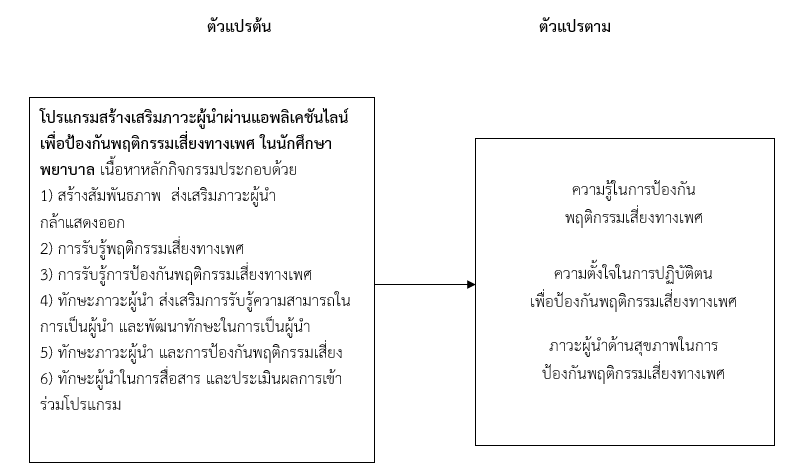
This quasi-experimental study with a two-group pre-test and post-test design aims to examine the effectiveness of a leadership enhancement program through the Line application on the knowledge, intention, and health leadership. The sample group was purposively selected, consisting of 84 second-year nursing students aged 18–24, divided into an experimental group and a control group, with 42 individuals in each group. The experimental group received the Leadership Promotion Program via the LINE application program, while the control group received standard care. The research instruments included the leadership development program through the Line application, knowledge, intention, and health leadership assessments, which were validated for content validity with values of 0.80, 0.91, 1.00, and 1.00, respectively. The reliability of the intention and leadership assessment was verified using Cronbach's alpha coefficients, which were 0.86 and 0.88, respectively. The knowledge assessment was verified using KR-20 with a value of 0.70. Data analysis, including frequency and percentage calculations for personal information, paired t-tests to compare pre- and post-program differences within the same group, and independent sample t-tests to compare the experimental and control groups.
The research findings indicate that after the experiment, the experimental group had significantly higher average scores in knowledge, intention to act, and health leadership in preventing risky sexual behaviors compared to before the experiment, with statistical significance at the p<.001 level. When comparing between groups, the experimental group had significantly higher average scores in knowledge, intention, and health leadership to prevent risky sexual behaviors than the control group, with statistical significance at the p<.001 and p<.05 levels. In summary, the leadership enhancement program to prevent risky sexual behaviors through the LINE application can be applied to prevent risky sexual behaviors and promote health leadership.
References
กระทรวงสาธารณสุข, กรมควบคุมโรค. (2561). โรคติดต่อทางเพศสัมพันธ์. https://ddc.moph.go.th/disease_detail.php?d=30
กระทรวงสาธารณสุข, กรมควบคุมโรค. (2565). พยากรณ์โรคและภัยสุขภาพรายสัปดาห์. สำนักสื่อสารความเสี่ยงและพัฒนาพฤติกรรมสุขภาพ. https://ddc.moph.go.th/ddce/news.php?news=19478&deptcode=
กระทรวงสาธารณสุข, กรมควบคุมโรค, สำนักงานป้องกันควบคุมโรคที่ 9. (2565). รายงานประจำปี พ.ศ. 2565. http://odpc9.ddc.moph.go.th/post/65-report.pdf
กระทรวงสาธารณสุข, กรมอนามัย. (2566). ระบบสารสนเทศสนับสนุนงานส่งเสริมสุขภาพและอนามัยสิ่งแวดล้อม. https://dashboard.anamai.moph.go.th/ministry/default/index?year=2023
กระทรวงสาธารณสุข, กรมอนามัย. (2567). ระบบสารสนเทศสนับสนุนงานส่งเสริมสุขภาพและอนามัยสิ่งแวดล้อม. https://dashboard.anamai.moph.go.th/dashboard/labor1519n/index?year=2024
กุลภัสสรณ์ ศิริมนัสสกุล. (2560). ผลของโปรแกรมสุขภาพในโรงเรียนต่อความรู้ในการป้องกันโรคซิฟิลิสของนักเรียนมัธยมศึกษาตอนต้น. วารสารสุขภาพและการศึกษาพยาบาล, 27(1), 139-140.
จันทิรา ขําสอาด, อโณชา แซเลา, กรชนก แสงสวัสดิ์, วริศรา นุชเกษม, อาติยา สวัสดี, ธนภัทร ไวจําปา, และภาสิต ศิริเทศ. (2564). ผลของการประยุกต์ใช้ทฤษฎีการรับรู้ความสามารถของตนเองต่อทักษะชีวิตในการป้องกันพฤติกรรมเสี่ยงทางเพศของวัยรุ่นตอนต้น จังหวัดเพชรบุรี. วารสารวิจัยและพัฒนา, 15(1), 35-50.
บุญชม ศรีสะอาด. (2560). การวิจัยเบื้องต้น (พิมพ์ครั้งที่ 10). สุวีริยาสาส์น.
ปฏิกาญจน์ สีชาลี, และรุจิรา ดวงสงค์. (2565). ผลของโปรแกรมป้องกันการตั้งครรภ์โดยการประยุกต์แนวคิดความรอบรู้ด้านสุขภาพในนักเรียนหญิงชั้นมัธยมศึกษาตอนต้น โรงเรียนแห่งหนึ่ง จังหวัดอุดรธานี. วารสารวิจัยสาธารณสุขศาสตร์ มหาวิทยาลัยขอนแก่น, 15(1), 24-36.
ปัณณพัฒน์ ลาวัลย์ตระกูล. (2563). ปัจจัยที่มีความสัมพันธ์ต่อความสนใจในการใช้ยาป้องกันก่อนการสัมผัสเชื้อเอชไอวี (PrEP) ในกลุ่มชายที่มีเพศสัมพันธ์กับชายในประเทศไทย. วารสารระบบบริการปฐมภูมิและเวชศาสตร์ครอบครัว, 13(1), 48.
มาลี สบายยิ่ง. (2562). พฤติกรรมเสี่ยงทางเพศของนักเรียนชั้นมัธยมศึกษาตอนปลายในสังคมปัจจุบัน. วารสารวิทยบริการ มหาวิทยาลัยสงขลานครินทร์, 30(3), 121-127.
ยุพิน พิมสวัสดิ์. (2557). ปัจจัยที่เกี่ยวข้องกับพฤติกรรมเสี่ยงทางเพศของนักเรียนหญิงชั้นมัธยมศึกษาตอนปลาย ในจังหวัดมุกดาหาร [วิทยานิพนธ์ปริญญามหาบัณฑิต]. มหาวิทยาลัยราชภัฏอุบลราชธานี.
ลัดดาวัลย์ เตจ๊ะ, และอลิสา นิติธรรม. (2566). ประสิทธิผลของโปรแกรมการป้องกันพฤติกรรมเสี่ยงทางเพศของนักเรียนหญิงชั้นประถมศึกษาตอนปลาย โรงเรียนพิบูลประชาสรรค์. วารสารสุขศึกษา พลศึกษา และสันทนาการ, 49(1), 216-226.
สายพิณ เกษมกิจวัฒนา, พรสวรรค์ เชื้อเจ็ดตน, และวรางคณา อ่ำศรีเวียง. (2557). นวัตกรรมการป้องกันพฤติกรรมเสี่ยงทางเพศของนักศึกษามหาวิทยาลัย. วารสารสภาการพยาบาล, 29(3), 5-18.
อัญชลี ติยะบุตร, สุดถนอม กมลเลิศ, และรวีวัลย์ ปัณเย็น. (2563). ปัจจัยที่สัมพันธ์กับการเกิดโรคติดต่อทางเพศสัมพันธ์ของชายที่มีเพศสัมพันธ์กับชายในอำเภอเมือง จังหวัดขอนแก่น. วารสารสาธารณสุขศาสตร์ มหาวิทยาลัยขอนแก่น, 13(4), 56-58.
Best, J. W. (1981). Research in education. Prentice-Hall.
Centers for Disease Control and Prevention. (2024, 22 November). Sexual risk behaviors . https://www.cdc.gov/youth-behavior/risk-behaviors/sexual-risk-behaviors.html
Davis, L. (1992). Instrument review: Getting the most from your panel of experts. Applied Nursing Research, 5(2), 104-107.
Dowling, R., Howell, E. M., Dasco, M. A., & Schwartzman, J. (2025). Digital sexual and reproductive health in adolescents in low- and middle-income countries: A scoping review. Youth, 5(1), 15. https://doi.org/10.3390/youth5010015
Gabarron, E., & Wynn, R. (2016). Use of social media for sexual health promotion: A scoping review. Global Health Action, 9, 32193. https://doi.org/10.3402/gha.v9.32193
Ghasemi, A., & Zahediasl, S. (2012). Normality tests for statistical analysis: A guide for non-statisticians. International Journal of Endocrinology and Metabolism, 10(2), 486–489. https://doi.org/10.5812/ijem.3505
Janeczko, L. L. (2022, 29 April). Sexually transmitted infections on a 30-year rise worldwide. Medscape. https://www.medscape.com/viewarticle/972937#vp_1?form=fpf
Kline, R. B. (2004). Beyond significance testing: Reforming data analysis methods in behavioral research. https://doi.org/10.1037/10693-000
Pender, N. J. (1996). Health promotion in nursing practice (3rd ed.). Appleton.
Sullivan, G. M., & Feinn, R. (2012). Using effect size-or why the p value Is not enough. Journal of Graduate Medical Education, 4(3), 279-282. https://doi.org/10.4300/JGME-D-12-00156.1
Tingey, L., Chambers, R., Patel, H., Littlepage, S., Lee, S., Lee, A., Susan, D., Melgar, L., Slimp, A., & Rosenstock, S. (2021). Prevention of sexually transmitted diseases and pregnancy prevention among Native American youths: A randomized controlled trial, 2016–2018. American Journal of Public Health, 111(10), 1874–1884. https://doi.org/10.2105/AJPH.2021.306447
World Health Organization. (2021, 20 May). World health statistics 2021: Monitoring health for the SDGs, sustainable development goals. https://www.who.int/publications/i/item/9789240027053
World Health Organization. (2025). Adolescent health. https://www.who.int/health-topics/adolescent-health#tab=tab_1
Downloads
Published
How to Cite
Issue
Section
License
Copyright (c) 2025 Journal of Boromarajonani College of Nursing, Surin

This work is licensed under a Creative Commons Attribution-NonCommercial-NoDerivatives 4.0 International License.
เนื้อหาและข้อมูลในบทความที่ตีพิมพ์ในราชาวดีสาร วิทยาลัยพยาบาลบรมราชชนนี สุรินทร์ ถือเป็นข้อคิดเห็นและความรับผิดชอบของผู้เขียนบทความโดยตรง ซึ่งกองบรรณาธิการวารสารไม่จำเป็นต้องเห็นด้วย หรือร่วมรับผิดชอบใดๆ
บทความ ข้อมูล เนื้อหา รูปภาพ ฯลฯ ที่ได้รับการตีพิมพ์ในราชาวดีสาร วิทยาลัยพยาบาลบรมราชชนนี สุรินทร์ หากบุคคลหรือหน่วยงานใดต้องการนำทั้งหมดหรือส่วนหนึ่งส่วนใดไปเผยแพร่หรือกระทำการใดๆ จะต้องได้รับอนุญาตเป็นลายลักษณ์อักษรจากราชาวดีสาร วิทยาลัยพยาบาลบรมราชชนนี สุรินทร์ ก่อนเท่านั้น