
The Effectiveness of a Health Behavior Promotion Program Using Group Process on Obesity Prevention Behaviors and Body Mass Index Among Personnel in Songkhla Hospital
Keywords:
Health behavior promotion program, Group process, Overweight, Obesity prevention behaviorsAbstract
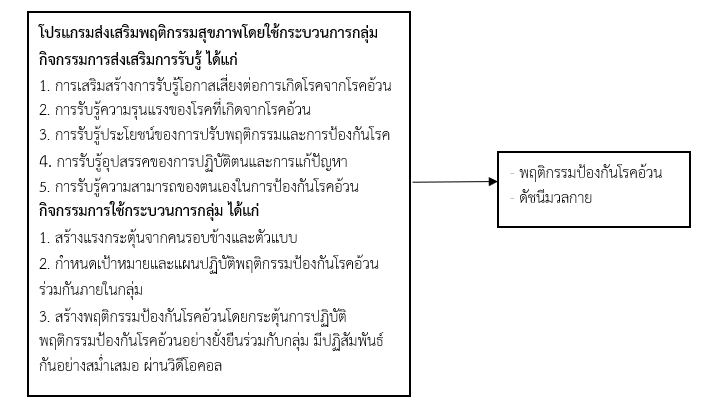
. This quasi-experimental research employed a one-group repeated-measures design and aimed to examine the effectiveness of a health behavior promotion program using a group process on obesity prevention behaviors and body mass index (BMI) among personnel in Songkhla Hospital. The sample group was selected using a simple random sampling method through a draw without replacement from individuals who met the inclusion criteria, totaling 50 people. The experimental instrument was a program incorporating awareness enhancement based on health belief models and process utilization. The intervention monitoring instrument included the obesity knowledge questionnaire and the perception of obesity questionnaire, with a reliability of 0.80 and 0.78, respectively. The data collection instrument included the obesity prevention behaviors questionnaire with a reliability of 0.78 and an ACCUNIQ weighing scale with an automatic calibration system. The statistics used for data analysis included percentages, means, standard deviations, and comparisons of differences in scores at four time points using non-parametric statistics (Friedman test).
The results showed that the mean obesity prevention behaviors scores post-intervention immediately (M = 48.16, SD = 2.87), at one month (M = 47.90, SD = 3.03), and at six months (M = 47.74, SD = 3.27) were significantly higher than pre-intervention scores (M = 38.24, SD = 3.53), at the .001 level. Similarly, the mean BMI scores post-intervention immediately (M = 26.84, SD = 2.09), at one month (M = 26.66, SD = 3.01), and at six months (M = 26.70, SD = 3.03) were significantly lower than the pre-intervention BMI (M = 28.67, SD = 3.07), at the .001 level. Therefore, the program can be applied by healthcare providers to promote healthy behaviors and reduce BMI in obese populations.
References
จริยา ทรัพย์เรือง, บุบผา วิริยรัตนกุล, และพัชรินทร์ สังวาลย์. (2564). ปัจจัยทํานายพฤติกรรมสร้างเสริมสุขภาพของผู้รับบริการกลุ่มวัยทํางานที่มีภาวะเมตาบอลิกซินโดรม. วารสารสังคมศาสตร์และมานุษยวิทยาเชิงพุทธ, 6(8), 386-399.
ธนพันธุ์ ไชยชนะ, กุลชญา ลอยหา, และจำลอง วงษ์ประเสริฐ. (2563). ผลของโปรแกรมสร้างเสริมสุขภาพโดยการประยุกต์ใช้แบบแผนความเชื่อด้านสุขภาพร่วมกับแรงสนับสนุนทางสังคมเพื่อควบคุมน้ำหนักของเด็กที่มีน้ำหนักเกินเกณฑ์มาตรฐานในนักเรียน ชั้นประถมศึกษาปีที่ 4-6. วารสาร มจร อุบลปริทรรศน์, 5(3), 303–314.
ณินญาภร ใจยอด, และอนุกูล มะโนทน. (2566). ประสิทธิผลการประยุกต์แนวคิดแบบแผนความเชื่อด้านสุขภาพในการปรับเปลี่ยนพฤติกรรมการลดภาวะโรคอ้วนของบุคลากรโรงพยาบาลสุโขทัย อำเภอเมือง จังหวัดสุโขทัย. วารสารวิชาการสาธารณสุขชุมชน, 9(1), 54–68.
นฤมล สุขศรี. (2558). ผลของกระบวนการกลุ่มต่อการปรับเปลี่ยนพฤติกรรมสุขภาพและสถานภาพสุขภาพของกลุ่มเสี่ยงต่อโรคเบาหวานในตำบลดอนสัก จังหวัดสุราษฎร์ธานี [วิทยานิพนธ์ปริญญามหาบัณฑิต]. มหาวิทยาลัยราชภัฏสุราษฎร์ธานี.
ปุรินทร์ ศรีศศลักษณ์, สุภาวดี นพรุจจินดา, ประทีป หมีทอง, และสุนิสา จันทร์แสง. (2567). ปัจจัยทำนายพฤติกรรมส่งเสริมสุขภาพของผู้ที่มีภาวะเสี่ยงต่อการเกิดโรคหลอดเลือดสมอง. วารสารวิจัยเพื่อการส่งเสริมสุขภาพและคุณภาพชีวิต, 4(2), 25–36.
พัทธ์ธิดา จินตนปัญญา. (2566). ผลของโปรแกรมปรับเปลี่ยนพฤติกรรมต่อพฤติกรรมสุขภาพ และภาวะโภชนาการของบุคลากรสาธารณสุขที่มีภาวะน้ำหนักเกินและโรคอ้วนในโรงพยาบาลทุ่งสง จังหวัดนครศรีธรรมราช. มหาราชนครศรีธรรมราชเวชสาร, 7(1), 28–41.
มูนา กิยะ, เมธาวี ณ อิ่น, และธนัช กนกเทศ. (2566). ความชุกและปัจจัยที่มีความสัมพันธ์กับดัชนีมวลกายของนิสิตระดับปริญญาตรี กลุ่มวิทยาศาสตร์สุขภาพ มหาวิทยาลัยนเรศวร. วารสารวิทยาศาสตร์และเทคโนโลยีนอร์ทเทิร์น, 4(2), 120–137.
วิไลรัตน์ บุญราศี. (2559). แบบแผนความเชื่อและพฤติกรรมสุขภาพของพนักงานโรงไฟฟ้าแม่เมาะที่มีภาวะอ้วนลงพุง [วิทยานิพนธ์ปริญญามหาบัณฑิต]. มหาวิทยาลัยธรรมศาสตร์.
สำราญ กาศสุวรรณ, ทัศนีย์ บุญอริยเทพ, และรุ่งกิจ ปิ่นใจ. (2565). ผลของโปรแกรมการปรับเปลี่ยนพฤติกรรมสุขภาพโดยใช้กระบวนการกลุ่มในกลุ่มเสี่ยงโรคความดันโลหิตสูง ตำบลร้องเข็ม อำเภอร้องกวาง จังหวัดแพร่. วารสารโรงพยาบาลแพร่, 30(2), 27–42.
de Vos, B. C., Runhaar, J., van Middelkoop, M., Krul, M., & Bierma-Zeinstra, S. M. (2016). Long-term effects of a randomized, controlled, tailor-made weight-loss intervention in primary care on the health and lifestyle of overweight and obese women. The American Journal of Clinical Nutrition, 104(1), 33–40. doi:10.3945/ajcn.116.133512
Jones, C. L., Jensen, J. D., Scherr, C. L., Brown, N. R., Christy, K., & Weaver, J. (2015). The health belief model as an explanatory framework in communication research: Exploring parallel, serial, and moderated mediation. Health Communication, 30(6), 566–576. https://doi.org/10.1080/10410236.2013.873363
Twari, A. K. (2023). A study of Kurt Lewin’s leadership styles and group dynamics in developing responsibility and performance among engineering students. AIP Conference Proceedings, 3006(1), 040005. https://doi.org/10.1063/5.0187387
World Obesity Federation. (2024). World Obesity Atlas 2024 (7th ed.). https://data.worldobesity.org/publications/WOF-Obesity-Atlas-v7.pdf
Downloads
Published
How to Cite
Issue
Section
License
Copyright (c) 2025 Journal of Boromarajonani College of Nursing, Surin

This work is licensed under a Creative Commons Attribution-NonCommercial-NoDerivatives 4.0 International License.
เนื้อหาและข้อมูลในบทความที่ตีพิมพ์ในราชาวดีสาร วิทยาลัยพยาบาลบรมราชชนนี สุรินทร์ ถือเป็นข้อคิดเห็นและความรับผิดชอบของผู้เขียนบทความโดยตรง ซึ่งกองบรรณาธิการวารสารไม่จำเป็นต้องเห็นด้วย หรือร่วมรับผิดชอบใดๆ
บทความ ข้อมูล เนื้อหา รูปภาพ ฯลฯ ที่ได้รับการตีพิมพ์ในราชาวดีสาร วิทยาลัยพยาบาลบรมราชชนนี สุรินทร์ หากบุคคลหรือหน่วยงานใดต้องการนำทั้งหมดหรือส่วนหนึ่งส่วนใดไปเผยแพร่หรือกระทำการใดๆ จะต้องได้รับอนุญาตเป็นลายลักษณ์อักษรจากราชาวดีสาร วิทยาลัยพยาบาลบรมราชชนนี สุรินทร์ ก่อนเท่านั้น