
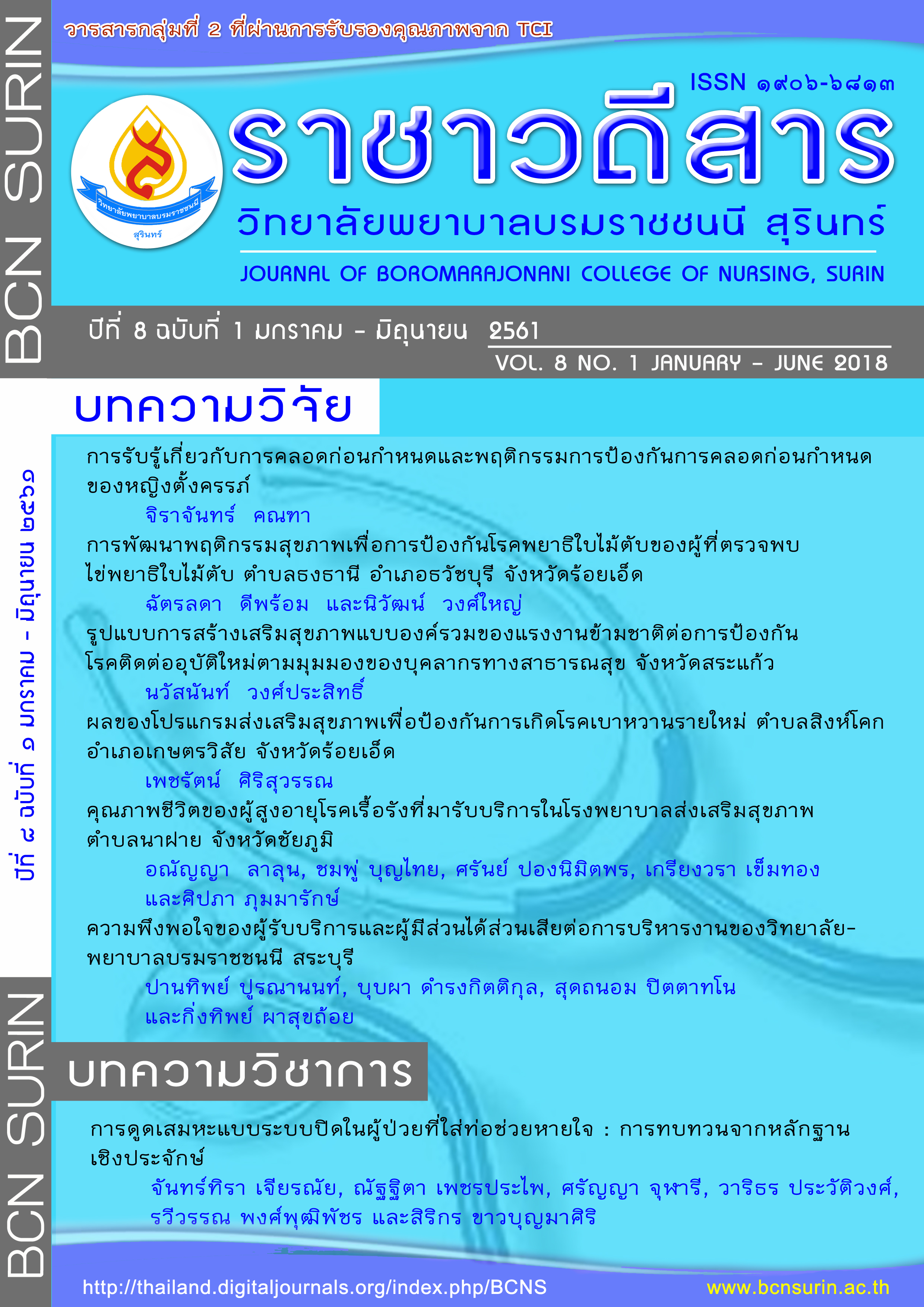
Closed Suction System in Patients with Artificial Airway:
A Review of Empirical Evidence
Keywords:
Closed endotracheal suctioning system, Empirical evidence, Endotracheal suctioningAbstract
Suction is an important nursing intervention for an intubated patient with mechanical ventilator. Now there are two general types of suctioning systems-closed endotracheal suctioning system and open endotracheal suctioning system. This article is presenting with closed endotracheal suctioning system in 4 main points derived from the reviewing of the empirical evidence including; 1) the difference of the two suctioning types, 2) equipment, 3) procedures, and 4) complications that may occur.
References
นภาพร อภิรดีวจีเศรษฐ์, สิริรัตน์ เปรมประวัติ, ศิริรัตน์ ปานพันธุ์โพธิ์ และกัณฑ์ธิมา แดงนิ่ม. (2549). การสร้างแนวปฏิบัติการพยาบาลดูดเสมหะเพื่อป้องกันการติดเชื้อระบบทางเดินหายใจส่วนล่าง ในผู้ป่วยที่ใช้เครื่องช่วยหายใจ. วารสารพยาบาลศิริราช, 15-30.
ประภาดา วัชรนาถ, อำภาพร นามวงศ์พรหม และน้ำอ้อย ภักดีวงศ์. (2558). ประสิทธิผลของการใช้แนวปฏิบัติการพยาบาล ในการดูแลผู้ป่วยที่ใช้เครื่องช่วยหายใจ. วารสารเกื้อการุณย์, 22(1), 144-155.
ผกาวดี บุณยชาต และจันทร์คำ โพธิ์อ่อง. (2557). ผลการพัฒนารูปแบบการป้องกันการติดเชื้อปอดอักเสบที่สัมพันธ์กับการใช้เครื่องช่วยหายใจ. วารสารพยาบาลกระทรวงสาธารณสุข, 23(3), 76-87.
ยุวนิดา อารารมย์. (2558). การใช้หลักฐานเชิงประจักษ์ ในการดูแลผู้ป่วยเพื่อป้องกันการติดเชื้อปอดอักเสบจากการใช้เครื่องช่วยหายใจ. วารสารเครือข่ายวิทยาลัยพยาบาลและการสาธารณสุขภาคใต้, 2(3), 144-158.
วัฒนา พันธุ์ศักดิ์. (2550). การดูดเสมหะ (Suctioning). ใน สิริรัตน์ ฉัตรชัยสุดา, ปรางค์ทิพย์ อุจะรัตน และณัฐสุรางค์ บุญจันทร์ (บรรณาธิการ), ทักษะพื้นฐานทางการพยาบาล (หน้า 215-226). กรุงเทพฯ: เอ็น พี เพรส.
สรีรัตน์ เปรมประวัติ. (2551). การดูดเสมหะในผู้ป่วยที่ใส่ท่อช่วยหายใจ. วารสารพยาบาลศาสตร์, 26(1), 14-24.
สุนันทา บุรภัทรวงศ์, วราภรณ์ เทียนทอง และวีรวัฒน์ มโนสุทธิ. (2551). การพัฒนาเทคนิคการดูดเสมหะด้วยระบบปิดในผู้ป่วยที่ใช้เครื่องช่วยหายใจในสถาบันบำราศนราดูร. วารสารควบคุมโรค, 34(3), 385-396.
อภิญญา เพียรพิจารณ์ (บรรณาธิการ). (2552). แนวคิดพื้นฐานและหลักการพยาบาล เล่ม 2. นนทบุรี: ยุทธรินทร์การพิมพ์.
Åkerman, E., Larsson, C., & Ersson, A. (2013). Clinical experience and incidence of ventilator-associated pneumonia using closed versus open suction-system. Nursing in Critical Care, 19(1), 34–41. doi: 10.1111/nicc.12010
American Association for Respiratory Care. (2010). Endotracheal suctioning of mechanically ventilated patients with artificial airways 2010. Respiratory Care, 55(6), 758-764.
Blackwood, B. (1998). The practice and perception of intensive care staff using the closed suctioning system. Journal of Advanced Nursing, 28(5), 1020–9. Retrieved from http://www.ncbi.nlm.nih.gov/pubmed/9840873
Elsaman, S.E. (2017). Effect of Application of Endotracheal Suction Guidelines on Cardio respiratory Parameters of Mechanically Ventilated Patients. IOSR-JNHS, 6(1), 41-48.
Evans, J., Syddall, S., Butt, W., & Kinney, S. (2014). Comparison of open and closed suction on safety, efficacy and nursing time in a paediatric intensive care unit. Australian Critical Care, 27(2), 70–74. doi: 10.1016/j.aucc.2014.01.003
Faraji, A., Khatony, A., Moradi, G., Abdi, A., & Rezaei, M. (2015). Open and Closed Endotracheal Suctioning and Arterial Blood Gas Values : A Single-Blind Crossover Randomized Clinical Trial. Critical care research and practice, 2015, 1-7. doi: 10.1155/2015/470842
Haghighat, S., & Yazdannik, A. (2015). The practice of intensive care nurses using the closed suctioning system: An observational study. Iranian Journal of Nursing and Midwifery Research, 20(5), 619-625.doi: 10.4103/1735-9066.164509.
Harada, N. (2010). Closed suctioning system: Critical analysis for its use. Japan Journal of Nursing Science, 7(1), 19–28. doi: 10.1111/j.1742-7924.2010.00143.x
Hlinková, E., Nemcová, J., & Bielená, K. (2014). Closed versus open suction system of the airways in the prevention of infection in ventilated patients. Central European Journal of Nursing and Midwifery, 5(2), 63–71. Retrieved from http://www.scopus.com/inward/record.url?eid=2-s2.0-84902115914&partnerID=tZOtx3y1
Jongerden, I. P., Kesecioglu, J., Speelberg, B., Buiting, A. G., Leverstein-van Hall, M. A., & Bonten, M. J. (2012). Changes in heart rate, mean arterial pressure, and oxygen saturation after open and closed endotracheal suctioning: A prospective observational study. Journal of Critical Care, 27(6), 647–654.doi: 10.1016/j.jcrc.2012.02.016
Juneja, D., Singh, O., Pandey, R., Javeri, Y., Nasa, P., & Uniyal, B. (2011). Comparing influence of intermittent subglottic secretions drainage with/without closed suction systems on the incidence of ventilator associated pneumonia. Indian Journal of Critical Care Medicine, 15, 168. doi: 10.4103/0972-5229.84902
Maggiore, S. M., Iacobone, E., Zito, G., Conti, G., Antonelli, M., & Proietti, R. (2002). Closed versus open suctioning techniques. Minerva Anestesiological, 68(5), 360–364.
Özden, D., & Görgülü, R.S. (2012). Development of standard practice guidelines for open and Closed system suctioning. Journal of Clinical Nursing, 21(9-10),1327-38.
Sole, M. L., Byera, J. F., Ludy, J. E., & Ostrow, C. L. (2002). Suctioning techniques and airway management practices: pilot study and instrument evaluation. American journal of critical care, 11(4), 363-368.
The Joanna Briggs Institute. (2000). Tracheal Suctioning of Adults with an Artificial Airway. Best Practice, 4(4), 1–6.
Vonberg, R.P., Eckmanns, T., Welte, T., & Gastmeier, P. (2006). Impact of the suctioning System (open vs. closed) on the incidence of ventilation-associated pneumonia: Meta-analysis of randomized controlled trials. Intensive Care Medicine, 32(9), 1329–1335. doi: 10.1007/s00134-006-0241-3
Zeitoun, S.S., Leite De Barros, A. L. B., & Diccini, S. (2003). A prospective, randomized study of ventilator-associated pneumonia in patients using a closed vs. open suction system. Journal of Clinical Nursing, 12(4), 484–489. doi: 10.1046/j.1365-2702.2003.00749.x
Downloads
Published
How to Cite
Issue
Section
License
เนื้อหาและข้อมูลในบทความที่ตีพิมพ์ในราชาวดีสาร วิทยาลัยพยาบาลบรมราชชนนี สุรินทร์ ถือเป็นข้อคิดเห็นและความรับผิดชอบของผู้เขียนบทความโดยตรง ซึ่งกองบรรณาธิการวารสารไม่จำเป็นต้องเห็นด้วย หรือร่วมรับผิดชอบใดๆ
บทความ ข้อมูล เนื้อหา รูปภาพ ฯลฯ ที่ได้รับการตีพิมพ์ในราชาวดีสาร วิทยาลัยพยาบาลบรมราชชนนี สุรินทร์ หากบุคคลหรือหน่วยงานใดต้องการนำทั้งหมดหรือส่วนหนึ่งส่วนใดไปเผยแพร่หรือกระทำการใดๆ จะต้องได้รับอนุญาตเป็นลายลักษณ์อักษรจากราชาวดีสาร วิทยาลัยพยาบาลบรมราชชนนี สุรินทร์ ก่อนเท่านั้น