การรับรู้อุปสรรคและความต้องการด้านการฟื้นฟูสมรรถภาพผู้ป่วยหลังผ่าตัดหัวใจแบบเปิดต่อเนื่องที่บ้าน
บริบทโรงพยาบาลศูนย์แห่งหนึ่ง
คำสำคัญ:
การรับรู้อุปสรรคและความต้องการ , การฟื้นฟูสมรรถภาพหัวใจที่บ้าน , ผู้ป่วยหลังผ่าตัดหัวใจแบบเปิด, การวิจัยเชิงคุณภาพ , โรงพยาบาลศูนย์บทคัดย่อ
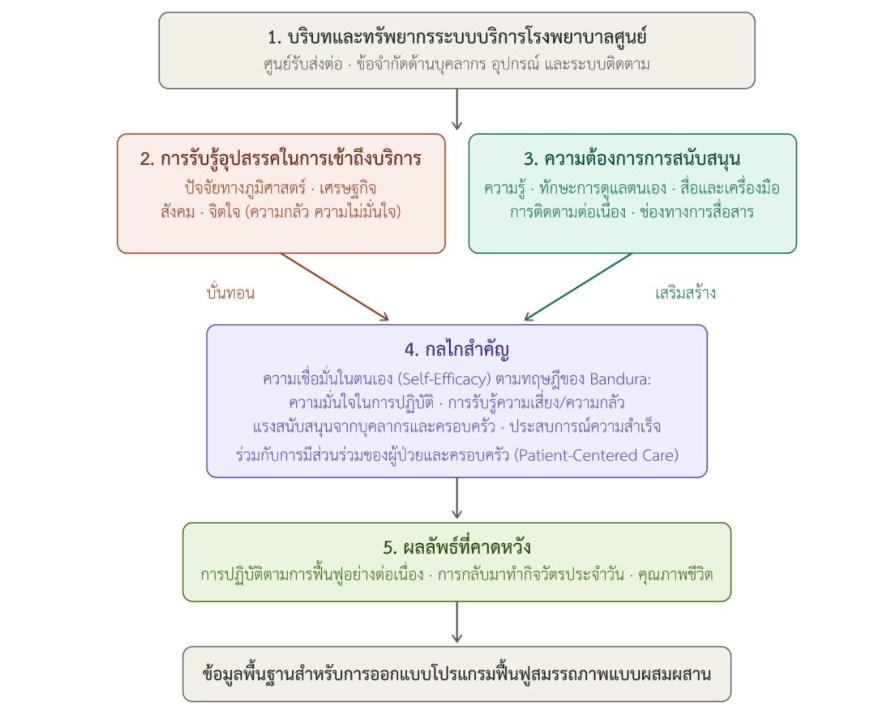
การวิจัยเชิงคุณภาพแบบพรรณนา มีวัตถุประสงค์เพื่ออธิบายการรับรู้อุปสรรคและความต้องการด้านการฟื้นฟูสมรรถภาพผู้ป่วยหลังผ่าตัดหัวใจแบบเปิดต่อเนื่องที่บ้าน ตามมุมมองของผู้ป่วย ผู้ดูแล และบุคลากรทางการแพทย์ ในบริบทของโรงพยาบาลศูนย์แห่งหนึ่ง โดยใช้ทฤษฎีความเชื่อมั่นในตนเองของแบนดูร่าร่วมกับแนวคิดการดูแลที่เน้นผู้ป่วยเป็นศูนย์กลางเป็นกรอบแนวคิด คัดเลือกผู้ให้ข้อมูลแบบเจาะจง ได้แก่ ผู้ป่วยหลังผ่าตัดหัวใจแบบเปิด 5 คน ญาติผู้ดูแล 3 คน และบุคลากรทางการแพทย์ 10 คน รวม 18 คน เก็บข้อมูลด้วยการสัมภาษณ์เชิงลึกและการสนทนากลุ่ม ระหว่างเดือนพฤษภาคม–กรกฎาคม พ.ศ. 2568 เครื่องมือวิจัย ได้แก่ แบบสัมภาษณ์กึ่งโครงสร้าง ตรวจสอบคุณภาพของเครื่องมือ โดยผู้ทรงคุณวุฒิ 3 คน และทดลองใช้ก่อนเก็บข้อมูลจริง วิเคราะห์ข้อมูลด้วยการวิเคราะห์เนื้อหา ตรวจสอบความน่าเชื่อถือด้วยการตรวจสอบสามเส้าและการตรวจสอบกับผู้ให้ข้อมูล
ผลการวิจัยพบ 6 ประเด็นหลัก ได้แก่ (1) อุปสรรคทางภูมิศาสตร์และภาระทางเศรษฐกิจ ผู้ป่วยอาศัยห่างโรงพยาบาล 40–80 กิโลเมตร ค่าเดินทาง 300–500 บาทต่อครั้ง (2) ความกลัวว่าจะเกิดอันตรายซ้ำจากการออกกำลังกาย (3) ช่องว่างด้านความรู้และทักษะการดูแลตนเอง (4) ความรู้สึกถูกทอดทิ้งหลังจำหน่ายและขาดการติดตามต่อเนื่อง (5) ความต้องการสื่อการเรียนรู้ที่เข้าถึงได้ และ (6) ความต้องการช่องทางสื่อสารกับบุคลากรทางการแพทย์ สรุปได้ว่า โปรแกรมฟื้นฟูสมรรถภาพที่บ้านแบบผสมผสานที่บูรณาการการติดตามทางไกลผ่านโทรศัพท์และแอปพลิเคชันไลน์ร่วมกับการนัดติดตามที่โรงพยาบาลมีความจำเป็น ผู้บริหารโรงพยาบาลศูนย์ควรจัดตั้งระบบติดตามทางไกลร่วมกับเครือข่ายปฐมภูมิ ทีมสหวิชาชีพควรพัฒนาสื่อ ช่องทางสื่อสารที่เข้าถึงง่าย เพื่อลดอุปสรรคการเข้าถึงบริการและยกระดับคุณภาพชีวิตของผู้ป่วย
เอกสารอ้างอิง
Bandura, A. (1997). Self-efficacy: The exercise of control. W. H. Freeman and Company.
Bracewell, N. J., Plasschaert, J., Conti, C. R., Keeley, E. C., & Conti, J. B. (2022). Cardiac rehabilitation: Effective yet underutilized in patients with cardiovascular disease. Clinical Cardiology, 45(11), 1128–1134. https://doi.org/10.1002/clc.23911
Fanget, M., Sayegh, N., Simon, A., & Pavy, B. (2022). Effects of cardiac telerehabilitation during COVID-19 on cardiorespiratory fitness and physical activity in coronary patients. Frontiers in Physiology, 13, 837482. https://doi.org/10.3389/fphys.2022.837482
Gao, Y., Wang, N., Zhang, L., & Liu, N. (2023). Effectiveness of home-based cardiac telerehabilitation in patients with heart failure: A systematic review and meta-analysis of randomised controlled trials. Journal of Clinical Nursing, 32, 7661–7676. https://doi.org/10.1111/jocn.16726
Noor Hanita, Z., Khatijah, L.A., Kamaruzzaman, S., Karuthan, C., & Raja Mokhtar, R. A. (2022). A pilot study on development and feasibility of the ‘MyEducation: CABG application’ for patients undergoing coronary artery bypass graft (CABG) surgery. BMC Nursing, 21, 40. https://doi.org/10.1186/s12912-022-00814-4
Hassanzadeh, A., Baharestani, B., Dizaji, N. N., Shabani, F., Fathollahi, M. S., Goli, R., & Kouhpayeh, M. S. (2024). Comparison of the effect of telephone follow-up with social network follow-up program on self-efficacy and depression in patients undergoing coronary artery bypass graft surgery: A randomized controlled trial. Internet Interventions, 37, 100757. https://doi.org/10.1016/j.invent.2024.100757
Jo, H. S., Kim, H. M., Go, C. H., Yu, H. Y., Park, H. K., & Han, J. Y. (2024). Effectiveness of home-based cardiac rehabilitation with optimized exercise prescriptions using a mobile healthcare app in patients with acute myocardial infarction: A randomized controlled trial. Life, 14(9), 1122. https://doi.org/10.3390/life14091122
Mahfouz Khalil, M. I., El-Monshed, A. H., Shaala, R. S., El-Sherif, S. M., & Mousa, E. F. S. (2024). Home-based transitional cardiac telerehabilitation in older adults post coronary artery bypass grafting: A randomized controlled trial. Geriatric Nursing, 59, 139–149. https://doi.org/10.1016/j.gerinurse.2024.06.044
McDonagh, S. T., Dalal, H., Moore, S., Clark, C. E., Dean, S. G., Jolly, K., Cowie, A., Afzal, J., & Taylor, R. S. (2023). Home-based versus centre-based cardiac rehabilitation. The Cochrane Database of Systematic Reviews, 10(10), CD007130. https://doi.org/10.1002/14651858.CD007130.pub5
Meslet, J. B., Dugué, B., Brisset, U., Pianeta, A., & Kubas, S. (2022). Evaluation of a hybrid cardiovascular rehabilitation program in acute coronary syndrome low-risk patients organised in both cardiac rehabilitation and sport centres: A model feasibility study. International Journal of Environmental Research and Public Health, 19(15), 9455. https://doi.org/10.3390/ijerph19159455
Saensoda, S., Pokpalagon, P., & Chaiviboontham, S. (2025). The effects of a home-based cardiac rehabilitation program via the Line application on functional capacity and quality of life among open-heart surgery patients: A quasi-experimental study. Healthcare, 13(9), 1051. https://doi.org/10.3390/healthcare13091051
Stefanakis, M., Batalik, L., Antoniou, V., & Pepera, G. (2022). Safety of home-based cardiac rehabilitation: A systematic review. Heart & Lung, 55, 117–126. https://doi.org/10.1016/j.hrtlng.2022.04.016
van Mierlo, R. F. R., Houben, V. J. G., Rikken, S. A. O. F., Gómez-Doblas, J. J., Lozano-Torres, J., & van ’t Hof, A. W. J. (2024). Cardiac (tele)rehabilitation in routine clinical practice for patients with coronary artery disease: Protocol of the REHAB+ trial. Frontiers in Cardiovascular Medicine, 11, 1387148. https://doi.org/10.3389/fcvm.2024.1387148
Zhong, W., Fu, C., Xu, L., Sun, X., Wang, S., He, C., & Wei, Q. (2023). Effects of home-based cardiac telerehabilitation programs in patients undergoing percutaneous coronary intervention: a systematic review and meta-analysis. BMC Cardiovascular Disorders, 23, 101. https://doi.org/10.1186/s12872-023-03120-2
ดาวน์โหลด
เผยแพร่แล้ว
รูปแบบการอ้างอิง
ฉบับ
ประเภทบทความ
สัญญาอนุญาต
ลิขสิทธิ์ (c) 2026 ราชาวดีสาร วิทยาลัยพยาบาลบรมราชชนนี สุรินทร์

อนุญาตภายใต้เงื่อนไข Creative Commons Attribution-NonCommercial-NoDerivatives 4.0 International License.
เนื้อหาและข้อมูลในบทความที่ตีพิมพ์ในราชาวดีสาร วิทยาลัยพยาบาลบรมราชชนนี สุรินทร์ ถือเป็นข้อคิดเห็นและความรับผิดชอบของผู้เขียนบทความโดยตรง ซึ่งกองบรรณาธิการวารสารไม่จำเป็นต้องเห็นด้วย หรือร่วมรับผิดชอบใดๆ
บทความ ข้อมูล เนื้อหา รูปภาพ ฯลฯ ที่ได้รับการตีพิมพ์ในราชาวดีสาร วิทยาลัยพยาบาลบรมราชชนนี สุรินทร์ หากบุคคลหรือหน่วยงานใดต้องการนำทั้งหมดหรือส่วนหนึ่งส่วนใดไปเผยแพร่หรือกระทำการใดๆ จะต้องได้รับอนุญาตเป็นลายลักษณ์อักษรจากราชาวดีสาร วิทยาลัยพยาบาลบรมราชชนนี สุรินทร์ ก่อนเท่านั้น