
ผลของโปรแกรมสติบำบัดต่อภาวะซึมเศร้าของนักเรียนมัธยมศึกษาตอนปลาย
คำสำคัญ:
โปรแกรมสติบำบัด, ภาวะซึมเศร้า, นักเรียนมัธยมศึกษาตอนปลายบทคัดย่อ
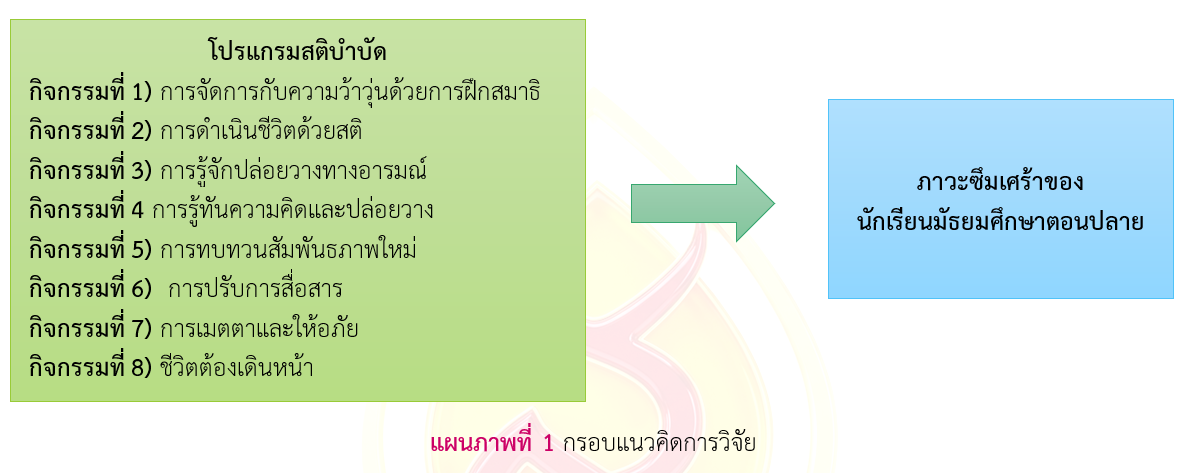
ภาวะซึมเศร้าเป็นปัญหาสุขภาพจิตที่สำคัญ ซึ่งส่งผลกระทบต่อคุณภาพชีวิตในหลายด้าน ทั้งความสัมพันธ์ในครอบครัว เพื่อน และชุมชน รวมถึงอาจก่อให้เกิดปัญหาในการเรียนและการทำงาน การวิจัยกึ่งทดลองแบบสองกลุ่ม วัดผล 3 ระยะนี้ มีวัตถุประสงค์เพื่อศึกษาผลของโปรแกรมสติบำบัดต่อภาวะซึมเศร้าของนักเรียนระดับมัธยมศึกษาตอนปลาย กลุ่มตัวอย่างเป็นนักเรียนชั้นมัธยมศึกษาปีที่ 4 ในโรงเรียนมัธยมศึกษาแห่งหนึ่งในจังหวัดเชียงราย จำนวน 42 คน คัดเลือกโดยการสุ่มจากนักเรียนที่มีคะแนนมากกว่า 22 คะแนน จากแบบคัดกรองภาวะซึมเศร้าในวัยรุ่น แบ่งเป็นกลุ่มควบคุม 21 คน และกลุ่มทดลอง 21 คน โดยกลุ่มทดลองได้รับโปรแกรมสติบำบัดเป็นระยะเวลา 8 สัปดาห์ เก็บรวบรวมข้อมูลระหว่างเดือนพฤษภาคมถึงสิงหาคม ปี 2568 เครื่องมือวิจัยประกอบด้วย 1) โปรแกรมการสติบำบัด และ 2) แบบคัดกรองภาวะซึมเศร้าสำหรับวัยรุ่น ซึ่งมีค่าสัมประสิทธิ์อัลฟ่าของครอนบาค เท่ากับ .78 วิเคราะห์ข้อมูลทั่วไปด้วยสถิติเชิงพรรณนา สถิติไควสแควร์ สถิติฟิชเชอร์ สถิติทีอิสระ และสถิติวิเคราะห์ความแปรปรวนสองทางแบบวัดซ้ำ ผลการศึกษาพบว่า ค่าเฉลี่ยคะแนนภาวะซึมเศร้าของกลุ่มทดลองมีการเปลี่ยนแปลงตามช่วงเวลาแตกต่างจากกลุ่มควบคุมอย่างมีนัยสำคัญทางสถิติ (F(1.13, 1453.06)=14.12, p<.001, partial η²=.26) เมื่อเปรียบเทียบรายคู่ด้วยวิธี Bonferroni พบว่า กลุ่มทดลองมีค่าเฉลี่ยคะแนนภาวะซึมเศร้าหลังการทดลองและระยะ 1 เดือนหลังการทดลองต่ำกว่าก่อนการทดลองอย่างมีนัยสำคัญทางสถิติ (p<.001) ขณะที่กลุ่มควบคุมไม่พบความแตกต่างของค่าเฉลี่ยคะแนนภาวะซึมเศร้าระหว่างช่วงเวลา (p>.05) ผลของการศึกษาครั้งนี้สามารถใช้เป็นแนวทางในการพัฒนาการดูแลและส่งเสริมสุขภาพจิตเพื่อลดภาวะซึมเศร้า และเพิ่มคุณภาพชีวิตของนักเรียนระดับมัธยมศึกษาตอนปลายที่มีผลการประเมินว่าเข้าข่ายมีภาวะซึมเศร้าต่อไป
เอกสารอ้างอิง
Anantaseriwidhya, T., Punyapas, S., & Hosiri, T. (2021). Prevalence and factors associated with depression among boarding school students in Suratthani. Chiang Mai Medical Journal, 60(4), 574–585. https://doi.org/10.12982/CMUMEDJ.2021.50 (in Thai)
Areekit, P., & Lueboonthavatchai, O. (2012). The effect of cognitive behavioral therapy and mindfulness on depression in depressive disorder patients. Journal of Psychiatric Nursing and Mental Health, 26(3), 71–80. (in Thai)
Beck, A. T., Rush, A. J., Shaw, B. F., & Emery, G. (1979). Cognitive therapy of depression. Guilford Press.
Department of Mental Health, Ministry of Public Health. (2022). Emotional instability in adolescents (Part 1). https://dmh.go.th/news/view.asp?id=2503 (in Thai)
Erikson, E. (1959). Identity and the life cycle. International Universities Press.
Gupta, S., Das, S., Das, M., Banerjee, S., Neogi, R., & Mukherjee, S. (2023). Prevalence and correlates of depression, anxiety, and stress among high school students in a block of Hooghly district, West Bengal: A cross-sectional study. Journal of Education and Health Promotion, 12(1), Article e1769. https://doi.org/10.4103/jehp.jehp_1769_22
Information and Communication Technology Center, Office of the Permanent Secretary, Ministry of Public Health. (2026). Report on access to services for patients with depression. Thai Depression. https://thaidepression.com/www/report/main_report/ (in Thai)
Kabat-Zinn, J. (1994). Wherever you go, there you are: mindfulness meditation in everyday life. Hyperion.
Kenbuppha, K., Pianthong, K., Saguanrum, K., & Sukhawaha, S. (2023). Effectiveness of mindfulness-based cognitive therapy for depression: A systematic review. Thai Nursing Council Journal, 40(1). https://he02.tci-thaijo.org/index.php/JPNMH/article/view/263671/181862 (in Thai)
Liu, Q., Yang, X., Zhang, C., & Xiong, J. (2024). Is decreasing problematic mobile phone use a pathway for alleviating adolescent depression and sleep disorders?. Journal of Behavioral Addictions, 13(2), 525–541. https://doi.org/10.1556/2006.2024.00034
Makassawad, R. (2021). Factors influencing depression among upper secondary school students in Pathum Thani Province. Regional Health Promotion Center 9 Journal, 15(38), 528–540. https://he02.tci-thaijo.org/index.php/RHPC9Journal/article/view/251406/171371 (in Thai)
Phaokuntatakorn, W., & Jiratjitan, N. (2021). Effects of mindfulness therapy on depression and quality of life among patients with depressive disorder. Journal of Mental Health of Thailand, 29(4), 286–296. https://he01.tci-thaijo.org/index.php/jmht/article/view/247270 (in Thai)
Piaget, J. (1952). The origins of intelligence in children. International Universities Press. https://doi.org/10.1037/11494-000
Reangsing, C., Seethikaew, N., Kodyee, S., Maneekungwong, K., Pitchalard, K., & Moonpanane, K. (2026). The effects of MyMind application on psychological outcomes among Thai adolescents with depression: A randomized controlled trial. Mindfulness, 17, 1753–1761. https://doi.org/10.1007/s12671-026-02856-0 (in Thai)
Ruanjai, T., Siri, S., Amyong, N., Munsawaengsub, C., & Apidechkul, T. (2024). Prevalence and factors associated with depression among hill-tribe high school students in Chiang Rai Province, Thailand: A multilevel cross-sectional study. Journal of the Medical Association of Thailand, 107(9), 708–717. https://doi.org/10.35755/jmedassocthai.2024.9.708-717-792 (in Thai)
Segal, Z. V., Williams, J. M. G., & Teasdale, J. D. (2002). Mindfulness-based cognitive therapy for depression. Guilford Press.
The Bangkok Insight. (2025, September 10). The number of Thais attempting suicide. https://today.line.me/th/v3/article/BE3Pg9z (in Thai)
Trangkasombat, U., Lapboontrap, W., & Hawannont, P. (1997). Use of the CES-D for screening depression among adolescents. Journal of the Psychiatric Association of Thailand, 42(1), 2-13. https://dmh.go.th/abstract/details.asp?id=4694 (in Thai)
Wongpiromsarn, Y. (2024). Mindfulness-based therapy and counselling (MBTC) manual (5th ed.). knowledge management project on behavioral and psychosocial care in the public health system (Phase 4), Department of Mental Health, Ministry of Public Health. (in Thai)
World Health Organization. (2024, March 6). Adolescent health. https://www.who.int/health-topics/adolescent-health#tab=tab_1
World Health Organization. (2025, March 25). Suicide. https://www.who.int/news-room/fact-sheets/detail/suicide
World Health Organization. (2025, September 2). Over a billion people living with mental health conditions – services require urgent scale-up. https://www.who.int/news/item/02-09-2025-over-a-billion-people-living-with-mental-health-conditions-services-require-urgent-scale-up
Yiamthaisong, S., & Rujkorakarn, D. (2024). Effects of mindful self-compassion enhancing program on depression in junior high school students. Journal of the Psychiatric Association of Thailand, 69(3), 282–292. https://he01.tci-thaijo.org/index.php/JPAT/article/view/270945 (in Thai)
ดาวน์โหลด
เผยแพร่แล้ว
รูปแบบการอ้างอิง
ฉบับ
ประเภทบทความ
สัญญาอนุญาต
ลิขสิทธิ์ (c) 2026 วารสารวิจัยการพยาบาลและสุขภาพ

อนุญาตภายใต้เงื่อนไข Creative Commons Attribution-NonCommercial-NoDerivatives 4.0 International License.

