
Effects of mindfulness based therapy and counseling program on depression among high school students
Keywords:
MBCT, Mindfulness, Depression, High school studentAbstract
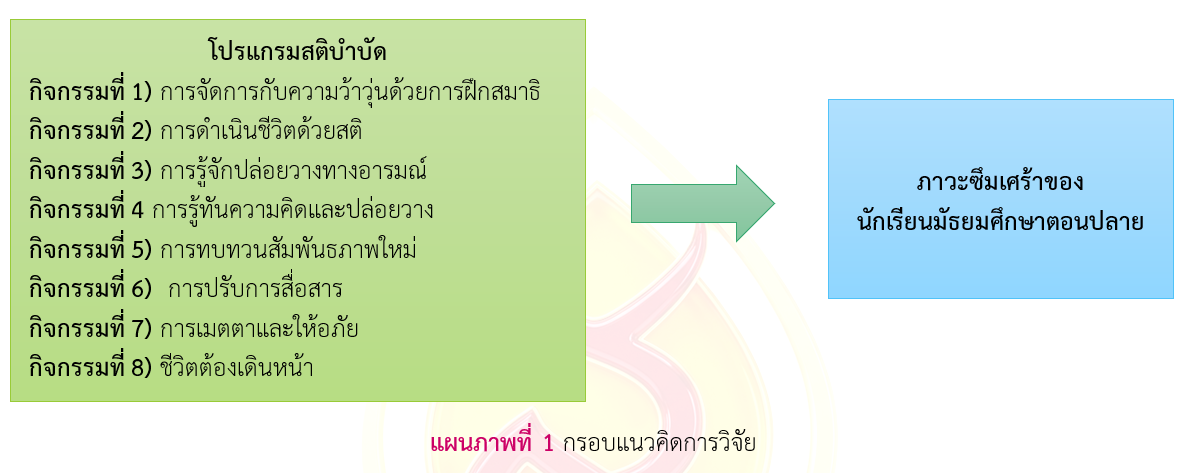
Depression is a significant mental health problem that adversely affects various aspects of quality of life, including relationships with family, peers, and the community, and may also lead to difficulties in academic performance and daily functioning. This quasi-experimental study employing a two-group pretest–posttest design aimed to examine the effects of a mindfulness-based intervention program on depression among high school students. The participants consisted of 42 students from a secondary school in Chiang Rai Province. Participants were recruited through random sampling from students who scored higher than 22 on the Center for Epidemiologic Studies Depression Scale. They were equally assigned into a control group (n=21) and an experimental group (n=21). The experimental group participated in an 8-week mindfulness-based intervention program. Data were collected between May and August 2025. The research instruments included: 1) Mindfulness Based Therapy and Counseling (MBTC) , and 2) the Center for Epidemiologic Studies Depression Scale (CES-D), which demonstrated good reliability with a Cronbach’s alpha coefficient of .78. Descriptive statistics and chi-square tests were used to analyze demographic data, while repeated measures analysis of variance (Repeated Measures ANOVA) was conducted to examine differences in depression scores over time. The findings indicated a statistically significant group-by-time interaction in mean depressive symptom scores, demonstrating that changes in the experimental group over time differed significantly from those observed in the control group (F(1.13, 1453.06)=14.12, p<.001, partial η²=.26) Bonferroni-adjusted pairwise comparisons showed that, in the experimental group, mean depressive symptom scores immediately after the intervention and at the one-month follow-up were significantly lower than the baseline score (p<.001). In contrast, no significant differences across the three measurement time points were observed in the control group (p>.05). The results of this study may serve as a guideline for developing mental health care and promotion programs aimed at reducing depressive symptoms and improving the quality of life of high school students identified as being at risk for depression.
References
Anantaseriwidhya, T., Punyapas, S., & Hosiri, T. (2021). Prevalence and factors associated with depression among boarding school students in Suratthani. Chiang Mai Medical Journal, 60(4), 574–585. https://doi.org/10.12982/CMUMEDJ.2021.50 (in Thai)
Areekit, P., & Lueboonthavatchai, O. (2012). The effect of cognitive behavioral therapy and mindfulness on depression in depressive disorder patients. Journal of Psychiatric Nursing and Mental Health, 26(3), 71–80. (in Thai)
Beck, A. T., Rush, A. J., Shaw, B. F., & Emery, G. (1979). Cognitive therapy of depression. Guilford Press.
Department of Mental Health, Ministry of Public Health. (2022). Emotional instability in adolescents (Part 1). https://dmh.go.th/news/view.asp?id=2503 (in Thai)
Erikson, E. (1959). Identity and the life cycle. International Universities Press.
Gupta, S., Das, S., Das, M., Banerjee, S., Neogi, R., & Mukherjee, S. (2023). Prevalence and correlates of depression, anxiety, and stress among high school students in a block of Hooghly district, West Bengal: A cross-sectional study. Journal of Education and Health Promotion, 12(1), Article e1769. https://doi.org/10.4103/jehp.jehp_1769_22
Information and Communication Technology Center, Office of the Permanent Secretary, Ministry of Public Health. (2026). Report on access to services for patients with depression. Thai Depression. https://thaidepression.com/www/report/main_report/ (in Thai)
Kabat-Zinn, J. (1994). Wherever you go, there you are: mindfulness meditation in everyday life. Hyperion.
Kenbuppha, K., Pianthong, K., Saguanrum, K., & Sukhawaha, S. (2023). Effectiveness of mindfulness-based cognitive therapy for depression: A systematic review. Thai Nursing Council Journal, 40(1). https://he02.tci-thaijo.org/index.php/JPNMH/article/view/263671/181862 (in Thai)
Liu, Q., Yang, X., Zhang, C., & Xiong, J. (2024). Is decreasing problematic mobile phone use a pathway for alleviating adolescent depression and sleep disorders?. Journal of Behavioral Addictions, 13(2), 525–541. https://doi.org/10.1556/2006.2024.00034
Makassawad, R. (2021). Factors influencing depression among upper secondary school students in Pathum Thani Province. Regional Health Promotion Center 9 Journal, 15(38), 528–540. https://he02.tci-thaijo.org/index.php/RHPC9Journal/article/view/251406/171371 (in Thai)
Phaokuntatakorn, W., & Jiratjitan, N. (2021). Effects of mindfulness therapy on depression and quality of life among patients with depressive disorder. Journal of Mental Health of Thailand, 29(4), 286–296. https://he01.tci-thaijo.org/index.php/jmht/article/view/247270 (in Thai)
Piaget, J. (1952). The origins of intelligence in children. International Universities Press. https://doi.org/10.1037/11494-000
Reangsing, C., Seethikaew, N., Kodyee, S., Maneekungwong, K., Pitchalard, K., & Moonpanane, K. (2026). The effects of MyMind application on psychological outcomes among Thai adolescents with depression: A randomized controlled trial. Mindfulness, 17, 1753–1761. https://doi.org/10.1007/s12671-026-02856-0 (in Thai)
Ruanjai, T., Siri, S., Amyong, N., Munsawaengsub, C., & Apidechkul, T. (2024). Prevalence and factors associated with depression among hill-tribe high school students in Chiang Rai Province, Thailand: A multilevel cross-sectional study. Journal of the Medical Association of Thailand, 107(9), 708–717. https://doi.org/10.35755/jmedassocthai.2024.9.708-717-792 (in Thai)
Segal, Z. V., Williams, J. M. G., & Teasdale, J. D. (2002). Mindfulness-based cognitive therapy for depression. Guilford Press.
The Bangkok Insight. (2025, September 10). The number of Thais attempting suicide. https://today.line.me/th/v3/article/BE3Pg9z (in Thai)
Trangkasombat, U., Lapboontrap, W., & Hawannont, P. (1997). Use of the CES-D for screening depression among adolescents. Journal of the Psychiatric Association of Thailand, 42(1), 2-13. https://dmh.go.th/abstract/details.asp?id=4694 (in Thai)
Wongpiromsarn, Y. (2024). Mindfulness-based therapy and counselling (MBTC) manual (5th ed.). knowledge management project on behavioral and psychosocial care in the public health system (Phase 4), Department of Mental Health, Ministry of Public Health. (in Thai)
World Health Organization. (2024, March 6). Adolescent health. https://www.who.int/health-topics/adolescent-health#tab=tab_1
World Health Organization. (2025, March 25). Suicide. https://www.who.int/news-room/fact-sheets/detail/suicide
World Health Organization. (2025, September 2). Over a billion people living with mental health conditions – services require urgent scale-up. https://www.who.int/news/item/02-09-2025-over-a-billion-people-living-with-mental-health-conditions-services-require-urgent-scale-up
Yiamthaisong, S., & Rujkorakarn, D. (2024). Effects of mindful self-compassion enhancing program on depression in junior high school students. Journal of the Psychiatric Association of Thailand, 69(3), 282–292. https://he01.tci-thaijo.org/index.php/JPAT/article/view/270945 (in Thai)
Downloads
Published
How to Cite
Issue
Section
License
Copyright (c) 2026 Journal of Nursing and Health Research

This work is licensed under a Creative Commons Attribution-NonCommercial-NoDerivatives 4.0 International License.

