
Assessment of Indoor Air Quality and Sick Building Syndromes of Workers in a New Hospital Building
Article Sidebar
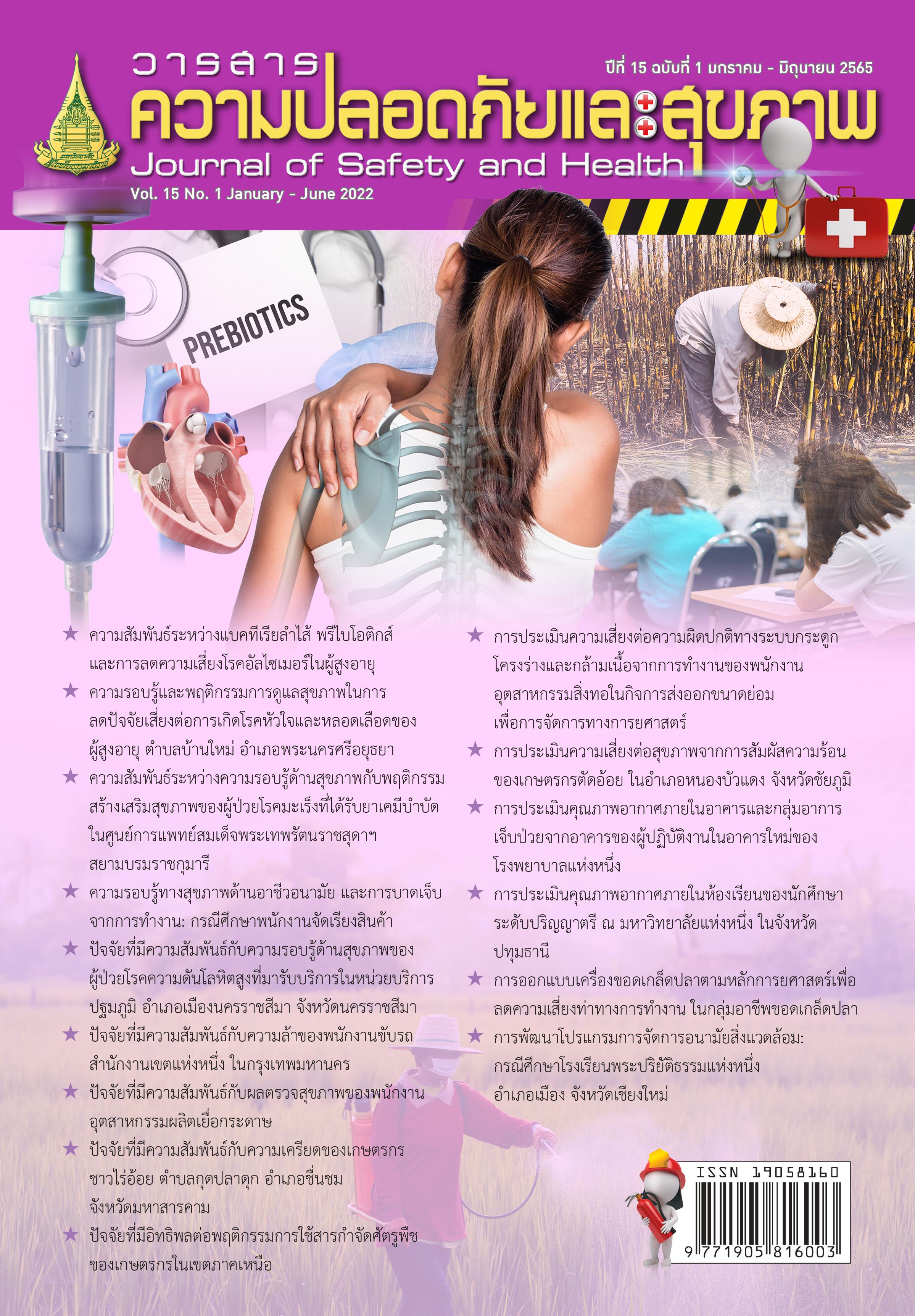
Main Article Content
Abstract
A cross-sectional descriptive study aims to assessment of indoor air quality, relationship between parameters and the prevalence of sick building syndromes among workers in a new hospital building. Indoor air quality assessment i.e., temperature, relative humidity, airborne bacterial and fungal concentrations was obtained in 15 areas using Air Quality Monitor and Andersen single-stage impact. Data collection were gathered using questionnaires from 113 workers. Results of indoor air quality assessment showed that temperature, relative humidity, and airborne bacterial and fungal concentrations exceeded the indoor air quality standard (100.0%, 99.3%, 100.0% and 40.0%, respectively). The correlation analysis of indoor air quality parameters found that indoor temperatures had a statistically significant positive correlation with airborne fungal concentrations (r = 0.540, p-value <0.05). Most workers had a working period in the building of less than 8 hours/day (61.9%), they wear respiratory protective equipment every time while working (38.1%), and the workers were reported experiencing sick building syndrome symptoms (84.95%). In addition, the most common symptom experienced was headache (61.9%). The relationship between the amount of airborne bacterial concentrations were associated with the syndrome, eye and skin statistically significant (p-value = 0.050). The findings indicated that indoor air quality problems may affect to sick building syndromes among workers. Therefore, an inspection of ventilation system should be managed in the new hospital building. Furthermore, regular monitoring is essential for assessing indoor air quality of hospital buildings and for investigating health problems of workers.
Article Details

This work is licensed under a Creative Commons Attribution-NonCommercial-NoDerivatives 4.0 International License.
Journal of Safety and Health is licensed under a Creative Commons Attribution-NonCommercial-NoDerivatives 4.0 International (CC BY-NC-ND 4.0) licence, unless otherwise stated.
References
ก้องนภา อุทังสังข์, และกาญจนา นาถะพินธุ. (2561). ชนิดและปริมาณเชื้อจุลินทรีย์ในอากาศ แผนกผู้ป่วยนอกของโรงพยาบาลสรรพสิทธิประสงค์ จังหวัดอุบลราชธานี. สำนักงานป้องกันควบคุมโรคที่ 7 ขอนแก่น. 25 (2), 14-21.
จุฑามาศ มูลวงษ์. (2558). แนวทางในการจัดการคุณภาพอากาศภายในโรงพยาบาล. วิทยานิพนธ์ปริญญาวิศวกรรมศาสตรมหาบัณฑิต สาขาวิศวกรรมสิ่งแวดล้อม, มหาวิทยาลัยเทคโนโลยีพระจอมเกล้าธนบุรี, กรุงเทพมหานคร.
ดำรงศักดิ์ ร่มเย็น. (2556). ความสัมพันธ์ของปัจจัยด้านสิ่งแวดล้อมจำแนกตามฤดูกาลต่ออัตราการป่วยด้วยกลุ่มอาการป่วยเหตุอาคารของผู้ปฏิบัติงานพยาบาลในโรงพยาบาลมหาวิทยาลัยแห่งหนึ่ง. วิทยานิพนธ์ปริญญาวิทยาศาสตรมหาบัณฑิต สาขาการจัดการสิ่งแวดล้อม, มหาวิทยาลัยสงขลา-นครินทร์, สงขลา.
พรพรรณ สกุลคู, และคณพศ แต่งเมือง. (2561). ปริมาณและชนิดของเชื้อแบคทีเรียในอากาศจากกิจกรรมการให้บริการหลักในคลินิกทันตกรรม กรณีศึกษาโรงพยาบาลชุมชน. สำนักงานป้องกันควบคุมโรคที่ 7 ขอนแก่น. 25 (1), 12-22.
ANSI/ASHRAE/ASHE. (2017). Standard 170-2017: Ventilation of Health Care Facilities. Retrieved December 2, 2020, from https:// www.ashrae.org
Kim, K., Kabir, E., & Jahan, S.A. (2018). Airborne bioaerosols and their impact on human health. Journal of Environmental Science, 67, 23-35.
Qudiesat, K., Abu-Elteen, A., Elkarmi, M., & Hamad, A. M. (2009). Assessment of airborne pathogens in healthcare settings. African Journal of Microbiology Research, 3 (2), 066-076.
Stockwell, R.E., Ballard, E.L., O’Rourke, P., Knibbs, L.D., Morawska, L., & Bell S.C. (2019). Indoor hospital air and the impact of ventilation on bioaerosols: a systematic review. Journal of Hospital Infection, 103, 175-184.
U.S. Environmental Protection Agency (USEPA). (1991, February). Indoor Air Facts No. 4 (revised) Sick Building Syndrome. Retrieved January 4, 2021, from https://www. epa.gov/sites/production/files/2014-08/documents/sick_building_factsheet.pdf
U.S. Environmental Protection Agency (USEPA). (2011). Exposure Factors Handbook. Washington DC: National Center for Environmental Assessment.
U.S. Environmental Protection Agency (USEPA). (2021). Indoor Air Quality (IAQ): Introduction to Indoor Air Quality. Retrieved January 20, 2021, from https://www. epa.gov/indoor-air-quality-iaq/introduction-indoor-air-quality
World Health Organization (WHO). (2009). WHO guidelines for indoor air quality: dampness and mould. Germany: WHO Regional Office for Europe.
World Health Organization (WHO). (2016). Health risk assessment of air pollution. Denmark: WHO Regional Office for Europe.