
Relationships between Health Literacy and Health Promotion Behaviors of Cancer Patients Receiving Chemotherapy in HRH Maha Chakri Sirindhorn Medical Center
Article Sidebar
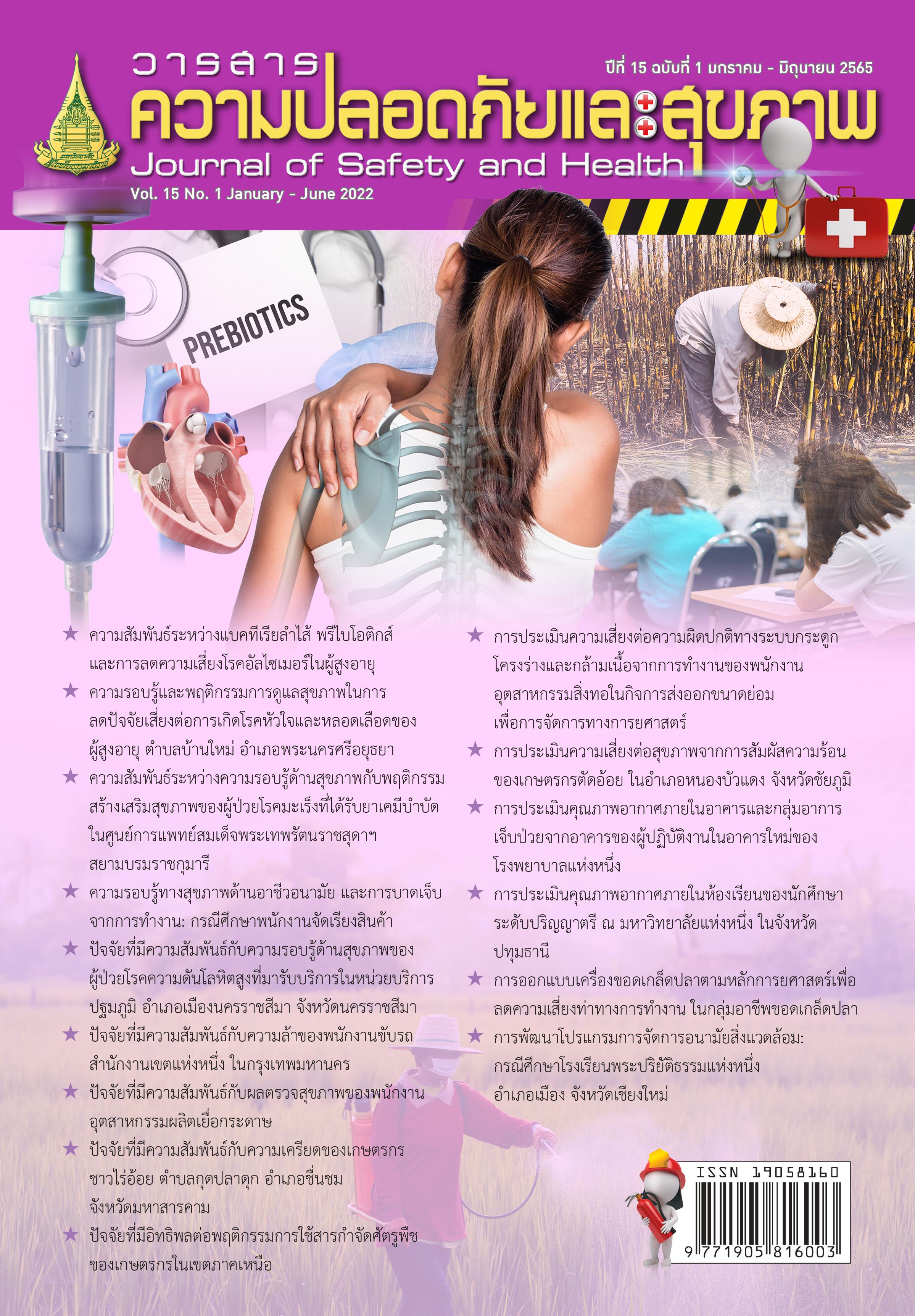
Main Article Content
Abstract
The purposes of this survey research were: (1) to study the level of health literacy about health promotion behaviors of cancer patients receiving chemotherapy; (2) to study the relationship between personal factors and health literacy; and (3) to study the relationship between health literacy and health promotion behaviors of cancer patients receiving chemotherapy in HRH Princess Maha Chakri Sirindhorn Medical Center. Data were collected from 216 people using a questionnaire tested for tool quality. The samples were selected using a specific selection method based on the sample's incusion criteria. The data were analyzed by descriptive statistics for number, percentage, mean, standard deviation, Chi square, Fisher’s exact test and Pearson's correlation coefficient.
The results showed that: (1) the overall level of health literacy about the health promoting behaviors of cancer patients receiving chemotherapy was 38.9 percent; (2) personal factors including gender, age, religion education level, marital status, career, average monthly income, and family history of cancer did not correlate with the level of health literacy; and (3)health literacy was a moderately significant positive correlation with the health promoting behaviors of cancer patients receiving chemotherapy. Increasing opportunities for accessing information and health services help to improve level of health literacy. The health facilities should provide accessible information with effective communication processes, provide health education, and also develop accurate and reliable health media in order to promote healthy behaviors of cancer patients receiving chemotherapy.
Article Details

This work is licensed under a Creative Commons Attribution-NonCommercial-NoDerivatives 4.0 International License.
Journal of Safety and Health is licensed under a Creative Commons Attribution-NonCommercial-NoDerivatives 4.0 International (CC BY-NC-ND 4.0) licence, unless otherwise stated.
References
กองยุทธศาสตร์และแผนงาน, กระทรวงสาธารณสุข. (2563). สถิติสาธารณสุข. สืบค้นเมื่อ 4 สิงหาคม 2563, จาก http://bps.moph.go.th/new_bps/sites/default/files/health_statistic2558.pdf.
กองสุขศึกษา, กระทรวงสาธารณสุข. (2554). ความฉลาดทางสุขภาพ. กรุงเทพฯ: โรงพิมพ์นิวธรรมดาการพิมพ์ (ประเทศไทย) จำกัด.
ธนาลักษณ์ สุขประสาน (2559). ความสัมพันธ์ระหว่างการรู้เท่าทันข้อมูลสุขภาพกับการควบคุมระดับน้ำตาลในเลือดของผู้ป่วยเบาหวานชนิดที่ 2. วิทยานิพนธ์ปริญญาสาธารณสุขศาสตรมหาบัณฑิต, มหาวิทยาลัยธรรมศาสตร์, กรุงเทพฯ.
ปัทมาพร ธรรมผล, นพวรรณ เปียซื่อ, และสุจินดา จารุพัฒนมารุโอ. (2559). ความแตกฉานด้านสุขภาพและผลลัพธ์ทางคลินิกของผู้ที่เป็นความดันโลหิตสูง ไขมันในเลือดผิดปกติ และเบาหวานชนิดที่ 2. วิทยานิพนธ์ปริญญาพยาบาลศาสตรมหาบัณฑิต, มหาวิทยาลัยมหิดล, กรุงเทพมหานคร.
สำนักงานสถิติแห่งชาติ, กระทรวงดิจิทัลเพื่อเศรษฐกิจและสังคม. (2563). สถิติประชากรศาสตร์ประชากรและเคหะ. สืบค้นเมื่อ 4 สิงหาคม 2563, จาก http://www.nso.go.th.
โสภิต ก่อพูนศิลป, และทิพาพร พงษ์เมษา. (2560). คุณภาพชีวิตของผู้ป่วยมะเร็งเต้านมในช่วงการรักษาด้วยยาเคมีบำบัด. สงขลานครินทร์เวชสาร. 35(4), 14-25.
หน่วยงานหลังคลอดและนรีเวช. (2563). สถิติผู้ป่วยหลังคลอด. สืบค้นเมื่อ 4 สิงหาคม 2563, จาก http://www.med.swu.ac.th/msmc/w8-2.
Nutbeam, D. (2008). Health Literacy and adolescents: a framework and agenda for future research. Health Education Research. 23(5). 48-56.
Pender, N.J. (2002). Pender's Health Promotion Theory. Retrieved August 5, 2002, from: http://www.nurse.ubu.ac.th/sub/knowledgedetail/PD.pdf.
Yamane, T. (1970). Determining Sample Size for Research Activities. Educational and Psychological Measurement, 32(4), 567-574.
