
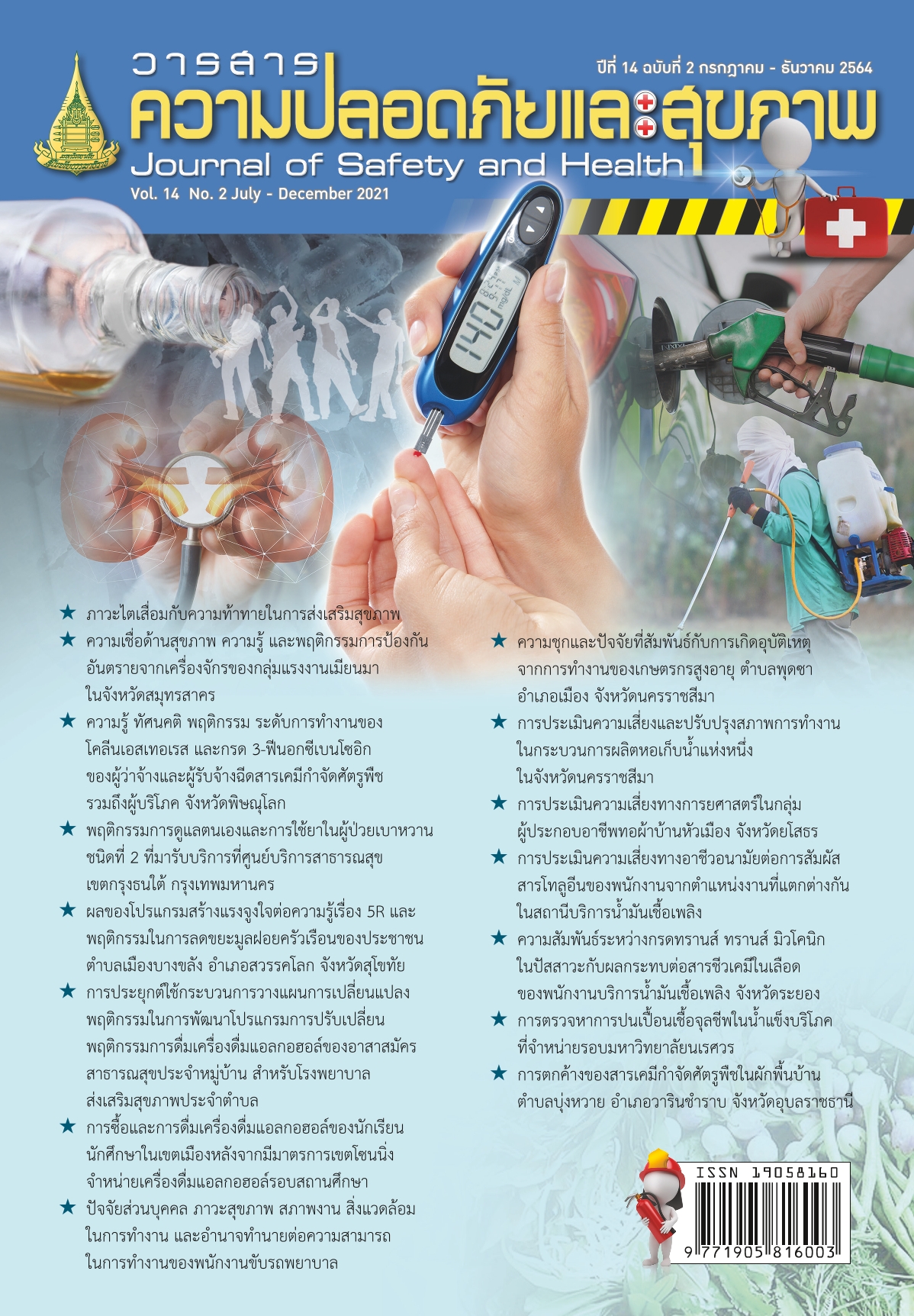
Renal failure with challenges in health promotion
Article Sidebar
Main Article Content
Abstract
Functional deterioration of the kidney is the deterioration of organs according to age. Factors for nephrotic syndrome were consumption foods high in sodium, using of pain medication, supplements, illness with high blood pressure and diabetes was deteriorate faster to renal failure. Signs and symptoms of nephrotic syndrome does not show but can be detected through laboratory examination. Causing disregard to self-care and had kidney failure when it was too lated, the disease is costly to treat. Therefore, disease prevention is a challenge for health workers to health promotion in all age groups.
Health promotion strategies in Thailand in Build healthy public policy also focuses on operating in the sick group, resulting in high costs while health promotion should be focused on low-cost disease prevention, Create supportive environment for health that is conducive to preventing and slowing down the kidneys, although all forms of media are created in a campaign, age groups may need to assess media reach both common media and niche media are different, Strength community action still need to develop community capabilities in participating in managing kidney degeneration problems, especially the campaign and the community measures, Develop personal skill focus was also on the patient population, if ignoring the still sick group may not be a long-term solution, Reorient health services in addition to the screening system for sick groups for treatment, Should focus on high-risk groups, especially working people. That result in cost reductions in the future if these people do not suffer from kidney disease.
Article Details
Journal of Safety and Health is licensed under a Creative Commons Attribution-NonCommercial-NoDerivatives 4.0 International (CC BY-NC-ND 4.0) licence, unless otherwise stated.
References
นีโลบล เนื่องตัน และนันตรา สุวันทารัตน์. (2553). การวัดระดับไมโครอัลบูมินในปัสสาวะ (Microalbuminuria). สืบค้นจาก https://www.si.mahidol.ac.th/th/healthdetail.asp?aid=411
พัชราภัณฑ์ ไชยสังข์, ประทีป หมีทอง. (2561). ปัจจัยที่เป็นตัวทำนายโรคไตเรื้อรังของผู้ป่วยโรคเรื้อรังในชุมชน. The Journal of Prapokklao Hospital Clinical Medical Education Center, 35(2), 26-37.
พัชรีมณี ไพโรจน์. (2562). กระบวนทัศน์การพัฒนาระบบสุขภาพไทย. วารสารพุทธปรัชญาวิวัฒน์ (P-ISSN: 2586-811X, E-ISSN: 2730-2644), 3(2), 62-71.
วรวรรณ ชัยลิมปมนตรี. (2561). โครงการพัฒนาต้นแบบโรงพยาบาลสร้างเสริมสุขภาพในการจัดการอาหารสุขภาพ ลดหวาน มัน เค็ม. สืบค้นจาก https://thlp.ops.moph.go.th/pdf/docdownload
วาสนา รวยสูงเนิน, ดลวิวัฒน์ แสนโสม, นงลักษณ์ เมธากาญจนศักดิ์, สมจิต แดนสีแก้ว, นพนันท์ ชัยภูมิ, รุ่งทิวา ขันธมูล, เกษม ดำนอก. (2561). สถานการณ์การรับประทานอาหารโซเดียมสูงและการรับรู้เกี่ยวกับการบริโภคอาหารโซเดียมสูงกับการเกิดโรคไตเรื้อรังของผู้ป่วยโรคไม่ติดต่อเรื้อรัง 36(3), 242-250.
วิศิษฏ์ สิตปรีชา. (2560). แนวโน้มคนไทยป่วยไตเรื้อรังเพิ่มขึ้น สธ.เร่งผุดคลินิกชะลอไตเสื่อมใน รพ.ทั่วประเทศ. สืบค้นจาก https://www.hfocus.org/content/2017/08/14351
สัมฤทธิ์ ศรีธำรงสวัสดิ์, ไพบูลย์ สุริยะวงศ์ไพศาล, สันติลาภ เบญจกุล และดวงดาว ศรียากูล. (2562) การวิจัยเพื่อพัฒนารูปแบบนำร่องการปฏิรูประบบบริการส่งเสริมสุขภาพป้องกันควบคุมโรคระดับพื้นที่. สถาบันวิจัยระบบสาธารณสุข.
สายหยุด มูลเพ็ชร. (2558). การสำรวจปริมาณโซเดียมที่ขับออกมาทางปัสสาวะและปัจจัยที่มีผลต่อการกินเค็มในกลุ่มผู้ที่มีความเสี่ยงต่อการเป็นความดันโลหิตสูง โรงพยาบาลตำบลดอนแก้ว อำเภอแม่ริม จังหวัดเชียงใหม่. รายงานวิจัยฉบับสมบูรณ์ สำนักงานวิจัยแห่งชาติ (วช.)
สำนักงานกองทุนสนับสนุนการสร้างเสริมสุขภาพ. (2562). ความหมายของนวัตกรรมสร้างเสริมสุขภาพ. สืบค้นจาก https://www.thaihealth.or.th/Content-s9-define
สำนักงานกองทุนสนับสนุนการสร้างเสริมสุขภาพ. (2562). ยุทธศาสตร์ (ยุติ) ความเค็ม. สืบค้นจาก https://www.thaihealth.or.th/Content/47702
สำนักงานกองทุนสนับสนุนการสร้างเสริมสุขภาพ. (2563). เผยสถิติคนไทยติดเค็ม ป่วยโรคไตเรื้อรังกว่า 8 ล้านคน. สืบค้นจาก https://www.thaihealth.or.th/Content
สำนักงานสาธารณสุข จังหวัดนนทบุรี. (2559). การบริโภคอาหารถูกส่วนจากแหล่งอาหารคุณภาพด้วยสูตร อาหาร 2:1:1 และสูตรอาหาร 6:6:1.
สำนักงานหลักประกันสุขภาพแห่งชาติ. (2560). สปสช.เผย 6 ปี ช่วยผู้ป่วยโรคไตเรื้อรังเข้าถึงการรักษา ปัจจุบันดูแลกว่า 2.7 หมื่นราย. สืบค้นจาก https://www.nhso.go.th/frontend/NewsInformationDetail.aspx?newsid=OTU4
สุรศักดิ์ กันตชูเวชศิริ. (2559). ตำราโรคไตเรื้อรัง. พิมพ์ครั้งที่ 1. กรุงเทพฯ : บริษัท เท็กซ์ แอนด์ เจอร์นัล พับลิเคชั่นจำกัด.
สุรศักดิ์ กันตชูเวชศิริ. (2560). คำแนะนำสำหรับการดูแลรักษาโรคไตเรื้อรังแบบองค์รวมชนิดประคับประคอง. สมาคมโรคไตแห่งประเทศไทย. พิมพ์ครั้งที่ 1. สืบค้นจาก http://www.nephrothai.org
Almirall J. (2016). Sodium Excretion, Cardiovascular Disease, and Chronic Kidney Disease. JAMA. Sep 13;316(10):1112. [PubMed]
Bello, A. K., Alrukhaimi, M., Ashuntantang, G. E., Bellorin-Font, E., Gharbi, M. B., Braam, B. and Johnson, D. W. (2018). Global overview of health systems oversight and financing for kidney care. Kidney international supplements, 8(2), 41-51.
Bindroo S., Bryan S., Rodriguez., Hima J., Challa. (2020). Renal Failure. Retrieved From https://www.ncbi.nlm.nih.gov/books/NBK519012/
Boozari, M., Hosseinzadeh, H. (2017). Natural medicines for acute renal failure: A review. Phytotherapy research, 31(12), 1824-1835.
Centre for Food Safety. (2019). Reduction of Dietary Sodium and Sugar. Retrieved From https://www.cfs.gov.hk/english/programme/programme_rdss/FAQ_Sodium_Public.html
Desmedt, S., Spinewine, A., Jadoul, M., Henrard, S., Wouters, D. and Dalleur, O. (2018). Impact of a clinical decision support system for drug dosage in patients with renal failure. International Journal of Clinical Pharmacy, 40(5), 1225-1233.
e Silva, G. F., de Souza, A. L. T., Sousa, B. D. O. P., Watanabe, M., da Fonseca, C. D. and Vattimo, M. D. F. F. (2020). Identification of acute kidney injury in an intensive care unit: parameters for clinical nursing evaluation. Research, Society and Development, 9(3), 80932451.
Khan, Y. H., Mallhi, T. H., Sarriff, A., Khan, A. H. and Tanveer, N. (2018). Prevalence of Chronic Kidney Disease in Asia: A Systematic Review of Population-Based Studies. Journal of the College of Physicians and Surgeons Pakistan, 28(12), 960-966.
Lindner A, Sherrard DJ. (1996). Acute renal failure. N. Engl. J. Med. Oct 24;335(17):1320-1; author reply 1321-2. [PubMed]
Ma, J., Lee, S., Kim, K. and Lee, Y. K. (2020). Sodium reduction in South Korean restaurants: A Daegu-based intervention project. Asia Pacific Journal of Clinical Nutrition, 29(2), 404.
Morales, C. and Rusmevichientong, P. (2020). Dietary Salt-Related Knowledge, Attitude, Behaviors, and Hypertension in a Rural Northern Thailand Population. Current Developments in Nutrition, 4(Supplement_2), 870-870.
Nerbass, F. B., Calice-Silva, V. and Pecoits-Filho, R. (2018). Sodium intake and blood pressure in patients with Chronic Kidney Disease: a salty relationship. Blood Purification, 45(1-3), 166-172.
Park, H. K., Lee, Y., Kang, B. W., Kwon, K. I., Kim, J. W., Kwon, O. S. and Kim, C. (2020). Progress on sodium reduction in South Korea. BMJ Global Health, 5.5: e002028.
Park, S., Lee, H., Seo, D. I., Oh, K. H., Hwang, T. G. and Choi, B. Y. (2016). Educating restaurant owners and cooks to lower their own sodium intake is a potential strategy for reducing the sodium contents of restaurant foods: a small-scale pilot study in South Korea. Nutrition Research and Practice, 10(6), 635-640.
Perlman, A., Heyman, S. N., Matok, I., Stokar, J., Muszkat, M. and Szalat, A. (2017). Acute renal failure with sodium-glucose-cotransporter-2 inhibitors: Analysis of the FDA adverse event report system database. Nutrition, Metabolism and Cardiovascular Diseases, 27(12), 1108-1113.
Wong, A. S. C., Coyle, D. H., Wu, J. H. and Louie, J. C. Y. (2020). Sodium concentration of pre-packaged foods sold in Hong Kong. Public Health Nutrition, 23(15), 2804-2810.
World Health Organization. (1986). Health promotion. Retrieved From https://www.who.int/healthpromotion/conferences/previous/ottawa/en/
World Health Organization. (2020). Salt reduction. Retrieved From https://www.who.int/news-room/fact-sheets/detail/salt-reduction
World Heath Organization. (2000). The World Health Report 2000: Health Systems: Improving performance. Geneva, WHO.
