
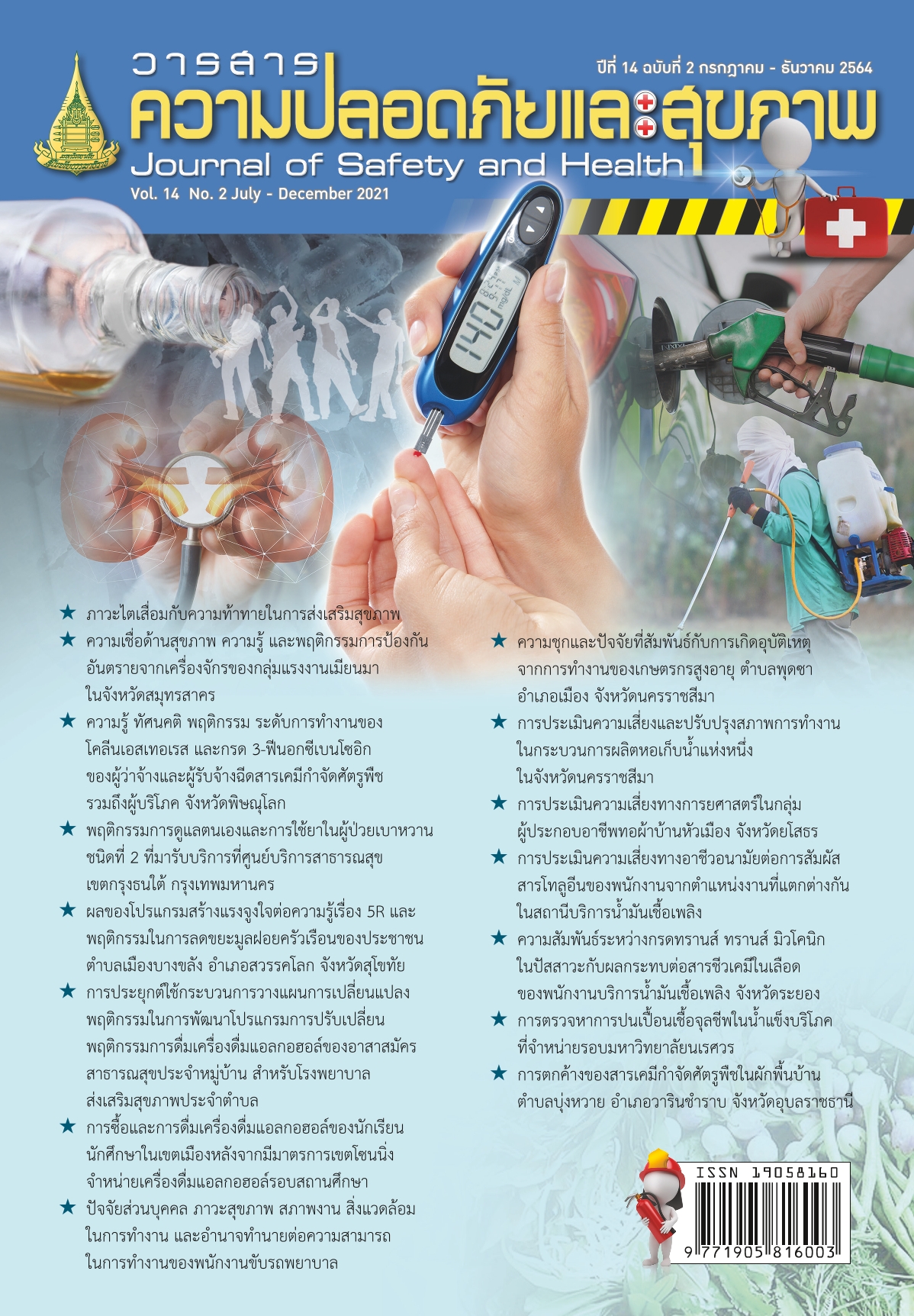
Knowledge, Attitude, Behavior, Cholinesterase Activity, and 3-Phenoxybenzoic Acid Levels among Spraying Workers, Employers, and Consumers in Phitsanulok Province
Article Sidebar
Main Article Content
Abstract
The objectives of descriptive research were to compare the levels of blood acetylcholine esterase (RAChE) activity and urinary 3-hydroxybenzoic acid (3-PBA) between group of pesticide application workers (n=30), farmers who were identified as employers for pesticide applicators (n=30) and consumers (n=30). And the level of knowledge, attitude and behavior about pesticide exposure among pesticide applicators were investigated in Phistanulok province.
The results from each questionnaires, the pesticide application workers showed the most of knowledge, attitude and behaviors at the high level for 75%, 80% and 62%, respectively. Moreover, this study found that pesticide application workers had lower RAChE activity than the employers and consumers, 16.67% was categorized in the health risk group (<3,379.20-5,004.27 U/L) which was higher than employers (6.67%) and consumers (0.00%). According to levels of urinary 3-PBA that were detected in pesticide application worker group, 13.33%, above at higher limit of quantitation (5.0 ng/ml) which was higher than employers (3.33%) and consumers (3.33%). The results of the questionnaire found that majority of the samples were male (51.1%) with primary education (66.7%) and had ever participated the safety practices training (53.3%). The television (25.0%) was the most frequency among the sources of knowledge that pesticide application workers received the information about safety practices but it was the one way communication. Therefore, the involved institutes should value consideration for content and focus on applying two-way communication with community participation to the real target group. Finally, the proper practice training is essential to reduce the risk of chemical exposure among pesticide application workers.
Article Details
Journal of Safety and Health is licensed under a Creative Commons Attribution-NonCommercial-NoDerivatives 4.0 International (CC BY-NC-ND 4.0) licence, unless otherwise stated.
References
ณัฐพร ปลื้มจันทร์ และณิชชาภัทร. (2559). ปัจจัยที่มีความสัมพันธ์กับระดับเอนไซม์โคลีนเอสเทอเรสใน เลือดของเกษตรกรในตาบลเกาะจันทร์ อาเภอเกาะจันทร์ จังหวัดชลบุรี. วารสารพิษ
วิทยาไทย. 30(2), 128-141.
วินัย วนานุกูล. (2550). Poision and Drug Information Bulletin [จุลสาร]. กรุงเทพฯ: คณะแพทยศาสตร์ มหาวิทยาลัยมหิดล.
ศรัทธา ศรีทิพงศ์ และทวีสิน แสงเงิน. (2553). ข้อมูลพื้นฐานด้านการเกษตรจังหวัดพิษณุโลก ประจำปี 2553 [จุลสาร] ค้นเมื่อวันที่ 1 มิถุนายน 2559 จาก
http://chmthai.onep.go.th/chm/data_province/Phitsanulok/doc
ไสว ชัยประโคม. (2559). เส้นทางการเข้าสู่อาชีพและความเสี่ยงอันตรายของคนรับจ้างฉีดพ่นยาฆ่าหญ้า พื้นที่ตำบลหนองแวง อำเภอบ้านผือ จังหวัดอุดรธานี. วารสารการพัฒนาสุขภาพชุมชน.
4(2), 269-290.
Bandura, A. (1986). Social foundations of thought and action: A social cognitive theory. Englewood Cliffs, NJ: Prentice-Hall.
Becker, M.H. & Maiman, L.A. (1975). Sociobehavioural determinants of compliance with medical care recommendations. Medical Care, 1(13), 10-24.
Best, J.W. (1977). Research in education (3rded.). New Jersey: Prentice-Hall.
Bloom, B.S. (1976). Human characteristics and school learning. New York: Mcgraw-hill.
Cronbach L.J. (1978). Citation classics. Current Contents, 13, 263.
Hongsibsong, S., Sittitoon, N. & Sapbamrer, R. (2017). Association of health symptoms with low-level exposure to organophosphates, DNA damage, RAChE
activity, and occupational knowledge and practice among rice, corn, and double-crop farmers. The Journal of Occupational Health. 59, 165-176.
Muñoz-Quezada, M.T., et al. (2013). Neurodevelopmental effects in children associated with exposure to organophosphate pesticides. A systematic review. Neuro
Toxicology, 39, 158-168.
Nassar, A.M.K. (2015). Acethylcholinesterase: a universal toxicity biomarker. Journal of Agriculture and Environmental Sciences, 14(1), 1-14.
Pakvilai, N. (2011). Exposure assessment of synthetic pyrethroid insecticides among school children from an agricultural community (Doctoral dissertation).
Chiangmai: Chiangmai University.
Poapongsakorn, N., Ruhs, M. & Tangjitwisuth, S. (1998). Problems and outlook of agriculture in Thailand. Thailand Development Research Institute, 13, 3–14.
Rendón von, O.J., Epomex, C., Tinoco-Ojanguren, R., Soares ,A.M. & Guilhermino, L. (2004). Effect of pesticide exposure on acetylcholinesterase activity in
subsistence farmers from Campeche, Mexico. Archives of Environmental Health An International Journal, 59(8), 418-425.
Rother, H.A. (2011). Challenges in pesticide risk communication. School of Public Health and Family Medicine, 1, 566-575.
Rovinelli, R.J. & Hambleton, R.K. (1977). On the use of content specialists in the assessment of criterion-referenced test item validity. Dutch Journal of Educational
Research, 2, 49-60.
Shan, G., Huang, H., Stoutamire, D.W., Gee, S.J., Leng, G. & Hammock, B.D. (2004). A sensitive class specific immunoassay for the detection of pyrethroid
metabolites in human urine. Chemical Research in Toxicology, 17, 218–225.
Thiphom, S., et al. (2012). An enzyme-linked immunosorbent assay for detecting 3- phenoxybenzoic acid in plasma and its application in farmers and consumers.
Analytical Methods, 4(11), 3772-3778.
Thiphom, S., Prapamontol, T., Chantara, S., Mangklabruksd, A. & Suphavilaib, C. (2013). A method for measuring cholinesterase activity in human saliva and its
application to farmers and consumers. Analytical Methods, 5, 4687-4693.
Yuantari, M.G., Van G.C.A., Van S.N.M., Widianarko, B., Sunoko, H.R. & Shobib, M.N. (2015). Knowledge, attitude, and practice of Indonesian farmers regarding
the use of personal protective equipment against pesticide exposure. Environmental Monitoring and Assessment, 187(3), 142.
