Effectiveness of Health Promotion Program in heart failure patients
Article Sidebar
Main Article Content
Abstract
This quasi – experimental research using a two groups design aimed to examine the effectiveness of health promotion program in heart failure patients. A sample of 60 heart failure patients and 10 registered nurses were recruited. A sample of 30 heart failure patients were randomly assigned to the experimental and the control groups equally. The experimental group received a series of 5-health promotion program for 12 weeks. The research instruments consisted of: 1) the health promotion program in heart failure patients, 2) a self-care handbook for patients and 3) a nursing guide of patients with heart failure. Data were collected using: 1) the self- care behaviors questionnaire, 2) a patient’s knowledge 3) a patient’s satisfaction questionnaire for patients' satisfaction, 4) a patient’s readmission record, 5) a nurse’s knowledge test, and 6) ) a nurse’s satisfaction questionnaire. Those tool were tested yielding a value of .93, .85, .89, .88, and .81 respectively. Data were analyzed using percentage, mean, standard deviation, and Paired t – test.
The results showed that a comparison of the average score on knowledge and self-care behaviors of the experimental group after getting the intervention was significant higher than before getting the intervention. A comparison of the average score on knowledge and self-care behaviors after getting the intervention, the experimental group was significant higher than the control group. The patient’s satisfaction of the experimental group was also significant higher than the control group. Readmission rate of the experimental group was lower than the control group. The average score of the nurse’s knowledge after using the program was significant higher than before using the program. The nurse’s satisfaction towards this model was quite high.
Article Details
References
2. WHO. Cardiovascular diseases (CVDs).[online]. 2017 [cited 2019 Juy 10]; Avaliable from http://www.who.int/ cardiovascular_diseases/about_cvd/en/.
3. WHO. Global status report on non communicable disease, 2010. Geneva: World Health Organization; 2011.
4. The Association of Cardiologists of Thailand under the Royal Patronage. (2013). Integrated Heart Failure Patient Care Manual. Chiang Mai: Faculty of Medicine,
Chiang Mai University; 2013. Thai.
5. The Association of Cardiologists of Thailand under the Royal Patronage. Diagnostic Practice Guidelines and Treatment of patients with heart failure 2019.
Bangkok: Neck Step Design Ltd., 2019. Thai.
6. Sirichaya Angkulkhajorn & Sunida Prechawong.The effect of health promoting program applying Pender’s model on dietary and medication adherence in
adult patients with heart failure. Thai Journal of Cardio-Thoracic Nursing 2014; 25(2):77-89. Thai.
7. Autchariya Poungkaew. Nursing management in in heart failure patients. Medical nursing 2, 3rd ed. Bangkok: N. P. Press limited; 2017. Thai.
8. Phonphan Therdsuthiranaphum Effects of Self-Care Promotion Program on Self-Care Behavior and Quality of Life of Patients with Heart Failure, Prachuap
Khiri Khan Hospital. Journal of Cardiovascular Disease. 2015;26 (1): 2-14. Thai.
9. Orem DE, Taylor SG, Renpenning KM. (2001). Nursing: Concepts of practice 6th ed. St. Louis: Mosby. Pichayapinyo, P, 2013.
10. Somchit Hanucharoenkul. Nursing: The Science of Practice. Bangkok: VJ Printing, 2001. Thai.
11. Woraphan Mahasaranon, Thiti-arpa Tangkhanich and Rungnaphachai Ratana. Study the results of the program. Towards self-care and quality of life of
ischemic heart patients. Journal of Cardiovascular Disease 2018;30 (1):102-16. Thai.
12. Manakorn Sripebua. Effects of a supportive and educative nursing program on foot care efficacy and foot care behavior in diabetic patients at risk of foot
ulcers. (thesis). Chonburi: Graduate School Burapha University; 2014. Thai.
13. Office of Policy and Strategy. 20-year national strategic plan (public health). [Internet]. 2017. [cited 2019 Jan 28]; Available from
https://waa.inter.nstda.or.th/stks/pub/2017/20171117-Ministry of Public Health.pdf. Thai.
14. Public Health Administration Division Driving the Health Service System Development Plan 2017-2021, Bangkok: The Agricultural Cooperative Association of
Thailand Press; 2017. Thai.
15. Information and Communication Technology Center Ministry of Public Health. Indicators of Service plan in the field of cardiovascular disease. [online]. 2563
[cite 2563 Jul 8]; Available from https://hdcservice.moph.go.th/hdc/report/kpi_php. Thai.
16. Saraburi Hospital Diagnostic statistics of Saraburi Hospital. [Internet]. 2018 [cited 2019 Aug 20]. Available from: http://10.0.255.1/service/GetICDStat.asp. Thai.
17. Ratsiri Tato. Nursing Research: Concept to Application. 2.nd Bangkok: Chulalongkorn University Press; 2009. Thai.
18. Melnyk BM, Fineout-Overholt, E. Evidence-based practice in nursing & healthcare. Philadelphia, PA: Lippincott Williams & Wilkins; 2005.
19. Grace J. Essential skills for evidence-based practice: Strength of evidence. J Nurs Sci. 2009;27(2):8-13.
20. Hackman JR, Oldham GR. Work Redesign. California: Addition Wesley Publishing Company Inc; 1980.
21. Chanjira Kiatsisakul, Suprida Mankong, Orsaphan Phakdee, Thanarat Chunngam. Self-care behavior and the severity of heart failure. Journal of
Cardiovascular Nursing. 2008;19(2):23-39. Thai.
22. Kanokwan Leaudtahan. Effects of a Supportive and Educational Nursing Program on Self-Care Behavior and Severity Index of Patients with Severe Obstructive
Pulmonary Disease. (thesis). Phitsanulok: Graduate School Naresuan University; 2015. Thai.
23. Chantima Rerkmunrit, Patcharin Kwanchai, Tasanee Soi-on. Effects of a support and education program on activity and self-care abilities of people with
heart failure. Ramathibodi Nursing Message. 2012;18(1):102-118. Thai.
24. Phonphan Therdsuthiranaphum. Effects of Self-Care Promotion Program on Self-Care Behavior and Quality of Life of Patients with Heart Failure, Prachuap
Khiri Khan Hospital. Journal of Cardiovascular Disease. 2015;26(1): 2-14. Thai.
25. Suchayada Khunsathian, Wanna Arame, Pranee Thongsai, Thavorn Sapthaweesin. Study the effect of informational programs in mothers / carers of
children with congenital heart disease in postoperative crises. Journal of Nursing Siriraj. 2012;5(1):1-13. Thai.
26. Molloy GJ, Johnston DW, Withame MD. Family caregiving and congestive heart failure Review and analysis. European Journal of Cardiovascular
Nursing. 2009;7:592-603.
27. Siriwan Chaikitamnuaychok and Jirapan Anburi. Development of the Transitional Care Program for Heart Failure Kamphaengphet Hospital. Journal of Nursing
Council. 2015;30(4): 45-56. Thai.
28. Thitima Tasuwan-in, et al. Effects of Self-Management Promotion on Quality of Life and Recurrence Rates of Elderly People with Heart Failure. Nursing
Materials. 2019;46(4):108-121. Thai.
29. Penchan Saenprasarn Duangkamon Watradun Ubon Chumchinda Vari Vanichpanjapon and Nawarat Suthipongstics
Articles
Editorial
Report Generator
Current Journal:
Journal of Nursing Division
Tasks 16
English
ภาษาไทย
View Site
sasamonss
View Profile
Logout
QuickSubmit Plugin
This plugin allows you to quickly add complete submissions to the production stage or directly into an issue.
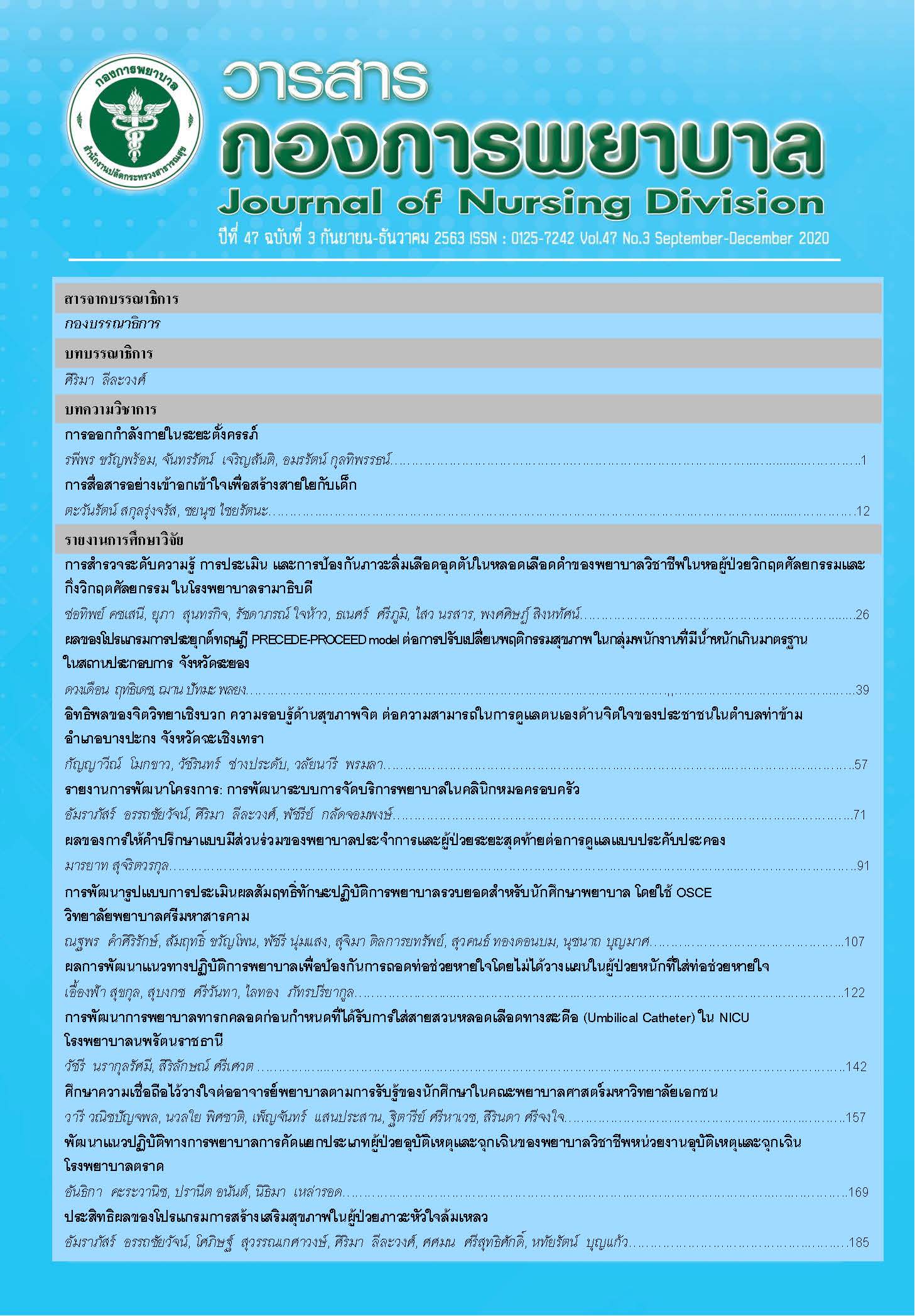
Cover image
Submission Language
ภาษาไทย
Submissions in several languages are accepted. Choose the primary language of the submission from the pulldown above.*
Section
บทความการศึกษาวิจัย
Articles must be submitted to one of the journal's sections.*
Prefix
Examples: A, The
Title*
ประสิทธิผลของโปรแกรมการสร้างเสริมสุขภาพในผู้ป่วยภาวะหัวใจล้มเหลว
Subtitle
Abstract*
Upload
Submission Metadata
These specifications are based on the Dublin Core metadata set, an international standard used to describe journal content.
Additional Refinements
Keywords*
ประสิทธิผล×โปรแกรม การสร้างเสริมสุขภาพ×ผู้ป่วยภาวะหัวใจล้มเหลว×
Supporting Agencies
References
. Effectiveness of Self-Knowledge Building
Program in Cardiovascular Nursing in Community Hospital Nurses. Journal of Cardiovascular Disease. 2017;28 (2):140-53. Thai.
30. Jiraporn Chimkaew, Yuwayong Chantarawichit and Somboon Tansupaswasikul. Effects of a Supportive and Educating Nursing Program on Self-Care Behaviors
of Recurrent Heart Failure Patients. Journal of Nursing and Health. 2018;12(Special ed.): 86-96. Thai.
