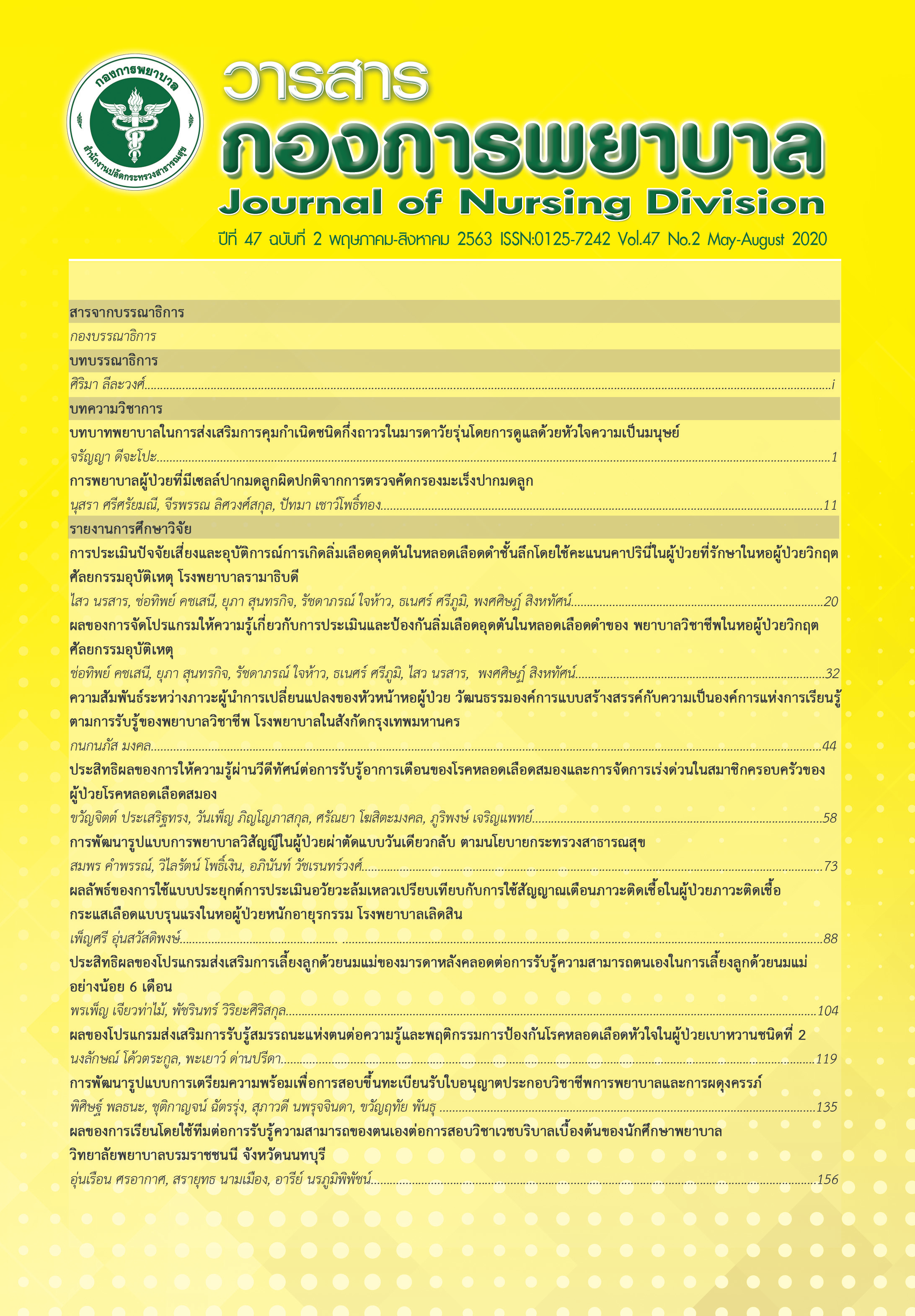
การประเมินปัจจัยเสี่ยงและอุบัติการณ์การเกิดลิ่มเลือดอุดตันในหลอดเลือดดำชั้นลึกโดยใช้คะแนนคาปรินี่ในผู้ป่วยที่รักษาในหอผู้ป่วยวิกฤตศัลยกรรมอุบัติเหตุ โรงพยาบาลรามาธิบดี
Article Sidebar
Main Article Content
บทคัดย่อ
การวิจัยนี้เป็นการศึกษาไปข้างหน้าเชิงสังเกต เพื่อศึกษาอุบัติการณ์การเกิดลิ่มเลือดอุดตันในหลอดเลือดดำ ชั้นลึก ประเมินค่าความเที่ยงของแบบประเมินความเสี่ยงคาปรินี่ และการจัดกลุ่มตามระดับความเสี่ยงต่อการเกิดลิ่มเลือดอุดตันในหลอดเลือดดำชั้นลึก โดยใช้แบบประเมินความเสี่ยงคาปรินี่ซึ่งแปลเป็นไทยโดยผู้วิจัย ผู้ป่วยทุกรายที่เข้ารับการรักษาในหอผู้ป่วยวิกฤตศัลยกรรมอุบัติเหตุในช่วงที่เก็บข้อมูลจะได้รับการประเมินความเสี่ยงคาปรินี่ โดยพยาบาล 2 คน คือพยาบาลประจำการ 1 คน และผู้วิจัย 1 คน (ประเมินซ้ำทุกราย) วิเคราะห์ข้อมูลใช้โดยสถิติบรรยาย และโคเฮน แคปปา
ผลการศึกษาในกลุ่มตัวอย่างจำนวน 101 ราย พบว่า แบบประเมินคาปรินี่มีค่าสัมประสิทธิ์โคเฮนแคปปาเท่ากับ .665 และพบผู้ป่วยที่เป็นกลุ่มตัวอย่างเกิดลิ่มเลือดอุดตันในหลอดเลือดดำทั้งหมด 4 ราย (ร้อยละ 3.96) โดยเกิดลิ่มเลือดอุดตันในหลอดเลือดดำชั้นลึกร่วมกับลิ่มเลือดอุดตันที่ปอด 2 ราย (ร้อยละ 1.98) และเกิดลิ่มเลือดอุดตันที่ปอดอย่างเดียว 2 ราย (ร้อยละ 1.98) ผู้ป่วยที่มีภาวะลิ่มเลือดอุดตันในหลอดเลือดดำชั้นลึก มีค่าคะแนนความเสี่ยงคาปรินี่ตั้งแต่ 11 คะแนนขึ้นไป การศึกษาครั้งนี้ สรุปว่าแบบประเมินความเสี่ยงคาปรินี่ฉบับภาษาไทยมีความเที่ยง พยาบาลสามารถนำแบบประเมินความเสี่ยงคาปรินี่นี้มาใช้ในการประเมินความเสี่ยงของผู้ป่วย และควรจัดระดับความเสี่ยงใหม่เพื่อจะได้ให้การป้องกันได้อย่างเหมาะสม
Article Details
เอกสารอ้างอิง
2. Boddi M, Peris A. Deep vein thrombosis in intensive care. Adv Exp Med Biol. 2017;906:167-81.
3. Minet C, Potton L, Bonadona A, et al. Venous thrombo embolism in ICU: main characteristics, diagnosis and thromboprophylaxis. Crit Care. 2015;19(1):287.
4. Ejaz A, Ahmed MM, Tasleem A, et al. Thromboprophylaxis in Intensive Care Unit Patients: A Literature Review. Cureus. 2018;10(9):e3341.
5. Boonyawat K, Crowther MA. Venous thromboembolism prophylaxis in critically ill patients. Semin Thromb Hemost. 2015;41(1):68-74.
6. Supparerk P, Monravee T, Suvit S, et al. Incidence and associated factors of deep vein thrombosis in Thai surgical ICU patients without chemoprophylaxis: One Year Study. J Med
Assoc Thai. 2015;98(5):472-8.
7. Chibbaro S, Cebula H, Todeschi J, et al. Evolution of prophylaxis protocols for venous thromboembolism in neurosurgery: results from a prospective comparative study on low
molecular-weight heparin, elastic stockings, and intermittent pneumatic compression devices. World Neurosurg. 2018;109:e510-16.
8. Scolaro JA, Taylor RM, Wigner NA. Venous thromboembolism in orthopedic trauma. J Am Acad Orthop Surg. 2015;23(1):1-6.
9. Nunno A, Li Y, Pieters TA, et al. Risk factors and associated complications of symptomatic venous thromboembolism in patients with craniotomy for meningioma. World Neurosurg.
2019;122:e1505-10.
10. Ganau M, Prisco L, Cebula H, et al. Risk of deep vein thrombosis in neurosurgery: state of the art on prophylaxis protocols and best clinical practices. J Clin Neurosci. 2017;45:60-6.
11. Sermsathanasawaddi N, Thongrod R, yakira K, et al. Prevalence of perioperative asymptomatic proximal deep vein thrombosis in Thai gynaecologic cancer patients. J Med Assoc
Thai. 2014;97(2):153-8.
12. Bauersachs RM. Clinical presentation of deep vein thrombosis and pulmonary embolism. Best Pract Res Clin Haematol. 2012;25(3):243-51.
13. Jeraq M, Cote DJ, Smith TR. Venous thromboembolism in brain tumor patients. Adv Exp Med Biol. 2017;906:215-28.
14. Caprini JA. Thrombosis Risk Assessment as a Guide to Quality Patient Care. Dis Mon. 2005;51(2-3):70-8.
15. Marauyad Y, Pranee S. Sampling for research [Internet]. 2018 [cited 2019 Aug 20]. Available from: http://www.fsh.mi.th/km/wp-content/uploads/2014/04/resch.pdf. Thai.
16. Pannucci CJ, Bailey SH, Dreszer G, et al. Validation of Caprini risk assessment model in plastic and reconstructive surgery patients. J Am Coll Surg. 2011; 212(1):105-12.
17. Pasunun P. Evaluation of inter-rater reliability using Kappa statistics. J Faculty Applied Art. 2015; 8(1):2-20. Thai.
18. Champon W, Kidakorn K, Suthas H, et al. Deep venous thrombosis in surgical intensive care unit: prevalence and risk factors. Asian J Surg. 2009;32(2):85–8.
19. Obi AT, Pannucci CJ, Nackashi Andrew, et al. Validation of the Caprini Venous Thromboembolism Risk Assessment Model in Critically Ill Surgical patients. JAMA Surg.
2015;150(10):941-8.
20. Bahl V, Hu HM, Henke PK, Wakefield TW, Campbell DA, Caprini JA. A validation study of retrospective venous thromboembolism risk scoring method. Ann Surg. 2010; 251(2):344-50.
