
ความรอบรู้ด้านสุขภาพจิตและความทุกข์ทางใจในผู้ที่เป็นมะเร็งระยะลุกลาม
บทคัดย่อ
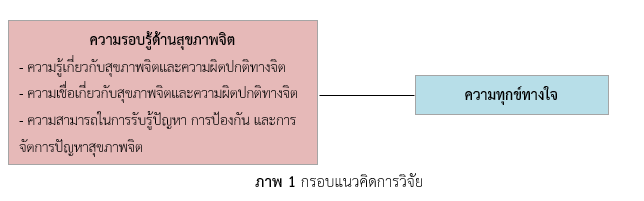
การวิจัยครั้งนี้เป็นการวิจัยเชิงพรรณนาหาความสัมพันธ์ มีวัตถุประสงค์เพื่อศึกษาหาความสัมพันธ์ระหว่าง ความรอบรู้ด้านสุขภาพจิตและความทุกข์ทางใจในผู้ที่เป็นโรคมะเร็งระยะลุกลาม กลุ่มตัวอย่างคือผู้ที่เป็นโรคมะเร็งระยะลุกลาม อาศัยอยู่ในเขตพื้นที่รับผิดชอบของโรงพยาบาลส่งเสริมสุขภาพตำบลภาคตะวันออกเฉียงเหนือ จำนวน 106 คน โดยการสุ่มแบบหลายขั้นตอนเครื่องมือที่ใช้เป็นแบบประเมินความทุกข์ทางใจเคสเลอร์ 10 มีค่าความตรงของเนื้อหาเท่ากับ .95 โดยค่าความเชื่อมั่นสัมประสิทธิ์แอลฟาของครอนบาคเท่ากับ .89 และแบบประเมินความรอบรู้ด้านสุขภาพจิตมีค่าความตรงของเนื้อหาอยู่ระหว่าง .80 ถึง 1.0 โดยค่าความเชื่อมั่นสัมประสิทธิ์แอลฟาของครอนบาค .81 และ .88 ตามลำดับ วิเคราะห์ข้อมูลหาค่าความถี่ ร้อยละ ค่าเฉลี่ย ส่วนเบี่ยงเบนมาตรฐาน และสัมประสิทธิ์สหสัมพันธ์สเปียแมน ผลการศึกษาพบว่า
1. ผู้ที่เป็นโรคมะเร็งระยะลุกลาม มีความรอบรู้ด้านสุขภาพจิตโดยรวมของกลุ่มตัวอย่างอยู่ในระดับสูง (M = 8.94, SD = 1.98) และมีความทุกข์ทางใจคะแนนเฉลี่ย 22.38 คะแนน (SD = 7.67) ซึ่งมีแนวโน้มที่จะผิดปกติปานกลางร้อยละ 37.70 รองลงมาคือมีแนวโน้มที่จะมีความผิดปกติเล็กน้อย ร้อยละ 32.10 อยู่ที่ระดับค่อนข้างปกติ ร้อยละ 23.60 และมีแนวโน้มที่จะผิดปกติอย่างรุนแรง ร้อยละ 6.60 ที่ต้องเข้าสู่กระบวนการรักษาโดยพบผู้เชี่ยวชาญด้านสุขภาพจิต
2. ความสัมพันธ์ระหว่างความรอบรู้ด้านสุขภาพจิตและความทุกข์ทางใจในผู้ที่เป็นมะเร็งระยะลุกลาม มีความสัมพันธ์กันทางลบในระดับปานกลาง (r = -.626) อย่างมีนัยสำคัญทางสถิติที่ระดับ .01 (p-value < .01)
ผลการวิจัยนี้สามารถนำไปเป็นข้อมูลพื้นฐานแก่บุคลากรสาธารณสุขที่มีส่วนเกี่ยวข้องในการพัฒนาความรอบรู้ด้านสุขภาพจิตให้แก่ผู้ที่เป็นโรคมะเร็งระยะลุกลามเพื่อหาแนวทางในการจัดการกับความทุกข์ทางใจในผู้ที่เป็นโรคมะเร็งระยะลุกลามในลำดับต่อไป
เอกสารอ้างอิง
Banks, E., Byles, J. E., Gibson, R. E., Rodgers, I. A., Latz, I. K., Robinson, A. B., et al. (2010). Is psychological distress in people living with cancer related to the fact of diagnosis, current treatment or level of disability? findings from a large Australian study. The Medical Journal of Australia, 193(5), S62-S67. doi:10.5694/j.13265377.2010. tb03931.x
Buajan, A., Phetnui, T., & Sawat, T. (2018). Depression and Quality of Life among Cancer Patients in Chaiyaphum District area, Chaiyaphum Province. Nakhon Phanom University Journal 25th Anniversary Academic Conference Issue, 132-139. (in Thai)
Chaichompoo, R., Namvongprom, A., Pakdevong, N., Preechakoon, P. & Ounlam, T. (2019). Relationship between symptom severity and distress in patients with advanced cancer. Journal of Nursing and Health Sciences, 13(4), 107-119. (in Thai)
Chengtawee, P. & Sirilerttrakul, P. (2017). Factors Related to depressive episode among the colorectal cancer patients receiving chemotherapy: A case study at oncology unit, Ramathibodi Hospital. Srinakarin Medical Journal, 32(1), 64-70. (in Thai)
Cheung, Y. T., Ong, Y. T., Tan, Y. P., Fan, G., Chan, C. W., Molassiotis, A. et al. (2015) Assessment of mental health literacy in patients with breast cancer. Journal of Oncology Pharmacy Practice, 1(1), 1-11. doi: 10.1177/1078155215587541
Chirawatkul, A. (2015). “Statistics for Health Science Research. (2nd ed.)”. Bangkok: S. Asia Press (1989): Company Limited. (in Thai)
Committee for Preparing the National Cancer Prevention and Control Plan. (2020). National Cancer Prevention and Control Plan 2020-2022. Nonthaburi: Ministry of Public Health. (in Thai)
Department of Medical Services Planning and Evaluation Working Group. (2019). Strategic Plan of the National Cancer Institute 2019-2022. Nonthaburi: Ministry of Public Health. (in Thai)
Gray, J. R., Grove, S. K., & Sutherland, S. (2016). Burns and Grove’s the Practice of Nursing Research-E-Book: Appraisal, Synthesis, and Generation of Evidence: Elsevier Health Sciences.
Henson, K.E., Brock, R., Charnock, J., Wickramasinghe, B., Will, O., & Pitman, A. (2019). Risk of suicide after cancer diagnosis in England. JAMA Psychiatry,76(1), 51-61.
Inchaithep, S., Puasiri, S., Punsawat, M., Thungmepon, P., & Robkob, W. (2018). Development of mental health literacy indicators for the public. Journal of Rajachonnani Uttaradit College of Nursing, 10(2), 97-109. (in Thai)
Jorm, A. F., Korten, A. E., Jacomb, P. A., Christensen, H., Rodgers, B., & Pollitt, P. (1997). Mental health literacy: a survey of the public’s ability to recognize mental disorders and their beliefs about the effectiveness of treatment. The Medical Journal Australia, 166(4), 182-186.
Kessler, R., & Mroczek, D. (1994). Final Versions of Our Non-Specific Psychological Distress Scale. Ann Arbor, MI: Survey Research Center of the Institute for Social Research, University of Michigan.
Kongsuwan, W. & Khongthong, S. (2013). “Sad state. In Nilmanat, K., Kongsuwan, W.” Common phenomena in the final stages of life and care. (pp. 100-120). Songkhla: Joy print. (in Thai)
Lazarus & Folkman. (1984). Stress, Appraisal, and Coping. New York: Springer
Likittrakankul, I., Anson, B., Chaiyasilp, P., Phetkan, R., Poolsawat, P., Nueatet, Y., et al., (2016). Strategies to Promote Financial Saving in Adulthood to Prepare for Seniorhood. Songkhla: Technical Promotion and Support Office 1–12, Songkhla. (in Thai)
Lu, D., Andersson, T. M. L., Hultman, K. F., Czene, K., Valdimarsdottir, U., & Fang, F. (2016). Clinical diagnosis of mental disorders immediately before and after cancer diagnosis: A nationwide matched cohort study in Sweden. JAMA Oncology, 2(9), 1188-1196.
Namdej, N., Phongsakchal, P. & Sangournpak, O. (2018). Mental health literacy among senior high school students in Saraburi province. Journal of Nursing and Education, 11(3), 125- 138. (in Thai)
Okuyama, T., Nakane, Y., Endo, C., Seto, T., Kato, K., & Seki, N., et al. (2006). Mental health literacy in Japanese cancer patients: ability to recognize depression and preferences of treatments-comparison with Japanese lay public. Psycho-Oncology, 16(9), 834-842. doi: 10.1002/pon.1119.
Phosai, W., Bunchu, R., Wattraduly, D., Makkappalanon, K., & Tangkratok, P. (2020). Mental health literacy and quality of life among patients with stroke, Chiang Mai Medical Journal, 60(1), 63-74.
Poon, S. H., Wang, F. Q., Goh, J., Chan, Y.H., & Lim, C. L. (2019). Mental health literacy in cancer outpatients in Singapore. East Asian Archives of Psychiatry, 29(3), 91-94. doi: 10.12809/ eaap1813
Rahman, M. A., Islam, S. M. S., Nitayawan, S., Inthong, S., Tungpunkom, P., Thongyu, R., et al., (2021). COVID -19: Factors associated with psychological distress, fear, and coping strategies among community members across 17 countries. Global Health, 17(117) 1-19.
Srisathitnarakun, B. (2007). The Methodology in Nursing Research (4th Edition). Bangkok: UANI Intermedia. (in Thai)
Sriwichai, N., Boonchiang, W., & Kreausukon, P. (2021). The correlation between mental health literacy, mental well-being, and loneliness among the student at Chiang Mai university. Humanities Journal, 22(1), 143-161. (in Thai)
Sumneangsanor, T. (2013). Coping with loss and grief. Journal of Science and Technology, 21(7), 658-667. (in Thai)
Temtab, S. & Nilmanat, K. (2017). The relationship between psychological distress and coping strategies in patients with advanced or terminal stage hepatocellular carcinoma: A cross-sectional descriptive study. Songklanagarind Journal, 35(4), 313-324. (in Thai)
Thasaneesuwan, S. & Nilmanat, K. (2019). Psychological Distress in Patient with Cancer Undergoing Chemotherapy and Nursing Care. Songklanagarind Journal of Nursing, 39(4), 110-119. (in Thai)
World Health Organization. (2022) . Global Cancer Observatory: Cancer Today. Lyon: International Agency for Research on Cancer.
ดาวน์โหลด
เผยแพร่แล้ว
ฉบับ
ประเภทบทความ
สัญญาอนุญาต
ลิขสิทธิ์ (c) 2024 วารสารการพยาบาลและการศึกษา

อนุญาตภายใต้เงื่อนไข Creative Commons Attribution-NonCommercial-NoDerivatives 4.0 International License.


