
Parental Nutritional Literacy and Its Association with the Nutritional Status of Children in Northeastern Thailand: A Cross-Sectional Study
Keywords:
Parental Nutritional Literacy, Nutrition Status, Late primary school-aged children, SociodemographicAbstract
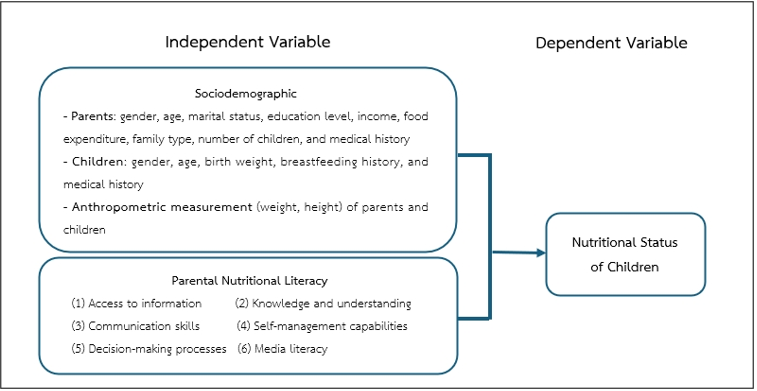
This cross-sectional descriptive study aimed to evaluate gender-based differences in parental nutritional literacy and to investigate its association with the nutritional status of school-aged children in Sakon Nakhon Province, Thailand. A total of 414 parent-child dyads were recruited through multistage sampling. Parental nutritional literacy was assessed across six domains using a validated instrument (Item-Objective Congruence index = .78; overall Cronbach’s alpha = .84). Children’s nutritional status was determined using BMI-for-age z-scores (BAZ). Data were analyzed using descriptive statistics and multivariable logistic regression.
The findings indicated that 43.48% of parents possessed adequate nutritional literacy. Female parents demonstrated significantly higher proficiency in self-management, whereas media literacy was identified as the lowest-scoring domain across both genders. Multivariable logistic regression analysis revealed that children of parents with inadequate (AOR = 2.22, 95% CI: 1.10 – 4.48) or moderate nutritional literacy (AOR = 2.15, 95% CI: 1.24 – 3.72) had significantly higher odds of poor nutritional outcomes. Furthermore, advanced parental age (≥51 years; AOR = 2.14) and male gender in children (AOR = 1.55) were identified as significant risk factors.
These findings highlight generational gaps in health literacy and a need for media-literacy-focused interventions. Public health policies should prioritize family-centered, gender-tailored strategies to enhance parental appraisal of nutritional information and mitigate Thailand’s dual burden of malnutrition.
References
Aekplakorn, W. (Ed.). (2021). Report on the Sixth National Health Survey of Thailand, 2019-2020. Faculty of Medicine Ramathibodi Hospital, Mahidol University. (in Thai)
Aygun, O., & Topcu, M. (2023). The relationship between parental health literacy levels and anthropometric measurements of children in Turkey. BMC Pediatrics, 23(1), Article 559. doi: 10.1186/s12887-023-04385-4.
Biswas, T., Townsend, N., Magalhaes, R. J. S., Hasan, M., & Mamun, A. (2021). Patterns and determinants of the double burden of malnutrition at the household level in South and Southeast Asia. European Journal of Clinical Nutrition, 75(2), 385-391. doi: 10.1038/s41430-020-00726-z
Bozbulut, R., Ertaş-Öztürk, Y., Döğer, E., Bideci, A., & Köksal, E. (2020). Increased obesity awareness and adherence to healthy lifestyle-diet reduce metabolic syndrome risk in overweight children. Journal of the American College of Nutrition, 39(5), 432–437. doi: 10.1080/07315724.2019.1691951.
Bureau of Nutrition, Department of Health, Ministry of Public Health. (2020). Manual for the Assessment of Nutritional Status in School-aged Children and Adolescents. Ministry of Public Health. (in Thai)
Carroll, N., Perreault, M., David, W. L., Ma, D. W. L., & Haines, J. (2021). Assessing food and nutrition literacy in children and adolescents: A systematic review of existing tools. Public Health Nutrition, 25(4), 850 – 865. DOI: https://doi.org/10.1017/S1368980021004389
Chinnamart, K. (2024). Factors associated with health literacy and the relationship between health literacy, nutritional status, and early childhood development among caregivers. Research and Development Health System Journal, 17(2), 140–153. (in Thai)
Costarelli, V., Michou, M., Panagiotakos, D. B., & Lionis, C. (2022). Parental health literacy and nutrition literacy affect child feeding practices: A cross-sectional study. Nutrition Health, 28(1), 59-68. DOI: 10.1177/02601060211001489.
Deesamer, S., Piaseu, N., Maneesriwongul, W., Orathai, P., & Schepp, K.G. (2020). Development and psychometric testing of the Thai nutrition literacy assessment tool for adolescents. Pacific Rim International Journal of Nursing Research, 24(1), 5–19.
Grzymislawska, M., Puch, E. A., Zawada, A., & Grzymislawski, M. (2020). Do nutritional behaviors depend on biological sex and cultural gender?. Advances in Clinical and Experimental Medicine, 29(1), 165-172. DOI: 10.17219/acem/111817
Health Data Center, Sakon Nakhon Provincial Public Health Office. (2025). Standard Report, Prevention Promotion Report Group. Ministry of Public Health. Retrieved November 15, 2025, from https://hdc.moph.go.th/snk/public/standard-report/73daf277928bc32a1b3c8e772192543c
Janpeang, J., Suwannapoom, C., & Anukunwathaka, N. (2022). Nutritional status and related factors among ethnic preschool children in Northern Thailand: A cross-sectional study. Child Health Nursing Research, 28(3), 176–186. DOI: https://doi.org/10.4094/chnr.2022.28.3.176
Jindarattanaporn, N., Rittirong, J., Phulkerd, S., Thapsuwan, S., & Thongcharoenchupong, N. (2023). Are exposure to health information and media health literacy associated with fruit and vegetable consumption? BMC Public Health, 23, Article 1554. doi: 10.1186/s12889-023-16474-1
Li, M. X., Zhu, W. L., Xu, Y. J., & Ma, G. S. (2020). Research and application of assessment tools for residents’ nutrition literacy. Zhonghua Yu Fang Yi Xue Za Zhi [Chinese Journal of Preventive Medicine], 54(9), 1031-1034. DOI: 10.3760/cma.j.cn112150-20200303-00236
Michou, M., Panagiotakos, D. B., Lionis, C., & Costarelli, V. (2019). Socioeconomic inequalities in relation to health and nutrition literacy in Greece. International Journal of Food Sciences and Nutrition, 70(8), 1007-1013. DOI: 10.1080/09637486.2019.1593951.
Mungvongsa, A., Yangyuen, S., Jareanpon, C., & Somdee, T. (2023). Associations between health literacy and dietary intake: A cross-sectional study of adults with metabolic syndrome in Thailand. Journal of Education and Community Health, 10(3), 136–144. doi: 10.34172/jech.2447.
Ngamjarus, C., & Pattanittum, P. (2024). N4Studies Plus: Application for sample size calculation in health science research (Version 1.4) [Mobile app]. App store.
Nutbeam, D. (2000). Health literacy as a public health goal: A challenge for contemporary health education and communication strategies into the 21st century. Health Promotion International, 15(3), 259–267. DOI: https://doi.org/10.1093/heapro/15.3.259
Omidvar, N., Doustmohammadian, A., Shakibazadeh, E., Clark, C. C. T., Kasaii, M. S., & Hajigholam-Saryazdi, M. (2023). Effects of school-based interventions on Food and Nutrition Literacy (FNLIT) in primary-school-age children: A systematic review. British Journal of Nutrition, 129(12), 2102-2121. doi: https://doi.org/10.1017/S0007114522002811
Pathan, N., Yangyuen, S., & Somdee, T. (2025). The relationship of nutrition literacy to nutrition status and differences by gender in Thai high school students. International Journal of Public Health Science, 14(2), 860–868. DOI: http://doi.org/10.11591/ijphs.v14i2.25365
Qiu, C. S., Lunova, T., Greenfield, G., Kerr, G., Ergüven, Ö., Beaney, T., et al. (2025). Determinants of digital health literacy: international cross-sectional study. Journal of Medical Internet Research, 27, Article e66631. DOI: 10.2196/66631
UNICEF Thailand. (2021). Thailand Nutrition Profiles: Key Findings. Retrieved October 3, 2025 from https://www.unicef.org/thailand
Wang, S., Wu, Y., Shi, M., He, Z., Hao, L., & Wu, X. (2023). Association between nutrition and health knowledge and multiple chronic diseases: A large cross-sectional study in Wuhan, China. Nutrients, 15(9), Article 2096. DOI: https://doi.org/10.3390/nu15092096
Wedchakama, K., & Areemit, R. (2025). Health literacy and adherence to age-appropriate childcare recommendations among parents in Northeast Thailand. Child: care, Health and Development, 51(5), Article e70156. DOI: https://doi.org/10.1111/cch.70156
World Health Organization. (2004). Appropriate body-mass index for Asian populations and its implications for policy and intervention strategies. The Lancet, 363(9403), 157–163. DOI: https://doi.org/10.1016/S0140-6736(03)15268-3
World Health Organization. (2006). WHO Child Growth Standards: Length/height-for-age, weight-for-age, weight-for-length, weight-for-height and body mass index-for-age: Methods and development. World Health Organization. Retrieved October 3, 2025 from https://www.who.int/publications/i/item/924154693X
Worakul, J. (2024). Impact of nutritional education program for overweight and obese pediatric patients in Lampang hospital. Thai Journal of pediatrics, 63(3), 93–110. (in Thai)
Zeng, M., Zhu, Y., Cai, Z., Xian, J., Li, S., Wang, T., et al. (2022). Nutrition literacy of middle school students and its influencing factors: A cross-sectional study in Chongqing, China. Frontiers in Public Health, 10, Article 807526. doi: 10.3389/fpubh.2022.807526.
Downloads
Published
Issue
Section
License
Copyright (c) 2026 Journal of Nursing and Education

This work is licensed under a Creative Commons Attribution-NonCommercial-NoDerivatives 4.0 International License.



