
The Effects of a Village Health Volunteer–Led Health Promotion Program on Health Behaviors among Older Adults Living in Island Communities
Keywords:
Health-Promoting Behaviors, Older Adults, Village Health Volunteers, Island CommunitiesAbstract
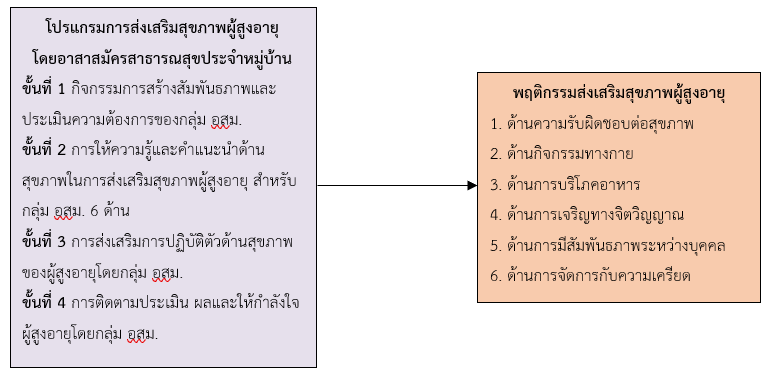
This one-group pretest–posttest design quasi-experimental study aimed to examine the effects of a Village Health Volunteer–led health promotion program on the health behaviors of older adults residing in Koh Chang Village, in the Koh Phayam subdistrict of Ranong Province. A total of
35 older adults participated in a two-day health promotion training program conducted by Village Health Volunteers, which focused on knowledge provision and skills training for healthy aging. Data were collected at baseline and at Weeks 1 and 4 post-intervention, using the Health-Promoting Behavior Questionnaire for Older Adults, which demonstrated a reliability coefficient of 0.86. Data were analyzed using descriptive statistics and paired t-tests.
The results showed that after participating in the health promotion program, the overall mean score of health-promoting behaviors among older adults was significantly higher than before the intervention (p-value < .05). When analyzed by domain, the mean scores for health responsibility, interpersonal relationships, and nutrition were significantly higher than pre-intervention levels (p-value < .001). Stress management scores were also significantly higher after the program (p-value < .01). However, no significant differences were found in physical activity or spiritual growth between pre- and post-intervention assessments.
These findings indicate that Village Health Volunteers who receive appropriate knowledge and skills training in elderly health promotion can effectively enhance health-promoting behaviors among older adults. Therefore, healthcare agencies may consider implementing this program as part of community-based health promotion initiatives.
References
Aekplakorn V., Pakcharoen H., & Sathianopakon W., (2023). The Sixth National Health Examination Survey of Thailand, 2019–2020. Nonthaburi: Health Systems Research Institute. (in Thai)
Creswell, J. W. & Creswell, J. D. (2018). Research Design: Qualitative, Quantitative, and Mixed Method Approache. (5th ed.). Retrieved October 21, 2024 from Research Design: Qualitative, Quantitative, and Mixed Methods Approaches - John W. Creswell, J. David Creswell - Google Books.
Department of Health. (2024). Health Situation of Thai Older Adults. Ministry of Public. Nonthaburi: Department of Health. (in Thai)
Department of Health Service Support. (2024). Handbook for Care Providers of Older Adults or Dependent Persons. Nonthaburi: Winai 2509. (in Thai)
Intamas. P. (2018). Factors Affecting Operations of Village Health Volunteers in Health Management Villages in Khanu Woralaksaburi District, Kamphaeng Phet Province. A Thesis Sunmitted in Partial Fulfillment of the Requirement for the Master of Public Health, Sukhothai Thammathirat Open University, Nonthaburi. (in Thai)
Khamchalee. T. (2023). Effectiveness of a health promotion model for older adults through empowerment and community participation in Non Khun sub-district, Yang Chum Noi District, Srisaket province. Srisaket Health Research and Development Journal, 2(2), 112–126. (in Thai)
Kongthong, P., & Sararnritthichai, K. (2021). Effectiveness of capacity-building learning for village health volunteers via smartphones using the AorSorMor online application in Don Chang subdistrict, Mueang district, Khon Kaen province. Journal of Nursing Science and Health, 44(3), 47–57. (in Thai)
Lee, E., & Choi, M. (2024). Factors associated with medication adherence among older adults with multimorbidity: A culture perspective. Geriatric nursing (New York, N.Y.), 55, 297–303.
National Statistical Office. (2023). Statistical-Yearbook Thailand 2024. Retrieved May 5, 2024 from https://www.nso.go.th/public/e-book/Statistical-Yearbook/SYB-2024/2/index.html. (in Thai)
Nualrahong, K., Sornsujan, P., & Chaisena, N. (2020). Health promotion activities for the elderly group: Enhancing community participation and quality of life. Journal of Nursing and Health Sciences, 14(3), 120–131. (in Thai)
Pender, N. J. (1987). Health Promotion in Nursing Practice (2nd ed.). East Norwalk CT: Appleton & Lange.
Pender, N. J. (2011). Health Promotion in Nursing Practice. (6th ed.). New York: Pearson.
Phusri, A. (2023). Food consumption behaviors of village health volunteers in Kamphaeng Saen district, Nakhon Pathom province. Journal of Health and Environmenal Education, 8(1), 392–401. (in Thai)
Plianbumroong, D. (2014). Effects of health promotion for older adults through community leaders. Journal of Nursing and Health Care, 32(3), 77–85. (in Thai)
Saiwiang, P. (2023). Effectiveness of a knowledge and health promotion behavior development program for older adults in Don Mot Daeng district, Ubon Ratchathani province. Journal of Public Health 10, 11(2), 41–55. (in Thai)
Thai Elderly Research and Development Institute Foundation. (2022). The Situation of Thai Elderly in 2022. Retrieved January 5, 2023 from https://thaitgri.org/?wpdmpro (in Thai)
Uthai, B. (2019). Effects of a health promotion program implemented by village health volunteers on the health behaviors of older adults in the community. Nursing Journal, 37(2), 45–58. (in Thai)
Walker, S. N. (1988). The Health-Promoting Lifestyle Profile: Development and Psychometric Characteristics. A Dissertation Submitted in Partial Fulfillment of the Requirement for the Doctoral, University of Nebraska, Lincoln.
Walker, S. N., Sechrist, K. R., & Pender, N. J. (1988). The health-promoting lifestyle profile: development and psychometric characteristics. Nursing Research, 36(2), 76–81.
Downloads
Published
Issue
Section
License
Copyright (c) 2026 Journal of Nursing and Education

This work is licensed under a Creative Commons Attribution-NonCommercial-NoDerivatives 4.0 International License.



