
The Development of a Human Resource Management Framework for High Potential Personnel of the Praboromarajchanok Institute
Keywords:
Human Resources Management Model, High-Potential Personnel, Praboromarajchanok InstituteAbstract
This research and development study aimed to develop a human resources management framework for high-potential personnel at Praboromarajchanok Institute. The study was conducted in three phases. Phase 1 examined the potential and competencies of personnel. The sample consisted of 352 individuals, including civil servants, government employees, and institutional staff. Data were collected using a questionnaire with a reliability coefficient of .80, and semi-structured interviews with five senior executives and ten human resource experts, yielding item-objective congruence scores ranging from .67 to 1.00. Phase 2 involved constructing the model by analyzing and synthesizing findings from Phase 1, drafting the model, and presenting it to three experts for review and refinement. Phase 3 assessed the quality of the model through connoisseurship seminars with six experts, evaluating appropriateness, feasibility, accuracy, completeness, and usefulness. Data were analyzed using descriptive statistics, Pearson’s correlation coefficient, and content analysis. The findings were as follows.
1. Personnel potential and competencies were rated with a high score high in three dimensions: work skills and abilities (M = 4.02, SD = 0.62), governance and organizational values (M = 4.36, SD = 0.63), and satisfaction with work outcomes (M = 4.06, SD = 0.66).
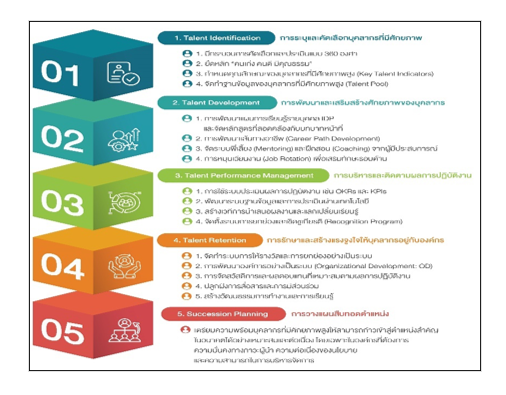
2. The developed model comprised five components: Talent Identification, Talent Development, Talent Performance Management, Talent Retention, and Succession Planning.
3.Expert evaluation indicated that the overall quality of the model was at the highest level (M = 4.67, SD = 0.05). Appropriateness (M = 4.83, SD = 0.41), feasibility, accuracy, and usefulness (M = 4.67, SD = 0.52) were rated at the highest level, while completeness was rated at a high level (M = 4.50, SD = 0.55).
The developed model can serve as a systemic conceptual framework for managing high-potential personnel. However, further implementation in real-world contexts is recommended to examine its effectiveness and support policy-level application.
References
Allan, S. (2010). Talent Management Systems: Best Practices in Technology Solutions for Recruitment, Retention and Workforce Planning. In L. A. Berger & D. R. Berger (Eds.), The Talent Management Handbook: Creating a Sustainable Competitive Advantage by Selecting, Developing, and Promoting the Best People (2nd ed., pp. 381–392). McGraw-Hill.
Angsuchot, S. (2013). Research Data Analysis for Teaching Development. In Research Documents for Teaching Development: Unit 6. Charoen Dee Man Kong Printing. (in Thai)
Armstrong, M. (2011). Strategic Human Resource Management: A Guide to Action. (3rd ed.).London: Kogan Page. Cappelli, P. (2008). Talent management for the twenty first century. Harvard Business Review, 86(3), 74-81.
Collings, D. G., & Mellahi, K. (2009). Strategic talent management: A review and research agenda. Human Resource Management Review, 19(4), 304–313.
Crabtree, B. F., & Miller, W. L. (1992). Doing Qualitative Research. Sage Publications, Inc. HREX.asia. (2019). Talent Management. Retrieved January 14, 2025 from https://th.hrnote.asia/ orgdevelopment/190114-thtalentmanagement/?utm_ source=chatgpt.com (in Thai)
HumanSoft. (2024). Talent Management: Effectively Managing Talented People in the Organization. Retrieved January 14, 2025 from https://www.humansoft.co.th/th/blog/talent-management (in Thai)
Lewis, R. E., & Heckman, R. J. (2006). Talent management: A critical review. Human Resource Management Review, 16(2), 139–154.
Pitipornwiwat, M. (2024). 'Inner Talent', A New Framework for Looking at Talent to its Core. Retrieved May 30, 2024 from https://www.baseplayhouse.co/blog/inner-talent-framework. (in Thai)
Srisaat, B. (2010). Basic Reasearch. (8th ed.) Bangkok: Suwiriyasan. (in Thai)
Srisaat, B. (2013). Preliminary Research. Bangkok: Suwiriyasan. (in Thai)
Supharatmi, R. (2020). Core competencies for senior government executives in Thailand in the 21st century. Civil Service Journal, 62(2), 4-9. (in Thai)
United Nations. (2023). Guidebook on Promoting Good Governance in Public-Private Partnerships. New York: United Nations.
Downloads
Published
Issue
Section
License
Copyright (c) 2026 Journal of Nursing and Education

This work is licensed under a Creative Commons Attribution-NonCommercial-NoDerivatives 4.0 International License.



