
Effects of a Behavioral Development Program to Prevent Cerebrovascular Disease for Hypertensive Patients at Wiangsa District, Nan Province
Keywords:
Program, Stroke Preventive Behavior, Hypertension, Health Belief ModelAbstract
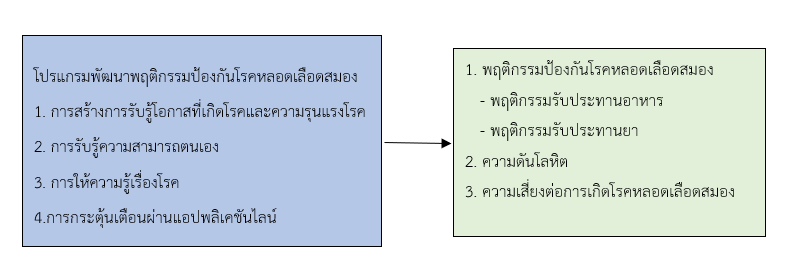
This two-group pretest–posttest design quasi-experimental study aimed to compare differences in stroke prevention behaviors, blood pressure, and stroke risk among the experimental group before and after receiving the program, and between the experimental and comparison groups after the program. The sample consisted of patients with essential hypertension who had low to moderate risk of stroke. Participants were selected from Aye Na Lai Subdistrict Health Promoting Hospital by simple random sampling for the experimental group, while the comparison group was selected from Lai Nan Subdistrict Health Promoting Hospital, matched for age, systolic blood pressure, and duration of illness. Each group included 30 participants. The intervention instruments were: 1) the new stroke preventive behavior development program for patients with hypertension, based on the Health Belief model, 2) recording forms, and 3) a LINE application channel. Data collection instruments were: 1) a questionnaire consisting of demographic and health information, as well as stroke preventive behaviors questions related to diet and medication adherence (content validity index of 1.00 and Cronbach’s alpha coefficients of .88 and .93, respectively), 2) a digital blood pressure monitor, and 3) a cardiovascular risk assessment tool using a color-coded chart. Data were analyzed using descriptive statistics, t-test, Wilcoxon matched-pairs signed-rank test, Mann–Whitney U test, and Minitab software. The results showed that
1. After the experiment, the experimental group had significantly higher stroke preventive behaviors than before the experiment and increased more than the comparison group (p-value < .05).
2. After the experiment, the experimental group had significantly lower systolic and diastolic blood pressure than before the experiment and decreased more than the comparison group, and the stroke risk was significantly lower than before the experiment and the comparison group (p-value < .05).
Therefore, the stroke prevention behavior development program for hypertensive patients can be applied to prevent stroke in patients with other chronic diseases such as diabetes, heart disease, and obesity.
References
American Heart Association. (2021). Lower Your Sodium and Blood Pressure Will Follow. Retrieved December 15, 2024 from https://www.heart.org/en/news/2021/02/15/lower-your-sodium-and- blood-pressure-will-follow.
Aroon, C. (2013). Statistics for Health Science Research (3rd ed.). Bangkok: Wittayapat. (in Thai)
Ayenalai Sub-district Health Promoting Hospital. (2024). Annual Report for Fiscal Year 2024. Ayenalai: Ayenalai Sub-district Health Promoting Hospital. (in Thai)
Chakkraphan, P. (2019). Health Behavior: Concepts, Theories, and Applications (3rd ed.). Phitsanulok: Naresuan University. (in Thai)
Chawapornphan, C., & Wilawan, S. (2023). Nursing and Health Promotion. In Teaching Materials for the Nursing Concepts and Process (Unit 7, pp. 18-20). Nonthaburi: Sukhothai Thammathirat Open University. (in Thai)
Department of Disease Control, Ministry of Public Health. (2019). Hypertension. Retrieved December 15, 2024 from https://www.ddc.moph.go.th/disease_detail.php?d=52
Department of Disease Control, Ministry of Public Health. (2023). The Department of Disease Control Advises the Public to Take Care of Their Health and Measure Their Blood Pressure Regularly to Prevent High Blood Pressure. Retrieved December 15, 2024 from https://ddc.moph.go.th/brc/news.php.
Department of Disease Control, Ministry of Public Health. (2024). Noncommunicable Disease Mortality/Illness Statistics. Retrieved December 15, 2024 from https://www.ddc.moph.go.th/dncd/news.php?news=39911.
Health Data Center, Ministry of Public Health. (2024). Health Data System. Retrieved December 15, 2024, from https://hdcservice.moph.go.th/hdc/main/index.php.
Hypertension Association of Thailand. (2019). Guidelines for the Treatment of Hypertension in General Practice 2019. Chiang Mai: Trick Think. (in Thai)
Juriporn, K., Sumanee, W., & Natthiwan P. (2015). Risk Assessment of Cardiovascular Disease in Diabetic and Hypertensive Patients. (1st ed., pp.3-9). Bangkok: Agricultural Cooperative Printing House of Thailand Co., Ltd. (in Thai)
Khajornphan, K., Wareenee, I., & Mukda, N. (2017). Effects of a program to develop stroke prevention behaviors among at-risk patients in Kanchanaburi Province. Journal of Nursing and Health Care, 35(3), 129–137. (in Thai)
Noppawan, D., Porntip, S., Wipada, T., Ausanee, W., Chayuttra, S., & Sumet B. (2021). Stroke in older people and guidelines for strengthening caregivers. Journal of The Royal Thai Army Nurses, 22(1), 20-28. (in Thai)
Noppawan, P. (2020). Unit 8: Nursing Care for Chronic Patients with Cardiovascular Disease Commonly Found in the Community. In Compilation of academic content on nursing for chronically ill patients (Unit 8, pp. 8-1–8-149). Nonthaburi: Sukhothai Thammathirat Open University. (in Thai)
Preedi, Y., Warinee, I., & Mukda, N. (2019). Effects of a behavioral development program on stroke prevention among hypertensive patients in Borabue District, Maha Sarakham Province. Nursing Journal, 68(4), 39-48. (in Thai)
Ronachai B., Kritsada, T., & Sriprapai, I. (2024). Stroke risk assessment using a color chart in diabetic and hypertensive patients. Ngao district hospital, Lampang province. Rajawadi Journal, 14(1), 144-159.
Rosenstock, M., Strecher, J., & Becker, H. (1988). Social leaning theory and the health belief model. Health Education Quarterly, 15(2), 175-183.
Supawadi, P., & Jiraporn, K. (2018). Effects of health belief program on complication prevention behaviors among elderly with hypertension. Naval Medical Journal, 45(3), 561-577. (in Thai)
Suphanatthakorn, M. (2022). Effects of stroke prevention program for hypertensive patients by applying health belief theory in Muang Pan District, Lampang Province. Singburi Hospital Journal, 31(1), 68-78.
Usa, W., Yupaporn N., & Montira, M. (2022). The effects of a stroke prevention program on knowledge, health behaviors, and blood pressure in patients with hypertension. Journal of Cardiothoracic Nursing, 33(2), 16-30. (in Thai)
Worarat, L., Wanarat, L., & Pornnapa, H. (2019). The effects of a health belief model application program combined with family support on stroke prevention behaviors in high-risk patients. Journal of Nursing and Education, 12(4), 32-45. (in Thai)
World Health Organization. (2023). First WHO Report Details Devastating Impact of Hypertension and Ways to Stop It. Retrieved December 15, 2024, from https://www.who.int/thailand/th/news/detail/19-09-2566-first-who-report-details-devastating-impact-of-hypertension-and-ways-to-stop-it.
Downloads
Published
Issue
Section
License
Copyright (c) 2026 Journal of Nursing and Education

This work is licensed under a Creative Commons Attribution-NonCommercial-NoDerivatives 4.0 International License.



