
Effectiveness of a Project-Based Learning Program in a Nursing Administration Course on Critical Thinking and Project Work Skills among Third-Year Nursing Students at the University of Phayao
Keywords:
Project-Based Learning, Nursing Administration, Critical Thinking, Nursing StudentsAbstract
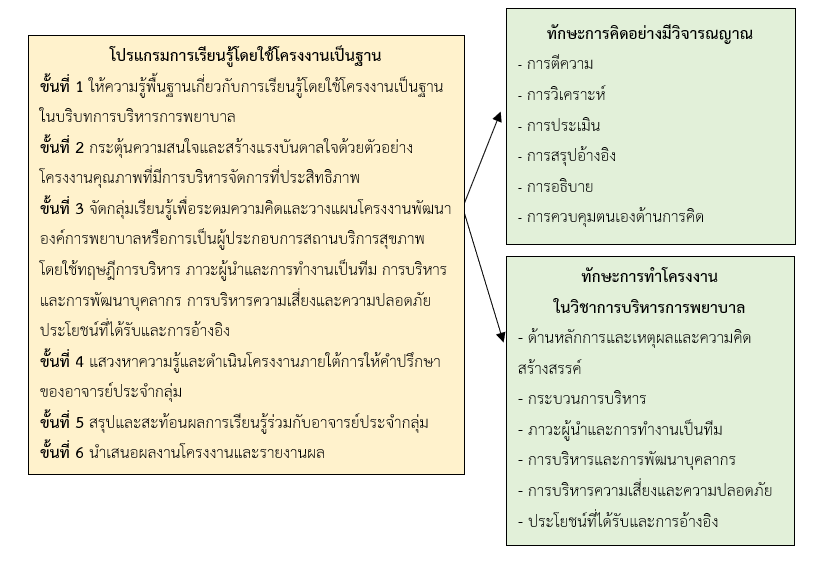
This one-group pretest–posttest quasi-experimental study aimed to compare the critical thinking skills of third-year nursing students at University of Phayao, before and after participating in a new project-based learning program in their Nursing Administration course, and to compare the mean score of their project work skills after the intervention with the 80% criterion. The sample consisted of 109 third-year nursing students, purposively selected according to specified criteria. Participants received a project-based learning program in nursing administration, conducted in six sessions over 16 weeks. Data were collected using a general information questionnaire, the project-based learning program, a critical thinking skills assessment tool, and a project performance evaluation form in Nursing Administration. All instruments were validated for content and reliability, with Cronbach’s alpha coefficients of .93 and .81. Data were analyzed using descriptive statistics, paired t-test, and one-sample Wilcoxon signed-ranks test. The results were as follows.
1. After participation in the program, the mean scores of students for overall critical thinking skills (notably the subscales of analysis, evaluation, inference, and explanation), were significantly higher than before the intervention (p-value < .05). However, no significant differences were found in the subscales of interpretation and metacognitive self-regulation.
2. After participation in the program, the mean scores of project work skills in Nursing Administration, both overall and in each subscale, were significantly higher than the 80% criterion (p-value < .001).
These results suggest that project-based learning can be adopted as a core instructional approach in the Nursing Administration course, with projects designed from real-life situations, continuous discussion and reflection activities, and clear evaluation criteria. This approach can enhance critical thinking skills and better prepare nursing students for professional practice.
References
Arif, Y., & Putri, Z. M. (2022). Project-Based Learning (PjBL) Method: Improving Critical Thinking and Problem-Solving Skills for Nursing Students. Advances in Social Science, Education and Humanities Research, 650, 48–52. doi:10.2991/assehr.k.220303.010
Boso, C. M., van der Merwe, A. S., & Gross, J. (2019). Critical thinking skills of nursing students: Observations of classroom instructional activities. Nursing Open, 7(2), 581–588. doi: 10.1002/nop2.426
Chan, Z. C. Y. (2013). Exploring creativity and critical thinking in traditional and innovative problem-based learning groups. Journal of Clinical Nursing, 25(15–16), 2298–2307. https://doi.org/10.1111/jocn.12186
Chantian, P., Nakornchai, T., Jaroenpong, J., Maneerat, S. & Anansupamongkol, D. (2019). The development of critical thinking of nursing science students. Kasem Bundit Journal, 20(2), 168-179. (In Thai)
Facione, N. C. & Facione, P. A. (1996). Externalizing the Critical Thinking in Knowledge Development and Clinical Judgment. Retrieved June 1, 2006 form http://www.insightassessment.com.
Hanklang, S., & Sivasan, S. (2021). Effectiveness of the project-based learning program on Thai nursing student competency for elderly care in the community. Journal of Health Research, 35(2), 132-146.
Kaddoura, M., Van-Dyke, O., & Yang, Q. (2017). Impact of a concept-based curriculum on nursing students’ critical thinking skills. Nurse Education in Practice, 23, 64–70. doi: 10.1111/nhs.12277
Kokotsaki, D., Menzies, V., & Wiggins, A. (2016). Project-based learning: A review of the literature. Improving Schools, 19(3), 267–277. https://doi.org/10.1177/1365480216659733
Liu, Q., & Pásztor, A. (2022). The critical thinking-oriented adaptations of problem-based learning: A meta-analysis. Frontiers in Education, 7, 1139987.
Moore, B. N., & Parker, R. (2001). Critical Thinking (6th ed.). California: Mayfield Publishing Company. Conference on Educational Development and Quality Assurance (ICED-QA 2021).
Mwale, O.G., Mukwato, P. K., & Makkukula, M. K. (2025). Teaching methods for promoting the acquisition of clinical reasoning skills in undergraduate nursing students: A systematic review. Journal of Nursing Advances in Clinical Sciences, 2(5), 271-277. https://doi.org/10.32598/JNACS.2501.1146
Oermann, M. H., De Gagne, J. C., & Phillips, B. C. (2022). Teaching in Nursing and Role of the Educator: The Complete Guide to Best Practice in Teaching, Evaluation, and Curriculum Development (3rd ed.). Springer Publishing.
Piriyasart, J., Pairoh , H., & Che Hasan, M. K. (2025). The effects of using reflective journals on reflective practice behaviors in the nursing administration practicum among fourth-year nursing students. Journal of Nursing and Education, 18(4), e275655. (In Thai)
Rattanajarana, S. (2021). The effect of project-based learning to enhance the 21st century skills of baccalaureate nursing students. Thai Pharmaceutical and Health Science Journal, 16(3), 203-210.
Sacgaca, L., Dagdagui, R., Rashidi, N., Buta, J., Maestro, R., & Villareal, S. (2022). Factors influencing critical thinking skills among nursing students: Reports from a cross-sectional study. Int J Adv Appl Sci, 9, 93-8.
Suvithayasiri, K., Wadyim, N., Techamuanwaiwit, S. Padklan, S. (2020). The effects of project based-learning to create innovation for developing of reflective thinking ability of nursing students. Journal of Health and Nursing Research, 36(3), 164-177. (In Thai)
Sharma, S., Saragih, I. D., Tarihoran, D. E. T. A. U., & Chou, F. H. (2022). Outcomes of problem-based learning in nurse education: A systematic review and meta-analysis. Nurse Education Today, 120, 105631. https://doi.org/10.1016/j.nedt.2022.105631
Shin, H., Ma, H., Park, J., Ji, E. S., & Kim, D. H. (2015). The effect of simulation courseware on critical thinking in undergraduate nursing students: Multi-site pre–post study. Nurse Education Today, 35(4), 537–542. https://doi.org/10.1016/j.nedt.2014.12.004
Srisawad K, Rattana-olarn T, Kiddee K. (2016). Factor analysis of critical thinking among nursing students from private higher education institutions. J Health Res, 30(5), 363-369. DOI: 10.14456/jhr.2016.49
Tafakur, T., Retnawati, H., & Shukri, A. A. M. (2023). Effectiveness of project-based learning for enhancing students' critical thinking skills: A meta-analysis. Jurnal Inovasi Pendidikan, 9(2), e22142. https://doi.org/10.22219/jinop.v9i2.22142
Turner, R. C., & Pitchon, M. A. (2016). Classroom-based assessment of 21st century skills: A primer. Journal of Applied Testing Technology, 17(1), 1–19.
Ulrich, B. T. (2016). Leadership and management competencies in nursing education. Journal of Nursing Administration, 46(4), 194–196. https://doi.org/10.1097/NNA.0000000000000335
Wanchai, A., Kaewsasri, A., Kuljoo, A., & Vichitkaew, N. (2018). The effects of the project-based learning on reflection thinking’s behaviors of nursing students. Songklanagarind Journal of Nursing, 38(2), 11-19.
Wei, B., Wang, H., Li, F., Long, Y., Zhang, Q., Liu, H., et al., (2024). Effectiveness of problem-based learning on development of nursing students’ critical thinking skills: A systematic review and meta-analysis. Nurse Educator, 49(3), e115-e119. https://doi.org/10.1097/NNE.0000000000001548
Xie, Q., Jantharajit, N., & Srikhao, S. (2024). Innovative approaches in nursing education: Enhancing learning efficiency and critical thinking based on cooperative and project-based learning. Asian Education Studies, 4(1), 153–165.
Yolao, D. (2014). A Study of PBL Learning Management from the Project to Create a Knowledge Set to Enhance 21st Century Skills of Children and Youth: From the Successful Experience of Thai Schools. Bangkok: Thipphawisut. (In Thai)
Downloads
Published
Issue
Section
License
Copyright (c) 2026 Journal of Nursing and Education

This work is licensed under a Creative Commons Attribution-NonCommercial-NoDerivatives 4.0 International License.



