
An Analysis of the Components of Ethical Identity Attributes among Nursing Students at Boromarajonani College of Nursing, Surat Thani, Faculty of Nursing, Praboromarajchanok Institute
Keywords:
Factor Analysis, Ethical Identity, Nursing StudentsAbstract
This descriptive research aimed to examine the level of ethical identity attributes, and to analyze the components of ethical identity attributes among 536 nursing students at the Nursing College of Surat Thani. The research instrument was the Ethical Identity Attributes Assessment Scale, which demonstrated a content validity index of .90. The reliability of the instrument, assessed by Cronbach’s alpha coefficient for each component and the total scale, was at the .98 level. Data were analyzed using descriptive statistics, including frequency, percentage, mean, and standard deviation, as well as exploratory factor analysis, using common factor analysis with Oblimin rotation. The results showed the following.
1. Overall, the nursing students’ ethical identity attributes were at the highest level (M = 4.53, SD = 0.43). Considering each component, the highest mean score was found for respect (M = 4.60, SD = 0.46), followed by honesty (M = 4.55, SD = 0.47), while sufficiency had the lowest mean score (M = 4.42, SD = 0.47).
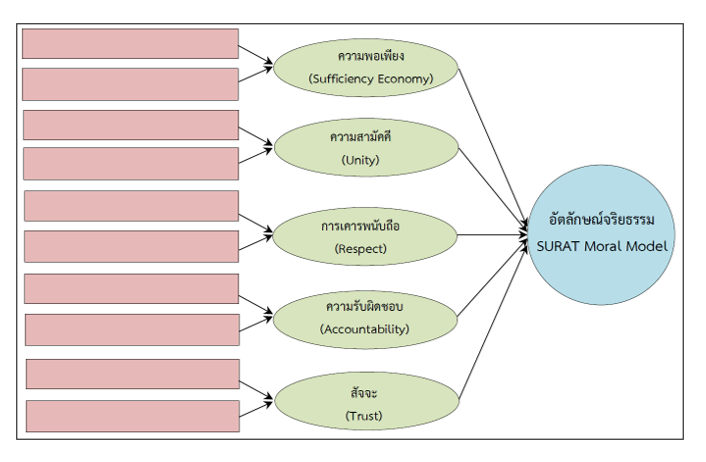
2. The analysis identified four components of ethical identity attributes: a) responsibility (17 variables), b) respect (10 variables), c) sufficiency (11 variables), and d) unity (11 variables), with a total cumulative variance of 64.514%.
The results suggest that data obtained from the Ethical Identity Attributes Assessment can be useful as a guideline for curriculum development, co-curricular activity planning, and the continuous cultivation of ethical values both in classroom learning and in clinical practice.
References
Chaowalit, A., Khamphalikhit, S., Thanasin, S., Nasae, T. & Suwanpatikorn, K. (Eds). (2024). Ethics Promotion Manual for Nursing Organization: Mechanisms and Practices. (2nd revised ed). Nonthaburi: Thailand Nursing and Midwifery Council. (in Thai)
Costello, A. B., & Osborne, J. (2005). Best practices in exploratory factor analysis: Four recommendations for getting the most from your analysis. Practical Assessment Research & Evaluation, 10(7), 1-9.
Courtney, M. G. R. (2013). Determining the number of factors to retain in EFA: Using the SPSS R-Menu v2.0 to make more judicious estimations. Practical Assessment, Research & Evaluation, 18(8), 1–14.
Hair, J. F., Black, W. C., Babin, B. J., & Anderson, R. E. (2019). Multivariate Data Analysis.(9th ed.). England Pearson Prentice.
Jarusiri, P., Aunwatthana, P., & Kusaltummarat S. (2021). Factors Influencing the Lifestyle Behavior of Students at Rajamangala University of Technology Phra Nakhon according to the Sufficiency Economy Philosophy. Faculty of Liberal Arts. Bangkok: University of Technology Phra Nakhon. (in Thai)
Keadthong, W., & Sueamak, W. (2017). Development of ethical behavior among nursing student in becoming moral nurse. Journal of Public Health Nursing, 31(2), 257-271. (in Thai)
Kobjaiklang, C., Praesri, S., & Kuhapensang, N. (2024). The Sufficiency Economy Philosophy Influencing Happiness Level : A Comparative Analysis Using Six Ranking Factors in Thailand Among Top Asean Nations. Journal of MCU Buddhapanya Review. 9(4), 1-13. (in Thai)
Kohlberg, L. (1984). Essays on Moral Development: Vol. 2. The psychology of moral development. Harper & Row.
MalaiPhong, P. (2023). Characteristics of nurses that are the goal of the Nursing Council. Mahidol University. Retrieved July 12, 2025 from https://archive.cm.mahidol.ac.th/handle/123456789/5114
Ngarmkham, S., & Bunjongkarn, M. (2020). Ethical behaviors among nursing students Boromarajonani college of nursing, Sawanpracharak Nakhon Sawan. Journal of Nurses Association of Thailand Northern Office. 26(2). 40-51. (in Thai)
Phrakrusutasarabundit, J. (2024). The influence of social media on the behavior and attitudes of the younger generation. Journal of Social Sciences Innovations, 1(3), 41-48. doi.org/10.14456/jssi.2024.14
Rest, J. R., Narvaez, D., Bebeau, M. J., & Thoma, S. J. (1999). Postconventional Moral Thinking: A Neo-Kohlbergian Approach. Lawrence Erlbaum Associates.
Saad, L. (2025). Americans, Ratings of U.S. Professions Stay Historically Low. Gallup. Retrieved November 3, 2025, form https://news.gallup.com/poll/655106/americans-ratings-professions-stay-historically-low.aspx
Silanoi, L. & Chindaprasert, K. (2019). The use of rating scale in quantitative research on social sciences, humanities, hotel and tourism study. Journal of Management Science, Ubon Ratchathani University, 8(15), 112-126. (in Thai)
Srichairattanakull, J., Tirapaiwong, Y., & Suvithayasiri, k. (2016). Knowledge and behavior of applying philosophy of sufficiency economy in living of nursing students. Journal of Boromarajonani College of Nursing, Bangkok, 32(3), 74-86. (in Thai)
Suchitra, S. (2020). Development of Moral Behavior Scale for Nursing Students (Master’s thesis). Boromarajonani College of Nursing Suratthani.
Thongjarm, R., Thongpun, S., & Leega, J. (2020). The development of ethical behavior for professional nurse. Journal of Graduate MCU Khonkaen Campus, 8(4), 201-212. (in Thai)
Downloads
Published
Issue
Section
License
Copyright (c) 2025 Journal of Nursing and Education

This work is licensed under a Creative Commons Attribution-NonCommercial-NoDerivatives 4.0 International License.



