
Translation and Reliability Testing of the Thai Version of the Postoperative Nausea and Vomiting Impact Scale (SPONVIS): A Pilot Study
Keywords:
Postoperative Nausea and Vomiting, PONV, Postoperative Nausea and Vomiting Impact Scale, Translation Process, ReliabilityAbstract
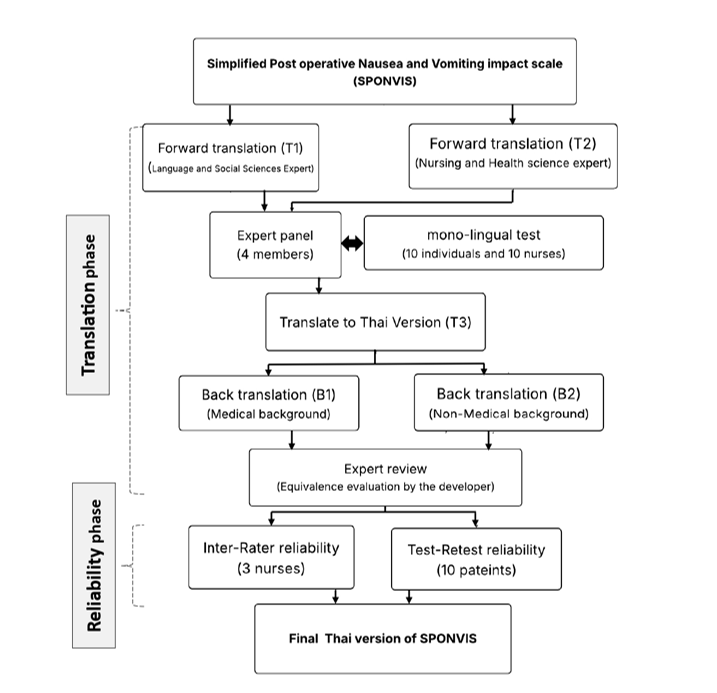
This pilot study aimed to translate the Postoperative Nausea and Vomiting Impact Scale (PONV) from English into Thai and to examine the reliability of the Thai version. The translation process was adapted from the World Health Organization’s guidelines for instrument translation and validation and consisted of: 1) forward translation from English to Thai, 2) expert review of the translated version, 3) pretesting with monolingual Thai speakers, 4) back-translation from Thai into English, and 5) assessment of equivalence by the original instrument developer. The finalized Thai version was pilot tested in 20 postoperative neurosurgical patients. Inter-rater reliability was assessed by three nurses in 10 patients, and test–retest reliability was evaluated in another 10 patients. Data were analyzed using the intraclass correlation coefficient (ICC). The results were as follows.
1. The Thai version of the Postoperative Nausea and Vomiting Impact Scale, developed through a standardized translation process, demonstrated equivalence with the original instrument in terms of language, content, and meaning, and was culturally appropriate for Thai patients.
2. The intraclass correlation coefficients for inter-rater reliability and test–retest reliability were .92 and .99, respectively, indicating excellent reliability.
These findings suggest that the Thai version of the scale demonstrates excellent reliability and can be used to assess the impact of postoperative nausea and vomiting among neurosurgical patients. However, further studies with larger and more diverse samples are recommended to confirm its reliability.
References
Apfel, C. C., Läärä, E., Koivuranta, M., Greim, C. A., & Roewer, N. (1999). A simplified risk score for predicting postoperative nausea and vomiting. Anesthesiology, 91, 693–700. doi:10.1097/00000542-199909000-00022
Hellickson, J. D., Worden, W. R., Ryan, C., Miers, A. G., Benike, D. A., Frank, S. P., et al. (2016). Predictors of postoperative nausea and vomiting in neurosurgical patients. Journal of Neuroscience Nursing, 48(6), 352–357. doi:10.1097/JNN.0000000000000241
Jangra, K., Kumari, K., Panda, N. B., Samagh, N., & Luthra, A. (2018). Postoperative nausea and vomiting in neurosurgical patients: Current concepts and management. Neurology India, 66, 1117–1123. doi:10.4103/0028-3886.236970
Kasa, K., Worakajit, P., Sinsen, S., & Samnieng, P. (2022). Translation, validation and reliability of a Thai version of the Xerostomia Inventory. Srinakharinwirot University Dental Journal, 15(1), 10–20. doi:10.58837/CHULA.THE.2022.1151 (in Thai).
Kongsomboon, K. (2019). Textbook of Epidemiological Research for Medical Studies (2nd ed.). Bangkok: Chulalongkorn University. (in Thai)
Koo, T. K., & Li, M. Y. (2016). A guideline of selecting and reporting intraclass correlation coefficients for reliability research. Journal of Chiropractic Medicine, 15(2), 155–163. doi:10.1016/j.jcm.2016.02.012
Lonjaret, L., Guyonnet, M., Bérard, E., Vironneau, M., Pérès, F., Sacrista, S., et al. (2017). Postoperative complications after craniotomy for brain tumor surgery. Anaesthesia, Critical Care & Pain Medicine, 36, 213–218. doi:10.1016/j.accpm.2016.06.012
Meehanpong, P., & Boonsin, S. (2021). The development of nursing research instruments. Journal of the Royal Thai Army Nurses, 22(1), 10–19. (in Thai)
Meek, R., Kelly, A. M., & Hu, X. F. (2009). Use of the visual analog scale to rate and monitor severity of nausea in the emergency department. Academic Emergency Medicine, 16, 1304–1310. doi:10.1111/j.1553-2712.2009.00581.x
Myles, P. S., & Wengritzky, R. (2012). Simplified postoperative nausea and vomiting impact scale for audit and post-discharge review. British Journal of Anaesthesia, 108(3), 423–429. doi:10.1093/bja/aer505
Pimta, K., Somjaivong, B., & Potisopha, W. (2024). Translation and reliability testing of the perioperative thirst discomfort scale (PTDS) Thai version. Journal of Nursing Science and Health, 47(3), 142–153. (in Thai)
Pruitthithada, S., Hoontanee, N., Duriyaprapan, P., & Ittichaikulthol, W. (2019). Incidence and associated factors of postoperative nausea and vomiting in patients undergoing craniotomy. Journal of the Department of Medical Services, 44(5), 114–119. (in Thai)
Siriket, R., Piasupun, P., & Raksasataya, A. (2022). Translation and reliability testing of the instrument satisfaction with palliative care for patients with end-of-life dementia. Srinagarind Medical Journal, 37(5), 533–538. (in Thai)
Shin, H. C., Kang, T. W., Wu, Y. H., Sun, H. S., & Tseng, C. C. A. (2018). Validation of simplified postoperative nausea and vomiting intensity scale in Taiwan. Journal of Clinical Monitoring and Computing, 32, 937–944. doi:10.1007/s10877-017-0084-1
Stephenson, S. J., Jiwanmall, M., Cherian, N. E., Kamakshi, S., & Williams, A. (2021). Reduction in postoperative nausea and vomiting (PONV) by preoperative risk stratification and adherence to a standardized antiemetic prophylaxis protocol in the day-care surgical population. Journal of Family Medicine and Primary Care, 9, 865–870. doi:10.4103/jfmpc.jfmpc_1692_20
Timerga, S., & Befkadu, A. (2024). Prevalence and associated factors of postoperative nausea and vomiting among adult patients undergoing elective surgery. Annals of Medicine & Surgery, 86, 1304–1308. doi:10.1097/MS9.0000000000001678
Tobbandit, W. (2020). Development of surgical evaluation form for patient risk for nausea and vomiting after surgery under general anesthesia. Mahasarakham Hospital Journal, 17(1), 161–168. (in Thai)
Uribe, A. A., Stoicea, N., Echeverria-Villalobos, M., Todeschini, A. B., Gutierrez, A. B., Folea, A. R., et al. (2021). Postoperative nausea and vomiting after craniotomy: An evidence-based review of general considerations, risk factors, and management. Journal of Neurosurgical Anesthesiology, 33(3), 212–220. doi:10.1097/ANA.0000000000000667
Witayapairoj, A., Thienthong, S., Rattasuwan, P., Charoenraj, P., Bunchungmongkol, N., Manuwong, S., et al. (2021). Prevention and treatment guideline for postoperative nausea and vomiting by the Royal College of Anesthesiologists of Thailand. The Thai Journal of Anesthesiology, 47(4), 374–379. (in Thai)
World Health Organization. (2020). WHOQOL Translation Methodology. Geneva: World Health Organization. Retrieved March 10, 2025, from https://www.who.int
Downloads
Published
Issue
Section
License
Copyright (c) 2026 Journal of Nursing and Education

This work is licensed under a Creative Commons Attribution-NonCommercial-NoDerivatives 4.0 International License.



