
การวิเคราะห์องค์ประกอบเชิงยืนยันความรอบรู้ด้านสุขภาพจิตเชิงบวกของผู้สูงอายุไทย
คำสำคัญ:
การวิเคราะห์องค์ประกอบเชิงยืนยัน , ความรอบรู้ด้านสุขภาพจิตเชิงบวก , ผู้สูงอายุไทยบทคัดย่อ
การวิจัยเชิงปริมาณนี้มีวัตถุประสงค์เพื่อวิเคราะห์องค์ประกอบเชิงยืนยันของความรอบรู้ด้านสุขภาพจิต เชิงบวกของผู้สูงอายุไทย กลุ่มตัวอย่างที่ใช้ในการศึกษา คือ ผู้สูงอายุที่มีอายุระหว่าง 60 - 79 ปี ภูมิลำเนา 4 ภูมิภาค จำนวน 400 คน ด้วยการสุ่มเลือกตัวอย่างแบบหลายชั้น เครื่องมือที่ใช้เก็บรวบรวมข้อมูล คือ แบบประเมินความรอบรู้ด้านสุขภาพจิตเชิงบวก มีค่าสัมประสิทธิ์แอลฟาครอนบาค เท่ากับ .88 และวิเคราะห์ข้อมูลโดยใช้การวิเคราะห์องค์ประกอบเชิงยืนยัน ผลการวิจัย พบว่า
โมเดลการวัดความรอบรู้ด้านสุขภาพจิตเชิงบวกผู้สูงอายุไทยสอดคล้องกลมกลืนกับข้อมูลเชิงประจักษ์ โดยค่าc2 = 248.39, p-value = 0.08, df = 219 ค่าสถิติไคสแควร์สัมพัทธ์ = 1.13, GFI = 0.95, AGFI = 0.93,
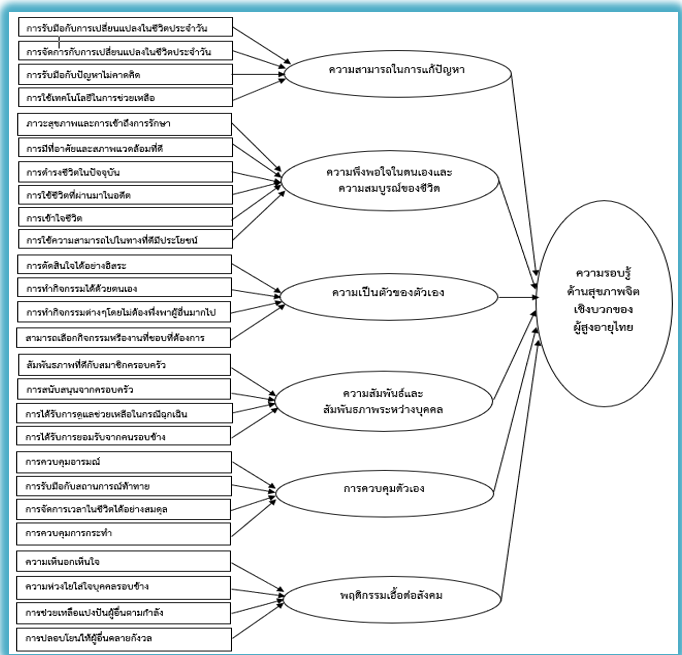
CFI = 1.00, AGFI = 0.93, RMSEA = 0.02 และองค์ประกอบความรอบรู้ด้านสุขภาพจิตเชิงบวกผู้สูงอายุไทย ทั้ง 6 องค์ประกอบ มีค่าน้ำหนักองค์ประกอบมาตรฐานเป็นบวกและมีนัยสำคัญทางสถิติที่ระดับ .05 ทุกองค์ประกอบ ได้แก่ ความสามารถในการแก้ปัญหา (0.97) พฤติกรรมเอื้อต่อสังคม (0.93) ความสัมพันธ์และสัมพันธภาพระหว่างบุคคล (0.90) ความพึงพอใจในตนเองและความสมบูรณ์ของชีวิต (0.90) การควบคุมตนเอง (0.87) และความเป็น ตัวของตัวเอง (0.83)
ผลการวิจัยสนับสนุนองค์ประกอบความรอบรู้ด้านสุขภาพจิตเชิงบวกในผู้สูงอายุไทย โมเดลมีความสอดคล้องกับข้อมูลเชิงประจักษ์ และองค์ประกอบทั้ง 6 ด้าน มีค่าน้ำหนักองค์ประกอบเป็นบวกอย่างมีนัยสำคัญ แสดงถึงความเหมาะสมในการนำไปใช้ประเมินและส่งเสริมสุขภาพจิตผู้สูงอายุได้อย่างมีประสิทธิภาพ
เอกสารอ้างอิง
Bennett, M., Ng-Knight, T., & Hayes, B. (2017). Autonomy-supportive teaching and its antecedents: Differences between teachers and teaching assistants and the predictive role of perceived competence. European Journal of Psychology of Education, 32(4), 643–667. doi.org/10.1007/s10212-016-0321
Bjornsen, H. N., Ringdal, R., Espnes, G. A., Eilertsen, M.-E., and Moksnes, U. K. (2018). Exploring MEST: a new universal teaching strategy for school health services to promote positive mental health literacy and mental wellbeing among Norwegian adolescents. BMC Health Services Research, 18, 1001. doi.org/10.1186/s12913-018-3826-5
Boonpichachan, P., Panutha, S., & Tamdee, D. (2022). Mental health literacy and psychological well-being among dependent elders. Nursing Journal CMU, 49(1), 186-198. (in Thai)
Carvalho, D., Sequeira, C., Querido, A., Tomás, C., Morgado, T., Valentim, O., et al., (2022). Positive mental health literacy: A concept analysis. Frontiers in Psychology, 13, 877611. doi.org/10.3389/fpsyg.2022.877611
Chewasopit, W. (2019). Aging society: The changed marketing factor. Journal of MCU Nakhondhat, 6(1), 38-54. (in Thai)
Craik, F. I., & Salthouse, T. (1992). The Handbook of Aging and Cognition. Hillsdale, Lawrence Eribaum Associates, Inc.
Cuijpers, P., Karyotaki, E., Reijnders, M., Purgato, M., Barbui, C., & de Beurs, D. (2020). Meta-analyses and mega-analyses of the effectiveness of problem-solving therapy for adult depression: A systematic review. Cognitive Behaviour Therapy, 49(1), 1–13.
Department of Disease Control. (2023). 5 Non-Communicable Diseases Found in The Elderly. Retrieved October 3, 2023 from https://ddc.moph.go.th/dncd/publishinfodetail.php? publish=15282&deptcode=dncd, (in Thai)
Department of Mental Health. (2020). National Mental Health Survey 2019. Ministry of Public Health, Thailand. (in Thai)
Department of Mental Health. (2023). Information on The Assessment of Mental Health of Thai People. Retrieved October 3, 2023 from http://checkin.dmh.go.th/dashboards. (in Thai)
Department of Older Persons. (2023). Situation of the Thai Elderly 2023. Retrieved August 12, 2023 from https://www.dop.go.th/th/statistics_side?content=1&sub=2. (in Thai)
Hedberg, L., & Lutzen, K. (2005). Self-care and self-regulation in older people: A nursing perspective. Journal of Clinical Nursing, 14(7), 853-861.
Hopper, E. (2024). Maslow's Hierarchy of Needs Explained. Retrieved October 3, 2024 fromhttps://www.thoughtco.com/maslows-hierarchy-of-needs-4582571.
Inagaki, T. K., MacCormack, J. K., & Muscatell, K. A. (2022). Prosocial and positive health behaviors during a period of chronic stress protect socioemotional well being. Affect Science, 3(1), 160–167. doi.org/10.1007/s42761-021-00052-7
Kim, Y. S., Lee, H. Y., Lee, M. H., Simms, T., & Park, B. H. (2017). Mental health literacy in Korean older adults: A cross-sectional survey. Journal of psychiatric and mental health Nursing, 24(7), 523–533. doi.org/10.1111/jpm.12369
Kutcher, S., Wei, Y., & Coniglio, C. (2016). Mental health literacy: past, present, and future. Canadian Journal of Psychiatry, 61(3), 154–158. doi.org/10.1177/0706743715616609
Lee, S., & Kim, H. (2021). The impact of chronic illness and social role loss on life satisfaction in older adults. Aging & Mental Health, 24(10), 1680–1687. doi.org/10.1080/13607863.2019.1633622
Lockwood, P. L., Abdurahman, A., Gabay, A. S., Drew, D., Tamm, M., Husain, M., & Apps, M. A. J. (2021). Aging increases prosocial motivation for effort. Psychological Science, 32(1), 1–14. doi.org/10.1177/0956797620960398
Maliwan, S. (2024). Dependency of the Thai elderly in the next 20 years: Health forecast. Anamai General Poll: Department of Health. Retrieved December 10, 2024 from https://hfd.anamai.moph.go.th/th/news-anamai-3/229198. (in Thai)
Park, S., Kim, B., & Lee, H. (2021). Social relationships and mental health among older adults in South Korea: The mediating role of loneliness. Aging & Mental Health, 25(5), 858–865. doi.org/10.1080/13607863.2019.1699022
Petrova, N. N., and Khvostikova, D.A. (2021). Prevalence, Structure, and Risk Factors for Mental Disorders in Older People. Advances in Gerontology, 11(4), 409–415.
Phulkerd, S., Gray, R. S., Chamratrithirong, A., Pattaravanich, U., & Thapsuwan, S. (2023). Financial satisfaction, food security, and shared meals are foundations of happiness among older persons in Thailand. BMC geriatrics, 23(1), 690. https://doi.org/10.1186/s12877-023-04411-1
Santini, Z. I., Torres-Sahli, M., Hinrichsen, C., Meilstrup, C., Madsen, K. R., Rayce, S. B., et al. (2020). Measuring positive mental health and flourishing in Denmark: validation of the mental health continuum-short form (MHC-SF) and cross-cultural comparison across three countries. Health and quality of life outcomes, 18(1), 297. https://doi.org/10.1186/s12955-020-01546-2
Schumacker, R. E., & Lomax, R. G. (2010). A Beginner’s Guide to Structural Equation Modeling (3rd ed.). Taylor & Francis Group.
Sithikan, W., Moolphate, S., & Jaitae, S. (2017). Factors associated with health-promoting behaviors of the elderly in Ban Hong subdistrict municipality, Ban Hong district, Lamphun. Lampang Medical Journal, 38(2), 49–58. (in Thai)
Smith, J. A., Brown, R. L., & Garcia, M. (2021). Factors influencing life satisfaction among older adults: A systematic review. Journal of Gerontological Nursing, 47(3), 15–23.
Tabsee, S. (2020). Factors related to self-care behavior of the elderly in Kangkrajan district, Phetchaburi province. Journal of Prachomklao College of Nursing, 3(1). 14-30. (in Thai)
Tachavijitjaru, C. (2018). Health literacy: A key indicator towards good health behavior and health outcomes. Journal of The Royal Thai Army Nurses, 19(Supplement). 1-9. (in Thai)
Urairat, M., & Laeheem, K. (2018). The relationship between interpersonal relationship and current self-concept with self-esteem of the elderly at Jong-Hua foundation, Songkhla province. Parichart Journal, 31(2), 215–230. (in Thai)
Wang, Y., Hu, Z., Liu, Y., & Yang, J. (2022). Social support and mental health among older adults living alone during the COVID-19 pandemic: A moderated mediation model. International Journal of Environmental Research and Public Health, 19(3), 1653. doi.org/10.3390/ijerph19031653
Willis, S. L. (1996). Everyday cognitive competence in elderly persons: Conceptual issues and empirical findings. Gerontologist, 36(5), 595–601. doi.org/10.1093/geront/36.5.595
World Health Organization. (2023). Mental Health of Older Adults. Retrieved August 12, 2023 from https://www.who.int/news-room/fact-sheets/detail/mental-health-of-older-adults.
Yamane, T. (1973). Statistics: An Introductory Analysis. (3rd ed). New York: Harper and Row.
ดาวน์โหลด
เผยแพร่แล้ว
ฉบับ
ประเภทบทความ
สัญญาอนุญาต
ลิขสิทธิ์ (c) 2025 วารสารการพยาบาลและการศึกษา

อนุญาตภายใต้เงื่อนไข Creative Commons Attribution-NonCommercial-NoDerivatives 4.0 International License.


