
ผลของโปรแกรมส่งเสริมสมรรถนะแห่งตนต่อพฤติกรรมการส่งเสริมพัฒนาการด้านภาษาของผู้ดูแลเด็กวัยก่อนเรียน
คำสำคัญ:
สมรรถนะแห่งตน , พัฒนาการด้านภาษา , ผู้ดูแลเด็กวัยก่อนเรียนบทคัดย่อ
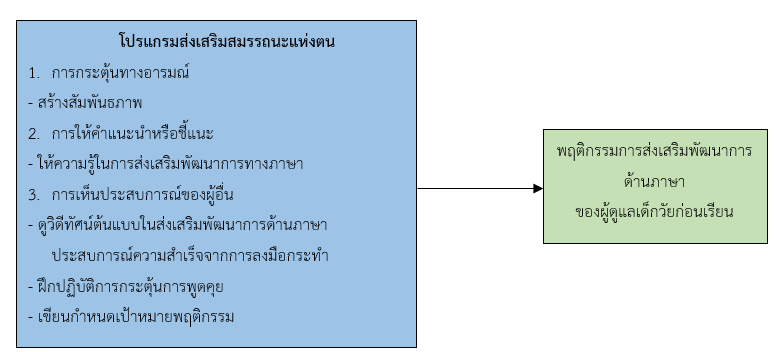
การวิจัยกึ่งทดลองแบบสองกลุ่มวัดก่อนและหลังนี้ เพื่อศึกษาผลของโปรแกรมส่งเสริมสมรรถนะแห่งตนต่อพฤติกรรมการส่งเสริมพัฒนาการด้านภาษาของผู้ดูแลเด็กวัยก่อนเรียน กลุ่มตัวอย่าง คือ ผู้ดูแลหลักขณะอยู่บ้านของเด็กวัยก่อนเรียนที่เข้ารับบริการ ณ ศูนย์พัฒนาเด็กวัยก่อนเรียน เขตเทศบาลเมือง จังหวัดราชบุรี จำนวน 52 คน คัดเลือกด้วยวิธีสุ่มอย่างง่าย แบ่งเป็นกลุ่มทดลอง 27 คน และกลุ่มควบคุม 25 คน ด้วยวิธีคัดเลือกคุณสมบัติตามเกณฑ์อายุของเด็ก คือ ผู้ดูแลเด็กอายุ 2–3 ปี 11 เดือน เก็บข้อมูลเดือนธันวาคม พ.ศ. 2566 ถึงกุมภาพันธ์ พ.ศ. 2567 เครื่องมือที่ใช้ในการวิจัย ได้แก่ แบบสอบถามข้อมูลทั่วไป แบบสอบถามพฤติกรรมการส่งเสริมพัฒนาการด้านภาษา ได้ค่าความตรงเชิงเนื้อหาเท่ากับ .97 ค่าสัมประสิทธิ์แอลฟาของครอนบาคเท่ากับ .82 และโปรแกรมส่งเสริมสมรรถนะแห่งตน ประกอบด้วย แผนการดำเนินโปรแกรมฯ ได้ค่าความตรงเชิงเนื้อหาเท่ากับ .96 หนังสือนิทาน วิดีโอต้นแบบและคู่มือการส่งเสริมพัฒนาการด้านภาษา ได้ค่าความตรงเชิงเนื้อหาเท่ากับ 1.00 วิเคราะห์ข้อมูลด้วยสถิติ Chi-square, Fisher Exact, Independent T-test และ Paired T-test ผลการวิจัยพบว่า
1. ผู้ดูแลเด็กวัยก่อนเรียนกลุ่มทดลอง มีคะแนนพฤติกรรมส่งเสริมพัฒนาการด้านภาษาสูงกว่ากลุ่มควบคุม อย่างมีนัยสำคัญทางสถิติที่ระดับ .05 ทั้งนี้ ไม่พบความแตกต่างอย่างมีนัยสำคัญทางสถิติในพฤติกรรมการส่งเสริมพัฒนาการด้านการเข้าใจภาษา (p-value = .055) และด้านการใช้ภาษา (p-value = .129) ระหว่างทั้งสองกลุ่ม
2. ผู้ดูแลเด็กวัยก่อนเรียนกลุ่มทดลอง มีคะแนนพฤติกรรมส่งเสริมพัฒนาการด้านภาษาหลังการทดลองสูงขึ้น อย่างมีนัยสำคัญทางสถิติที่ระดับ .05
ผลการวิจัยนี้ แสดงให้เห็นว่าพยาบาลควรนำโปรแกรมนี้ไปใช้กับผู้ดูแลเด็กวัยก่อนเรียน เพื่อสร้างความเชื่อมั่นและเสริมศักยภาพในการส่งเสริมพัฒนาการด้านภาษาแก่เด็กอย่างมีประสิทธิภาพ
เอกสารอ้างอิง
Albarran, A., & Reich, S. (2014). Using baby books to increase new mothers' self-efficacy and improve toddler language development. Infant Mental Health Journal, 23(4), 374-387. doi:10.1002/ icd.1832
American Academy of Pediatrics. (2016). Media and young minds. Pediatrics, 138(5), 1-6. doi:10.1542/ peds.2016-2591
Bandura, A. (1997). Self-efficacy: The Exercise of Control. New York, NY, US: W H Freeman/Times Books/ Henry Holt & Co.
Barani, M., Bilal, M., Rahdar, A., Arshad, R., Kumar, A., Hamishekar, H., et al. (2021). Nanodiagnosis and nanotreatment of colorectal cancer: An overview. Journal of Nanoparticle Research, 23(1), 18. doi.org/10.1007/s11051-020-05129-6
Best, J. W. (1977). Research in education (3rd ed.). Englewood Cliffs, NJ: Prentice-Hall. Burns, N., & Grove, S. K. (2001) The Practice of Nursing Research, Conduct, Critique, and Utilization. 4th Edition, W.B. Saunders Company, Philadelphia.
Chumprasert, T., Wirunphanich, W., & Wattanasit, P. (2019). The relationship between the use of electronic media and the development of children aged 2-5 years in local government-operated child development centers, Songkhla Province. Southern Region College of Nursing and Public Health Network Journal, 6(2), 91–104.
Group of Academic Support and Research, Health Promotion Department, Department of Health. (2018). Factors affecting early childhood development in Thailand. CG Tool Co., Ltd.
Grove, S. K., Burns, N., & Gray, J. (2012). The Practice of Nursing Research: Appraisal, Synthesis, and Generation of Evidence (7th ed.). St. Louis, MO: Elsevier Saunders.
Hsieh, R.-L., Hsueh, Y.-M., Huang, H.-Y., Lin, M.-I., Tseng, W.-C., & Lee, W.-C. (2013). Quality of life and impact of children with unclassified developmental delays. Journal of Paediatrics and Child Health, 49.
Koshy, B., Srinivasan, M., Bose, A., John, S., Mohan, V. R., Roshan, R., et al. (2021). Developmental trends in early childhood and their predictors from an Indian birth cohort. BMC Public Health, 21(1), 1-8.
Marrus, N., & Hall, L. (2017). Intellectual disability and language disorder. Child Adolesc Psychiatr Clin N Am, 26(3), 539-554. doi:10.1016/j.chc.2017.03.001
Mouton, B., Loop, L., Stiévenart, M., & Roskam, I. (2018). Confident parents for easier children: A parental self-efficacy program to improve young children’s behavior. Education Sciences, 8(3), 134.
National Institute for Child and Family Development. (2017). Annual Report 2017, National Institute for Child and Family Development. Department of Health, Ministry of Public Health: CG Tool Co., Ltd.
Pitiphat, A., Phokphatjapubet, S., Kamsripol, C., & Ruengworapoon, S. (2018). Factors associated with the promotion of growth and development behaviors of caregivers of toddlers. Boromarajonani College of Nursing, Bangkok Journal, 34(3), 1–10.
Pongpetchdit, B., & Attavee, B. (2020). Factors affecting early childhood development in Thailand: The 5th Public Health Center. Kue Karun Journal, 27(1), 59–70.
Radesky, J. S., Weeks, H. M., Ball, R., Schaller, A., Yeo, S., Durnez, J., et al. (2020). Young children’s use of smartphones and tablets. Pediatrics, 146(1), e20193518. doi.org/10.1542/peds.2019-3518
Srisatitnarakun, B. (2010). Research Methodology in Nursing Science (5Th Ed.). Bangkok, Thailand: U & I Inter Media.
Stievenart, M., & Martinez Perez, T. (2021). How can parental self-efficacy support children’s early language development? Review of preliminary research and future perspectives. European Journal of Developmental Psychology, 18(2), 199-213. doi:10.1080/17405629.2020.1776102
Sujaritpong, S., Rungpairawan, R., Hunsakunachai, T., Benjasuwanthep, B., Fuefue, A., Chuthapisit, J., et al. (2018). Textbook of Child Development and Behavior (Vol. 4). Bangkok: The Developmental and Behavioral Pediatric Society of Thailand.
Thisara, P., Phonmak, J., Sikhao, P., & Silapawitthayatorn, B. (2017). Predictive factors of parental behaviors in promoting early childhood development in Phayao Province. Journal of Nursing and Health Care, 35(2), 169–176.
Thongluang, P., Younak, R., & Tangkavanich, T. (2017). The effects of a self-efficacy enhancement program on early childhood development promotion. Journal of Nursing and Health, 11(3), 92–101.
TohYuso, N., & Maksingh, W. (2020). The effect of a self-efficacy enhancement program for mothers on promoting the development of children aged 0-5 years. Graduate School Journal of Mahamakut Buddhist University, 18(2), 195–208.
Wang , L., Liang, W., Zhang, S., Jonsson, L., Li, M., Yu, C., et al. (2019). Are infant/toddler developmental delays a problem across rural China?. Journal of Comparative Economics, 47(2), 458-469. doi:10.1016/j.jce.2019.02.003
World Health Organization. (2016). Investing in Early Childhood Development Essential to Helping More Children and Communities Thrive, New Lancet Series finds. Retrieved November 3, 2024 from https://www. who.int/news/item/05-10-2016-investing-in-early-childhood-development-essential-to-helping-more-children-and-communities-thrive-new-lancet-series-finds
ดาวน์โหลด
เผยแพร่แล้ว
ฉบับ
ประเภทบทความ
สัญญาอนุญาต
ลิขสิทธิ์ (c) 2025 วารสารการพยาบาลและการศึกษา

อนุญาตภายใต้เงื่อนไข Creative Commons Attribution-NonCommercial-NoDerivatives 4.0 International License.


