
Predictive Power of Curriculum Quality Based on ASEAN University Network Quality Assurance (AUN-QA) Criteria on Innovation and Digital Readiness of the Bachelor of Nursing Science Program, Boromarajonani College of Nursing, Uttaradit
Keywords:
การประเมินหลักสูตรพยาบาลศาสตร์, เกณฑ์ AUN QA, นวัตกรรมและดิจิทัล, การวิจัยแบบผสมผสาน, การศึกษาพยาบาลAbstract
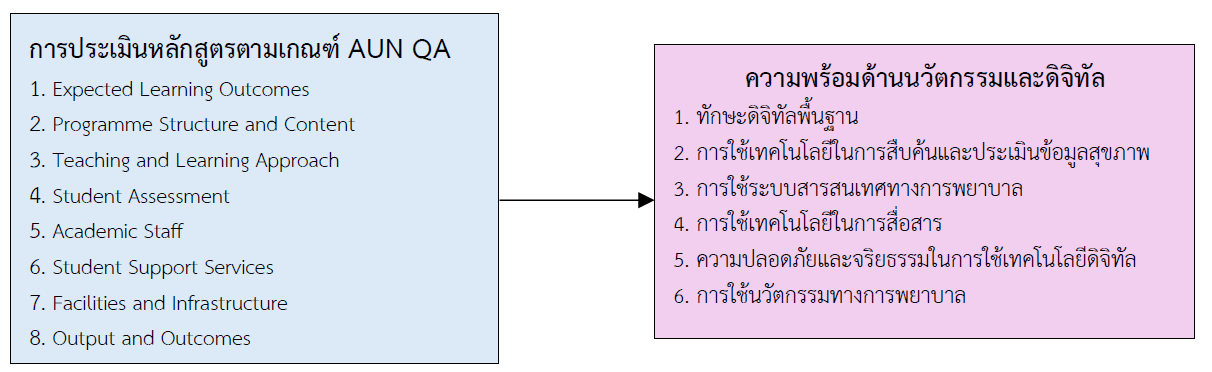
This mixed methods study aimed to: 1) examine the quality of the Thai Bachelor of Nursing Science program, based on the ASEAN University Network Quality Assurance (AUN-QA) criteria on innovation and digital readiness; and 2) investigate the predictive power of curriculum quality on innovation and digital readiness. The sample included 80 graduate employers and 52 clinical preceptors. Data were collected using questionnaires and in-depth interviews. Research instruments were validated for content validity by experts (IOC = .80 – 1.00) and demonstrated high reliability (Cronbach’s alpha = 0.92). Data were analyzed using descriptive statistics, multiple regression analysis, and content analysis. The results showed as follows.
1. The overall curriculum quality according to AUN-QA criteria was rated at a good level (M = 5.27, SD = 0.71), with academic staff scoring the highest (M = 5.48, SD = 0.65).
2. The program’s innovation and digital readiness was at a high level (M = 4.01, SD = 0.61), with the highest score in digital technology safety and ethics (M = 4.25, SD = 0.55).
3. Curriculum quality significantly predicted innovation and digital readiness, accounting for 65.9% of the variance (R² = 0.659). The strongest predictors were facilities and infrastructure (b = 0.385), followed by teaching and learning methods (b = 0.342), academic staff (b = 0.288), and student support services (b = 0.245).
The results suggest that nursing education institutions should strengthen digital infrastructure, integrate technology into teaching and learning, enhance faculty digital competencies, and establish effective student support systems to advance the innovation and digital readiness of nursing curricula in the digital era.
References
ASEAN University Network. (2020). Guide to AUN-QA Assessment at Programme Level Version 4.0. ASEAN University Network.
Creswell, J. W., & Plano Clark, V. L. (2018). Designing and Conducting Mixed Methods Research (3rd ed.). SAGE Publications.
Hair, J. F., Black, W. C., Babin, B. J., & Anderson, R. E. (2018). Multivariate Data Analysis (8th ed.). Cengage Learning.
Honey, M., Collins, E., & Britnell, S. (2020). Digital technology: Its role in enabling nurses' transition to academic life and generating new nursing knowledge. Nurse Education in Practice, 42, 102634. doi.org/10.1016/j.nepr.2019.102634
Konttila, J., Siira, H., Kyngäs, H., Lahtinen, M., Elo, S., Kääriäinen, M., et al. (2019). Healthcare professionals' competence in digitalisation: A systematic review. Journal of Clinical Nursing, 28(5-6), 745-761. doi.org/10.1111/jocn.14710
Lee, H., Park, K., & Jung, Y. (2021). Digital competency in nursing education: A comparative study of nursing students' readiness for digital healthcare. Nurse Education Today, 98, 104741. doi.org/10.1016/j.nedt.2020.104741
Park, S., Kim, J., & Lee, Y. (2024). Quality assurance in nursing education: Implementation and outcomes of AUN-QA criteria in Asian nursing schools. Journal of Professional Nursing, 49(1), 32-41. doi.org/10.1016/j.profnurs.2023.11.004
Rouleau, G., Gagnon, M. P., Côté, J., Richard, L., Chicoine, G., & Keating, N. (2021). Virtual patient simulation to improve nurses' digital health competencies: A pre-post study. Nurse Education Today, 99, 104829. doi.org/10.1016/j.nedt.2021.104829
Sukboonyasatit, K., Thanapop, S., & Wattanasit, P. (2023). Implementation of AUN-QA framework in nursing education: A mixed-methods study in Thailand. Nurse Education in Practice, 66, 103537. doi.org/10.1016/j.nepr.2022.103537
Wilson, L., Wocial, L. D., Slaven, J. E., & Happ, M. B. (2023). Digital transformation in nursing education: A systematic review and meta-analysis. Journal of Nursing Education, 62(3), 145-156. doi.org/10.3928/01484834-20221212-01
Zhang, Y., Liu, C., Wang, J., & Chen, H. (2022). Integrating digital health technologies into nursing curricula: A qualitative study of facilitators and barriers. Nurse Education Today, 110, 105265.
Downloads
Published
Issue
Section
License
Copyright (c) 2025 Journal of Nursing and Education

This work is licensed under a Creative Commons Attribution-NonCommercial-NoDerivatives 4.0 International License.



