
Development of a Home-Based Care Model (Home Ward) for Patients with Diabetes and Hypertension in the Community Hospital Network in Trang Province
Keywords:
Model, Home Care, Diabetes, hypertension, Community HospitalAbstract
This action research aimed to develop a home-based care model (home ward) for patients with diabetes and hypertension in the Trang Province community hospital network. The target groups included: a) 102 inpatients diagnosed with diabetes and hypertension, b) 30 home ward patients, and c) 30 healthcare workers from community hospitals in Trang Province. The research procedure was divided in three phases: 1) situation analysis (assessing the current situation and challenges in diabetes and hypertension patient care), 2) model development, and 3) model evaluation. Both qualitative and quantitative data were collected through observations, unstructured and semi-structured interviews, as well as focus group discussions. The study period was from January to November 2024. The data was analyzed using paired t-tests, one-sample t-tests, and content analysis. The findings showed the following.
1. There were seven main challenges in home-based care for diabetic and hypertensive patients in the community hospital network of Trang Province: 1) healthcare personnel lacked sufficient understanding of home care for patients, 2) roles and responsibilities of staff were unclear, 3) patients did not receive comprehensive care and lacked continuous follow-up, 4) adherence to standard patient care guidelines was at a high level (M = 8.32, SD = 3.22), 5) compliance with nursing care protocols was also at a high level (M = 17.27, SD = 5.86), 6) quality of service related to the model was highly rated (M = 3.88, SD = 0.47), 7) patient participation was at a high level (M = 3.99, SD = 0.44).
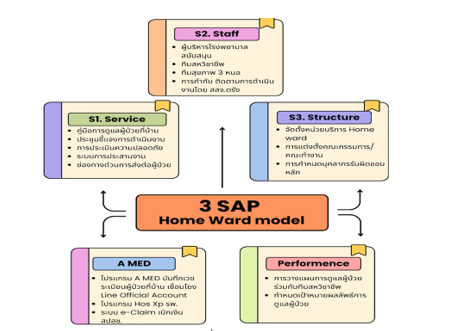
2. The developed model, called the "3SAP Home Ward Model", consisted of five core characteristics: 1) high-quality healthcare services, 2) healthcare workers and caregivers, 3) operational framework for home-based care, 4) a home patient medical record system, and 5) measurable patient care outcomes. The overall quality assessment of the model was rated at a high level (M = 4.45, SD = 0.51).
3. The total scores for adherence to patient care standards, compliance with nursing care guidelines, service quality, and patient participation were significantly higher than the target values (p-value < .01). Blood sugar and blood pressure levels significantly decreased after implementing the model (p-value < .001).
Therefore, this model can be applied to improve chronic disease management within hospital networks, aligning with local healthcare contexts.
References
American Diabetes Association (2020). Improving care and promoting Health in populations: Standards of medical care in diabetes-2020. Diabetes care, 43(Suppl 1), S7–S13.
Best, J. W. (1977). Research in Education (3rd ed.). Prentice Hall.
Department of Disease Control. (2023). Annual Report on Non-Communicable Diseases in Thailand. Ministry of Public Health. (in Thai)
Department of Disease Control. (2023). ODPC 9 Warns Public on World Hypertension Day. Retrieved 29 May 2024 from https://ddc.moph.go.th/index.phphttps://ddc.moph.go.th/ odpc9/news.php?news=34026&d. (in Thai)
Department of Medical Services. (2022). Guidelines and Standards for Home Care. Nonthaburi: Department of Medical Services, Ministry of Public Health. (in Thai)
Department of Medical Services, Ministry of Public Health. (2022). Guidelines and Standards for Home Care. Bangkok: Department of Medical Services, Ministry of Public Health. (in Thai)
Department of Medical Services, Ministry of Public Health. (2022). Guidelines for Home Ward Care: Expanding Medical Services to Patients' Homes. (in Thai)
Donabedian, A. (1988). The quality of care: How can it be assessed? Journal of the American Medical Association, 260(12), 1743-1748.
Engel, G. L. (1977). The need for a new medical model: A challenge for biomedicine. Science, 196(4286), 129-136.
Kemmis, S., & McTaggart, R., (1988). The Action Research Planner. Deakin University.
Magteppong, W., Nanudorn, A., Poungsamai, P. (2022). The development of the pattern of family roles in caring for elderly persons with hypertension through family participation. Thai Journal of Cardio-Thoracic Nursing, 33(2), 101-116. (in Thai)
Nursing Division, Ministry of Public Health. (2014). Home Visit Quality Standards. Bangkok: Agricultural Cooperative Printing of Thailand. (in Thai)
Rattanagreethakul, S., Thanakit, S., Krungkraipetch, N., Ritngam, A. (2018). Development of the home ward care: A case study of the health promoting innovation of Khlong-Yai hospital, Trat province. The Journal of Faculty of Nursing, 26(1), 79-90. (in Thai)
Shawwa L. (2023). The use of telemedicine in medical education and patient care. Cureus, 15(4), e37766. doi.org/10.7759/cureus.37766
Smith, J., & Brown, P. (2020). Home-based chronic disease care and its impact on hospitalization rates: A systematic review. Journal of Community Health, 45(4), 789-803.
Srina, S. (2021). Development of care model for diabetic type 2 by Line application. Journal of Research and Health Innovative Development, 2(1), 123-133. (in Thai)
Stoltzfus, M., Kaur, A., Chawla, A., Gupta, V., Anamika, F., & Jain, R. (2023). The role of telemedicine in healthcare: An overview and update. Egyptian Journal of Internal Medicine, 35, 49. https://doi.org/10.1186/s43162-023-00234-z
Trang Provincial Public Health Office. (2024). Annual Report 2023: Diabetes mellitus and hypertension report 2023. Trang. (in Thai)
Trang Provincial Public Health Office. (2024). Home Ward Care for Diabetes Mellitus and Hypertension Patients in Trang Province Report. Trang. (in Thai)
World Health Organization. (2021). Guideline for the Pharmacological Treatment of Hypertension in Adults. Geneva: World Health Organization.
Downloads
Published
Issue
Section
License
Copyright (c) 2025 Journal of Nursing and Education

This work is licensed under a Creative Commons Attribution-NonCommercial-NoDerivatives 4.0 International License.



