
Competency Levels of Nursing Instructors in Thai Private Higher Education Institutions of Thailand
Abstract
This descriptive research aimed to 1) examine the competency levels of nursing instructors and 2) analyze the confirmatory components of nursing instructor competencies in private higher education institutions in Thailand. The sample consisted of 237 nursing instructors working at private higher education institutions in Thailand, selected through multistage random sampling. The research instruments included 1) a personal information questionnaire with 7 items and 2) a nursing instructor competency scale consisting of 113 items, that were found with content validity indices (IOC) ranging from 0.60 to 1.00, and a reliability coefficient of 0.99. Data were collected via an online questionnaire from February to June 2024. Data analysis involved descriptive statistics and confirmatory factor analysis. The results showed as follows.
1. The overall competency level of nursing instructors in private higher education institutions in Thailand was high (M = 4.27, SD = 0.46).
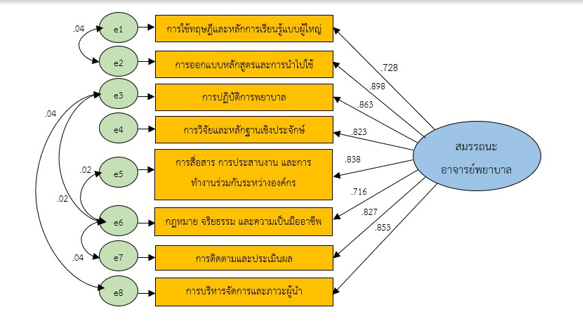
2. The confirmatory factor analysis identified eight competency components of nursing instructors in these institutions: 1) application of adult learning theories and principles, 2) curriculum design and implementation, 3) nursing practice, 4) research and empirical evidence, 5) communication, coordination, and inter-organizational collaboration, 6) legal, ethical, and professional standards, 7) monitoring and evaluation, and 8) management and leadership. The proposed competency model showed good fit with the data, indicated by chi-square (c2) = 22.924, degrees of freedom (df) = 15, relative chi-square (c2df) = 1.528, p-value = 0.086, root mean square error of approximation (RMSEA) = 0.047, root mean square residual (RMR) = 0.006, goodness-of-fit index (GFI) = 0.976, and adjusted goodness-of-fit index (AGFI) = 0.943.
Therefore, administrators of nursing education programs at private higher education institutions in Thailand can utilize these findings to plan the development of nursing instructor competencies, especially in curriculum design and implementation, nursing practice, and management and leadership, as these areas are among the most critical competencies.
References
Bownes, N. A. and Freeman, M.A. (2020). Clinical nurse instructor competencies: An exploratory study of role requirements. Quality Advancement in Nursing Education, 3(5), 1-13.
Buncham, S. (2017). Basic Research (10th ed.). Bangkok: Suwiriyasarn. Chaonarin, P., Chinatongkul, C., & Chaisirithanya, K. (2021). Administrative skills in 21st century of administrators in faculty of nursing under private higher education institution of Thailand. The Journal of Research and Academics, 5(1), 113-128. (in Thai).
Hababeh, M. O., & Lalithabai, D. S. (2020). Nurse trainees' perception of effective clinical instructor characteristics. International journal of nursing sciences, 7(3), 285–290
Hair, J. F., Black, W.C., Babin B.J., & Anderson, R.E. (2019). Multivariate Data Analysis (8th ed.). Hampshire: Annabel Ainscow.
Hassan, M., N., Mostafa, G. M. A., & Akel, D. T. (2021). Assessment of clinical instructors’ competencies in the nursing field. IOSR Journal of Nursing and Health Science, 10(2), 36–41.
Kerdbanchan, C. & Jarujittipant, P. (2019). Factors affecting the quality of Thai private university instructors. Journal of Social Sciences Srinakharinwirot University, 22(1), 13-27. (in Thai)
Kitphan, P. (2018). Aging society in Thailand. Thai Food and Drug Journal, 25(3), 4–8. (in Thai)
Kwanmueang N. (2021). The Development of Thai Private University’s Management According to the Concept of Entrepreneurial University. A dissertation submitted in partial fulfillment of the requirement for the Doctor of Philosophy in Leadership and Innovation in Educational Administration, Siam University. (in Thai)
Ministry of Higher Education, Science, Research, and Innovation. (2023). The Number of Lecturers in Higher Education Institutions for the Academic Year 2022, Second Semester, Categorized by Institution/Faculty/Group of Institutions. Retrieved December 10, 2023 from https://info. mhesi.go.th/stat_stf.php?search_year=2564& download=7086&file_id=202210121454.xlsx. (in Thai)
Mohamed, D. L. A., Shazly M., M., & Saad, N. F. (2018). Core competencies of nurse educator at technical institutes of nursing. Egyptian Journal of Health Care, 9(4), 110-119.
Park, H., Choi, E., Kim, G., Kim, Y., Jeon, M., & Hwang, H. (2022). Development of core competency scale for clinical nursing student educators. J Korean Academic Society Nursing Education, 28(4), 345-356.
Phaktoop, M., Suvanarak, T., & Bungum, R. (2019). Job retention of nurse educators in private education institute, Bangkok metropolitan region. Journal of Nursing and Education, 12(2). 97-110. (in Thai).
Potchana, R., Sanrattana. W, & Suwannoi, P. (2020). Adaptive leadership for teachers in Boromarajonani college of nursing under Boromarachanok institute. Journal of Nursing and Health Care, 38(1), 187-195 (in Thai).
Professional and Organizational Development Network of Thailand Higher Education. (2025). A Request for the Assessment of Nursing Faculty Competencies Aligned with Faculty Development Guidelines Aimed at Promoting the Achievement of Learning Outcomes in Accordance with the Thai Qualifications Framework for Higher Education 2023. Retrieved April 10, 2025 from https://surl.li/rdtfdy. (in Thai).
Roongruangsri, S., & Sngounsiritham, U. (2015). Nursing faculty: Challenging the personal competency. Nursing Journal CMU, 42, 214–220. (in Thai)
Rugmai, S. (2015). Development and Trends of Private Higher Education Institutions. A dissertation submitted in partial fulfillment of the requirement for the Doctor of Philosophy Program in Higher Education, Chulalongkorn University. (in Thai).
Saraketrin, A., Rongmuang, D. & Chantra, R. (2019). Nursing education in the 21st century: Competencies and roles of nursing instructors. Journal of The Royal Thai Army Nurses. 20(1), 12-20.
Sebach. A.M., (2022). Psychometric testing of a tool assessing nurse practitioner clinical educator competence. The Journal for Nurse Practitioners, 18, 217-220.
Supradith, B. (2019). Job performance of nursing instructors under the public educational institutions. The Journal of Boromarajonani College of Nursing Suphanburi. 2(2). 45-61. (in Thai).
Thailand Nursing and Midwifery Council. (2018). Announcement from the Nursing Council Regarding the Core Competencies of Graduates with a Bachelor's Degree, Master's Degree, and Doctoral Degree in Nursing, as well as the Advanced Nursing Training Program Leading to Certification/Authorization Demonstrating Specialized Knowledge and Expertise in Nursing and Midwifery, and Nursing in the Field of Nursing Science. Retrieved April 24, 2025 from https://www.tnmc.or.th/images/userfiles/files/112.pdf.
Turner, K., Charoensuk, S., Bormann, S. V., & Sawaengdee, K. (2019). Nurse competencies and associated factors in the context of nursing education institutions in Thailand. Journal of Nursing Division, 46(3), 1-19.
Tuzazon, C.M. (2016). Level of competencies of Clinical Instructors of the College of Nursing in a State University in the Philippines: An Assessment. RET Academy for international Journals of Multidisciplinary Research, 5(12), 27-34.
Wanchai, A., Phrompayak, D., & Prompuk, B. (2022). A needs assessment for competency development of nurse educators. Nursing Forum, 57(6), 1445–1451.
World Health Organization. (2016). Nurse Educator Core Competencies. Geneva: WHO Document Production Services.
Whittaker, T. A., & Schumacker, R. E. (2022). A Beginner’s Guide to Structural Equation Modelling (5th ed.). NY: Routledge.
Downloads
Published
Issue
Section
License
Copyright (c) 2025 Journal of Nursing and Education

This work is licensed under a Creative Commons Attribution-NonCommercial-NoDerivatives 4.0 International License.



