
The Effects of Design Thinking-Based Learning on Nursing Students' Innovation Thinking Skills: A Mixed-Methods Study
Abstract
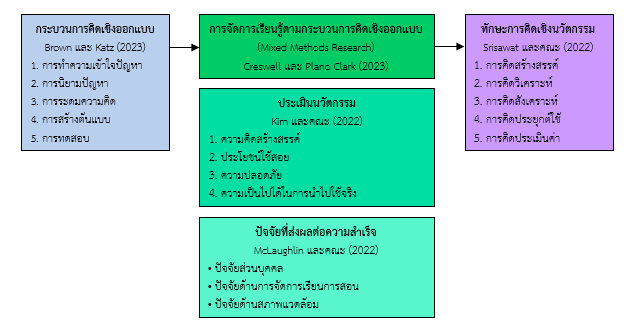
This mixed-methods study examined the impact of design thinking-based learning on nursing students' innovative thinking skills. The sample consisted of 133 third-year nursing students. Research instruments included an innovative thinking skills assessment, an innovation quality evaluation, in-depth interviews, and focus group discussions. Data were analyzed using descriptive statistics, paired t-tests, repeated measures ANOVA, and content analysis. Key findings include:
1. Post-learning innovation thinking skills scores were significantly higher than pre-learning scores (p-value < .01).
2. Students developed high-quality innovations that effectively addressed patient needs.
3. Participants reported positive learning experiences, particularly in deep learning through real-world application and holistic thinking development.
4. Patients demonstrated high satisfaction with the innovations (M = 4.59, SD = 0.52).
5. Factors influencing innovative thinking skills included GPA, prior innovation experience, and interest in innovation, collectively accounting for 42% of the variance (R² = .42).
These findings highlight the effectiveness of design thinking-based learning in enhancing nursing students' innovative thinking skills. Integrating this approach into nursing curricula could better equip students to address future healthcare challenges.
References
Anderson, L. W., & Krathwohl, D. R. (2001). A Taxonomy for Learning, Teaching, and Assessing: A Revision of Bloom's Taxonomy of Educational Objectives. New York: Longman.
Apedaile, L. (2022). Innovation in Health Science Education: An Experiential Learning Program. International Journal of Health Sciences Education. Retrieved May 28, 2024 from https://dc.etsu.edu/cgi/viewcontent.cgi?article=1130&context=ijhse
Beaird, G., Geist, M. J., & Lewis, E. J. (2018). Design thinking: Opportunities for application in nursing education. Nurse Education Today, 64, 115-118. doi.org/10.1016/j.nedt.2018.02.007
Brown, T., & Katz, B. (2023). Change by Design: How Design Thinking Can Transform Organizations and Inspire Innovation (3rd ed.). Harper Business.
Chen, S. C., Yang, C. C., Chen, C. C., & Hsu, C. C. (2021). Effectiveness of a nursing innovation workshop at enhancing nurses' innovation and research abilities. BMC Nursing, 20, 221.
Creswell, J. W., & Plano Clark, V. L. (2023). Designing and Conducting Mixed Methods Research (4th ed.). SAGE Publications.
Feng, Y., Zhu, L., Cai, W., Zhang, X., & Chen, H. (2024). Mindfulness in ward nurses: A concept analysis. Nursing Open, 11(2), 1112-1124. doi.org/10.1002/nop2.2052
Global Burden of Disease Study 2019 Collaborators. (2020). Global burden of 369 diseases and injuries in 204 countries and territories, 1990–2019: A systematic analysis for the Global Burden of Disease Study 2019. The Lancet, 396(10258), 1204-1222. doi.org/10.1016/S0140-6736(20)30925-9
Jackson, D., Bradbury‐Jones, C., Baptiste, D., Gelling, L., Morin, K., Neville, et al. (2021). Life in the pandemic: Some reflections on nursing in the context of COVID‐19. Journal of Clinical Nursing, 30(1-2), 86-89. doi.org/10.1111/jocn.15257
Kim, H., Sefcik, J. S., & Bradway, C. (2017). Characteristics of qualitative descriptive studies: A systematic review. Research in Nursing & Health, 40(1), 23–42. doi.org/10.1002/nur.21768
Kolb, D. A. (1984). Experiential Learning: Experience as the Source of Learning and Development. Prentice-Hall.
Labata-Lezaun, N., Canet-Vintró, M., López-de-Celis, C., Rodríguez-Sanz, J., Aiguadé, R., Cuadra-Llopart, L., Jovell-Fernández, E., Bosch, J., & Pérez-Bellmunt, A. (2023). Effectiveness of a multicomponent training program on physical performance and muscle quality in older adults: A quasi-experimental study. International Journal of Environmental Research and Public Health, 20(1), 123.
Moon, S., & Chang, S. J. (2024). Comparing the effects of patient safety education using design thinking and case-based learning on nursing students' competence and professional socialization: A quasi-experimental design. Heliyon, 10(9), e29942. doi.org/10.1016/j.heliyon.2024.e29942
Morin, K. H. (2020). Nursing education after COVID-19: Same or different? Journal of Clinical Nursing, 29(17-18), 3117-3119. doi.org/10.1111/jocn.15322
Ronquillo, C. E., Peltonen, L. M., Pruinelli, L., Chu, C. H., Bakken, S., Beduschi, A., et al. (2021). Artificial intelligence in nursing: Priorities and opportunities from an international invitational think-tank of the Nursing and Artificial Intelligence Leadership Collaborative. Journal of Advanced Nursing, 77(9), 3707–3717. doi.org/10.1111/jan.14855
Ryan, R. M., & Deci, E. L. (2000). Self-determination theory and the facilitation of intrinsic motivation, social development, and well-being. American Psychologist, 55(1), 68-78. doi.org/10.1037/0003-066X.55.1.68
University of Tulsa. (2025). Technology in Nursing Education: Leading Innovation. University of Tulsa Online. Retrieved June 24, 2024 from https://online.utulsa.edu/blog/technology-in-nursing-education/
World Health Organization. (2022). State of the World's Nursing 2022: Invest in Nursing and Respect Rights to Secure Global Health. Retrieved July 2, 2024 from https://www.who.int/publications/i/item/9789240019096
Yamane, T. (1967). Elementary Sampling Theory. Prentice-Hall.
Downloads
Published
Issue
Section
License
Copyright (c) 2025 Journal of Nursing and Education

This work is licensed under a Creative Commons Attribution-NonCommercial-NoDerivatives 4.0 International License.



