
The Effects of Implementing the N-PASS Care Bundle on the Incidence of Acute Kidney Injury and Clinical Outcomes in Patients with Sepsis and Septic Shock within an Internal Medicine Department
Abstract
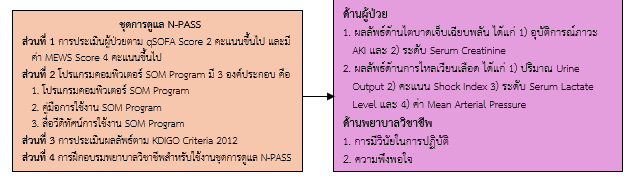
This quasi-experimental study utilized a non-randomized, post-test-only control group design to investigate the effects of the N-PASS (Nursing Care Bundle to Prevent Acute Kidney Injury among Patients with Sepsis and Septic Shock) care bundle on the incidence of acute kidney injury (AKI) and clinical outcomes in patients with sepsis and septic shock admitted to the internal medicine department of a tertiary hospital in Northeastern Thailand between April and July 2023. Eighty inpatients were assigned to either the control group (n = 40), which received standard hospital care, or the experimental group (n=40), which received care based on the N-PASS bundle. The N-PASS care bundle is an innovative nursing intervention developed based on established nursing guidelines for AKI prevention in patients with sepsis and septic shock. Data were analyzed using descriptive statistics, Cox Proportional Hazard Regression, independent t-tests, repeated measures ANOVA, and the Mann-Whitney U test. The following results were observed.
1. The incidence rate of AKI in the experimental group was 17.24 cases per 1,000 patient-days, compared to 515.63 cases per 1,000 patient-days in the control group. Patients in the control group had a 16.5 times higher risk of developing AKI than those in the experimental group (HR = 16.5, 95% CI [4.24, 64.18], p-value < .001). The experimental group had significantly lower mean serum creatinine levels at baseline (p-value = .002) and at 48 hours (p-value =.016). Mean urine output was significantly greater in the experimental group at 6 hours (p-value < .001) and 72 hours (p-value < .001). The Shock Index was significantly lower in the experimental group at baseline (p-value = .002), 3 hours (p-value < .001), 24 hours (p-value < .001), and 72 hours (p-value = .001). Mean serum lactate levels were significantly lower in the experimental group at baseline (p-value = .005) and 24 hours (p-value < .001). Mean Arterial Pressure (MAP) was s significantly higher in the experimental group at baseline (p-value < .001) and at 3 hours (p-value = .001).
2. Regarding nurses’ compliance and satisfaction, 100% of nurses adhered to the N-PASS care bundle, and 98.4% reported satisfaction with using the bundle.
This study suggests that the N-PASS care bundle is effective in reducing the incidence of AKI and improving clinical outcomes in patients with sepsis and septic shock. High nurse compliance and satisfaction with the N-PASS bundle indicate its feasibility for implementation in real-world clinical settings.
References
Bernard, H. (2000). Social Research Methods: Qualitative and Quantitative Approaches. Sage: Thousand Oaks. Centers for Medicare and Medicaid Services, & National
Center for Health Statistics. (2020). International Classification of Diseases, Related Health Problem 10th Revision, and Clinical Modification Official Guidelines for Coding and Reporting. Retrieved April 30, 2022, from https://www.cdc.gov/nchs/data/icd/10cmguidelines-FY2020_final.pdf
Chaimay, B. (2013). Sample size determination in descriptive study in public health. Thaksin Journal, 16(2), 9-18. (in Thai)
Cohen, J. (1988). Statistical Power Analysis for the Behavioral Sciences. 2nd edition. New York: Academic Press. https://doi.org/10.4324/9780203771587
Doenges, M. E., Moorhouse, M. F., & Murr, A. C. (2019). Nursing Diagnosis Manual: Planning, Individualizing, and Documenting Client Care. 6th ed. F.A.
Davis Company. Evans, L. E., Rhodes, A., Alhazzani, W., Antonelli, M., Coopersmith, C. M., French, C., et al. (2021). Surviving sepsis campaign: international guidelines for management of sepsis and septic shock 2021. Critical Care Medicine, 49(11), e1063-e1143.
Gotts, J. E., & Matthay, M. A. (2016). Sepsis: Pathophysiology and Clinical Management [Electronic version]. Retrieved April 30, 2022, from https://www.bmj.com/content/bmj/353/bmj.i1585.full.pdf
Huekherm, P. (2020). Nursing care for sepsis patients in the emergency room: Compare 2 cases. Udonthani hospital. Medical Journal, 28(2), 263-274. (in Thai)
International Classification of Diseases, Related Health Problem 10th Revision, and Clinical Modification Official Guidelines for Coding and Reporting. (2020). Retrieved April 30, 2022, from https://www.cdc.gov/nchs/data/icd/10cmguidelines-FY2020_final.pdf
Khwannimit, B., Bhurayanontachai, R., & Vattanavanit, V. (2018). Comparison of the performance of SOFA, qSOFA and SIRS for predicting mortality and organ failure among sepsis patients admitted to the intensive care unit in a middle-income country. Journal of Critical Care 44, 156-160.
Kidney Disease: Improving Global Outcomes (KDIGO) Acute Kidney Injury Work Group. (2012). KDIGO Clinical Practice Guideline for Acute Kidney Injury [online]. Retrieved April 30, 2022, from http://www.kdigo.org/clinical_practice_guidelines/pdf/KDIGO AKI Guideline.pdf
Koch, E., Lovett, S., Nghiem, T., Riggs, R. A., & Rech, M. A. (2019). Shock index in the emergency department: utility and limitations. Open Access Emergency Medicine, 11, 179-199.
Levy, M. M., Evans, L. E., & Rhodes, A. (2018). The surviving sepsis campaign bundle: 2018 update. Intensive Care Med 44, 925-928. https://doi.org/10.1007/s00134-018-5085-0
Nakwan, S. (2017). Incidence, risk factors, and impact of acute kidney injury in patients admitted to intensive care unit in Ratchaburi hospital. Region 4-5 Medical Journal, 39(4), 656-667. (in Thai)
National Health and Medical Research Council. (1999). A Guide to the Developmental, Implementation and Evaluation of Clinical Practice Guidelines. Retrieved April 30, 2022, from https://www.nhmrc.gov.au/sites/default/files/images/a-guide-to-the-development-and-evaluation-of-clinical-practice-guidelines.pdf
Ospina-Tascón, G. A., Teboul, J., Hernandez, G., Alvarez, I., Sánchez‐Ortiz, A. I., Calderón-Tapia, L. E., et al. (2020). Diastolic shock index and clinical outcomes in patients with septic shock. Annals of Intensive Care, 10(41), 1-11.
Polit, D.F., & Hungler, B.P. (1999). Nursing Research: Principles and Methods. 6th ed. Philadelphia: Lippincott.
Rotchanahiran, M. (2020). Effectiveness of clinical nursing practice guideline for the trauma patient with multiple injury In emergency department, Udon Thani hospital. Udonthani Hospital Medical Journal, 28(3), 413-425. (in Thai)
Rungwirivawanich, P. (2022). The standard of care for patients with sepsis syndrome at emergency department, Suddhavej hospital, faculty of medicine, Mahasarakham university. Journal of Nursing and Health Care, 40(1), 112-118. (in Thai)
Sernthaisong, S. (2019). Effect of modified early warning scores (MEWS) on the treatment of patients with sepsis at the ward in Ban Phue hospital. Udonthani Hospital Medical Journal, 27(2), 223-230. (in Thai)
Taweewan, S. (2018). Effects of using nursing practice guidelines based on “modified early warning scores” for patients with sepsis in the medicine women department at Buengkan hospital. Udonthani Hospital Medical Journal, 26(3). 153-163. (in Thai)
Thamcharoentrakul, B, & Saensom, M. (2019). Effects of using nursing practice guideline for ventilator associated pneumonia prevention: Medical department. The Journal of Baromarajonani College of Nusing, Nakhonratchasima, 25(1), 25-42. (in Thai)
Waehayee, A., Chanruangvanich, W., Thosingha, O., & Keorochana, K. (2019). Factors predicting the severity of acute kidney injuries in trauma patients within 48 Hours. Journal of Thailand Nursing and Midwifery Council, 34(1), 122-140. (in Thai)
World Health Organization. (2022). World Sepsis Day 2021. Retrieved April 30, 2022, from https://www.who.int/health-topics/sepsis#tab=tab_1
Downloads
Published
Issue
Section
License
Copyright (c) 2025 Journal of Nursing and Education

This work is licensed under a Creative Commons Attribution-NonCommercial-NoDerivatives 4.0 International License.



