
The Effects of a Self-efficacy Enhancing Program on Caregivers’ Management of Stroke Warning Signs for High-risk Older Persons
Keywords:
Self-efficacy Enhancing Program, Stroke Warning Signs Management, Caregiver of High-Risk Older PersonsAbstract
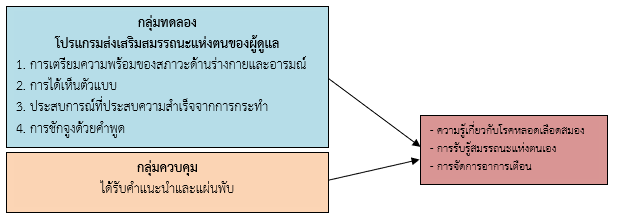
This quasi-experimental study aimed to investigate the effects of a self-efficacy enhancing program on caregivers’ management of stroke warning signs for high-risk older persons that was developed based on the self-efficacy theory. The subjects were 60 caregivers of high-risk older persons who were purposively selected following inclusion criteria. The 30 subjects in the control group received health information and advice, whereas the 30 subjects in the experimental group received the self-efficacy enhancing program. The program was approved by three experts and yielded a content validity index of 1.00. The instruments for data collection were : 1) a demographic and illness data of high-risk older persons form, 2) a demographic data of family caregivers of high-risk older persons form, 3) a knowledge of stoke in elderly and stroke warning signs management checklist, 4) a perceived self-efficacy on stroke warning signs management questionnaire, and 5) a performance of stroke warning signs management checklist. The instruments were approved by three experts and yielded a content validity index of 1.00. The reliabilities of the third, fourth and fifth parts of the instruments were .73, .93, and 100.0%, respectively. The data were analyzed using descriptive statistics, as well as comparison between groups, using Fisher’s Exact Test, Chi-Square, Wilcoxon Ranks test, and Mann-Whitney U test. The results showed as follows.
1. After receiving the self-efficacy enhancing program, the knowledge score of the experimental group was significantly higher than before (p-value < .01). The score of perceived self-efficacy on stroke warning signs and the score of stroke warning signs management of the experimental group was significantly higher than before (p-value < .001).
2. After receiving the self-efficacy enhancing program, the knowledge score of the experimental group was significantly higher than that of the control group (p-value < .01). The score of perceived self-efficacy on stroke warning signs and the score of stroke warning signs management of the experimental group were significantly higher than that of the control group (p-value < .001).
These findings illustrate the effects of the self-efficacy enhancing program on increasing self-efficacy of caregivers in observing stroke warning signs and is effectively caring and managing referred the high-risk older persons to access the treatment.
References
Bandura, A. (1997). Self-Efficacy: The Exercise of Control. New York: H. Freeman & Co.
Feigin, V. L., Brainin, M., Norrving, B., Martins, S., Sacco, R. L., Hacke, W., et al. (2022). World stroke organization (WSO): Global stroke fact sheet 2022. International Journal of Stroke, 17(1), 18-29.
Fillit, H. M., Rockwood, K., & Young, J. (2017). Brocklehurst’s Textbook of Geriatric Medicine and Gerontology. Elsevier: Saunders.
Kitrungrote, L., & Phromnoi, C. (2020). The Development of Model for Accessibility to EMS of Older Persons with Stroke: Spearhead Project. Songkhla: Faculty of Nursing, Prince of Songkla University. (in Thai)
Kittiboonthawal, P., Yingrengreung, S., & Srithanya, S. (2013). Perceptions of stroke warning signs among risk patients. Nursing Journal of The Ministry of Public Health, 23(3), 132-141. (in Thai)
Lorlowhakarn, S., Narintharaksa, P., Tiratuntayaporn, R., & Romin, J. (2021). Effectiveness of perception and prevention program with five bases on stroke in the life of hypertensive patients in Sub-district health promoting hospital, Phuket Province. Journal of Health Science of Thailand, 30(6), 1091-1100. (in Thai)
Majavong, M. (2019). Stroke in the elderly. Journal of Thai Stroke Society, 18(1), 59-74. (in Thai) Nilnate, N. (2019). Risk factors and prevention of stroke in hypertensive patients. Journal of the Royal Thai Army Nurses, 20(2), 51-57. (in Thai)
Noommeechai, N., Samartkit, N., & Masingboon, K. (2017). Factors related to response to stroke symptoms in family members of patients with acute ischemic stroke. Journal of Nursing and Education, 10(3), 23-38. (in Thai)
Phoonphoerm, M., Apinundecha, C., & Limtoprasert, S. (2021). The effectiveness of self-efficacy program on diabetes preventing behaviors of the risk groups. UMT Poly Journal, 18(2), 277-289. (in Thai)
Piyahirun, J., Kasipol, T., & Prasertsomg, C. (2018). Effects of a self-efficacy promotion program for stroke caregivers. Journal of Health Sciences and Wellness, 22(43-44), 130-142. (in Thai)
Powers, W. J., Rubinstein, A. A., Ackerson, T., Adeoye, O. M., Bambakidis, N. C., Becker, K., et al. (2019). Guidelines for the early management of patients with acute ischemic stroke: 2019 update to the 2018 guidelines for the early management of acute ischemic stroke.Stroke, 50: e344–e418. doi: 10.1161/STR.0000000000000211.
Puthasna, T. (2024). The effectiveness of the stroke assessment skill development program of village volunteers on access to the Stroke Fast Track service system in stroke patients. Journal of Environmental and Community Health, 9(1), 690-698. (in Thai)
Rattanachan, P. (2023). The factors related to seeking treatment at the hospital in stroke patients at Uthai Hospital, Phra Nakhon Sri Ayuthaya. Journal of Environmental and Community Health, 9(1), 37-45. (in Thai)
Saguaunsuk, P., & Mekrungrongwong, S. (2022). The effectiveness of a self-efficacy building program on stroke prevention behaviors among elderly patients with chronic illness in Khlong Khlung District, Kampaengphet Province. The Southern College Network Journal of Nursing and Public Health, 9(2), 122-37. (in Thai)
Suwintrakorn, C., Kalampakorn, S., & Rawiworraku, T. (2019). The effects of self-efficacy enhancement program for health volunteers on stroke surveillance and prevention. Thai Journal of Nursing, 68(1), 39-48. (in Thai)
Theamkou, S. (2022). Incidence of stroke in Thailand. Thai Journal of Neurology, 39(2), 39-46. (in Thai)
Vipaksongkhro, S., Kensaku, T., Takthaweephon, S., Supat, J., Boonthong, J., & Kosimongkol, S. (2024). Clinical Nursing Practice Guideline for Stroke. (5th Ed.). Bangkok: Thana Press. (in Thai)
Wanna, A., Kimsungnoen, N., & Namchanthra, R. (2020). Perceptions and management of warning signs among persons at risk of stroke. APHEIT Journal of Nursing and Health, 2(1), 30-44. (in Thai)
Wongrattana, C. (2009). Statistics for Research. (7th Ed.). Bangkok: Thaineramit Interprogrssive. (in Thai)
Yiadthaisong, K., Wngpiriryayothar, A., & Kuleelung, P. (2019). Factors predicting prehospital time of patients with acute ischemic stroke in acute phase. Journal of Nursing and Health, 37(1), 148-156. (in Thai)
Downloads
Published
Issue
Section
License
Copyright (c) 2025 Journal of Nursing and Education

This work is licensed under a Creative Commons Attribution-NonCommercial-NoDerivatives 4.0 International License.



