
The Competency of Curriculum Management of Curriculum Administrators Influencing the Quality of Curriculum Administration in the Bachelor of Nursing Science Program, Faculty of Nursing, Praboromarajchanok Institute
Abstract
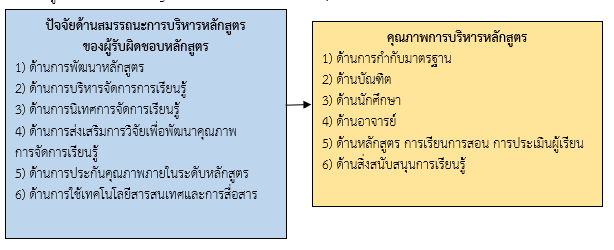
This predictive research aimed to examine: (1) the level of curriculum management competency among curriculum administrators, (2) the quality level of curriculum administration, and (3) the curriculum management competency factors that influence the quality of curriculum administration in the Bachelor of Nursing Science program at the Faculty of Nursing, Praboromarajchanok Institute. The sample consisted of 108 curriculum administrators from 30 nursing colleges under the Faculty of Nursing, selected through simple random sampling. The research instruments included questionnaires addressing personal information, curriculum management competency, and curriculum administration quality. The content validity index (CVI) ranged from 0.67 to 1.00. The reliability of the curriculum management competency questionnaire across six dimensions was assessed using Cronbach’s alpha, with coefficients of .87, .88, .84, .93, .94, and .90, respectively. Data were analyzed using descriptive statistics and stepwise multiple regression analysis. Research findings revealed that:
1. The overall level of curriculum management competency among curriculum administrators was very high (M = 4.22, SD = 0.39). The highest-scoring competency was internal quality assurance at the curriculum level (M = 4.41, SD = 0.49), followed by curriculum development (M = 4.30, SD = 0.43). The lowest-scoring aspect was the use of information and communication technology (M = 4.08, SD = 0.55)
2. The overall quality level of curriculum administration was high (M = 3.92, SD = 0.13). The highest-rated dimension was graduates (M = 4.58, SD = 0.30), followed by faculty members (M = 4.06, SD = 0.28), while the lowest-rated was students (M = 3.50, SD = 0.67).
3. The curriculum management competencies that significantly influenced the quality of curriculum administration included: 1) Curriculum development(Beta = .305, t = 5.552), 2) Instructional supervision (Beta = .285, t = 3.048), and (3) Learning management (Beta = .227, t = 2.393). These three variables collectively explained 20.2% of the variance in curriculum administration quality (R² = .202, p-value < .05).
It is recommended that the Faculty of Nursing, Praboromarajchanok Institute, prioritize and systematically promote the development of curriculum management competencies among curriculum administrators—particularly in the areas of curriculum development, instructional supervision, and learning management—to enhance the overall quality of curriculum administration.
References
Boromarajonani College of Nursing, Songkhla. (2020). Manual for The Curriculum Management for Bachelor of Nursing Science Program (Academic year 2019). Songkhla: Boromarajonani College of Nursing, Songkhla. (in Thai)
Chunaka, L., & Jansila, V. (2016). The Development Model to Competency for Academic Administrative of The School Administrators in Primary Educational Service Area Office. Journal of Education Naresuan University, 18(2), 72-79. (in Thai)
Cohen, J. (1988). Statistical Power Analysis for The Behavioral Sciences. New York: Academic Press.
Faul, F., Erdfelder, E., Lang, A.-G., & Buchner, A. (2007). G*Power 3: A Flexible Statistical Power Analysis Program for The Social, Behavioral, and Biomedical Sciences. Behavior Research Methods, 39(2), 175-191.
Hair, F. J., Black, C. W., Babin, J. B., & Anderson, E.R. (2010). Multivariate Data Analysis (7th ed). New Jersey: Pearson Education.
Junwin, B., Ratchathawan, R., Witwattananggoon, A., & Kanchanaaree, S. (2022). Factors Influencing the Development of 21st Century Skills among Nursing Students: A Study from Praboromarajchanok Institute, Ministry of Public Health. The Southern College Network Journal of Nursing and Public Health, 9(3), 1-14. (in Thai)
Loiwirat, T., Kaewknoo, K., & KongKaew, K. (2015). A Study of Causes and Factors Affecting the Termination of Status as Undergraduate Student, Prince of Songkla University, Songkla: Faculty of Engineering, Prince of Songkla University. (in Thai)
McClelland, D. C. (1973). Testing for competence rather than for “Intelligence”. American Psychologist, 28(1), pp. 1-14.
Navagitpaitoon, N. (2020). Components of Competency. Retrieved Octomber 18, 2020 from https://www.gotoknow.org/posts/500930.
Ngo-sate, T., & Prasarnkarn, H. (2018). Factors Affecting Implementation of Educational Quality Assurance Program Secondary School of Krabi Province under Secondary Educational Service Area Office 13. Phuket Rajabhat University Academic Journal, 13(2), 276-292. (in Thai)
Office of The Higher Education Commission. (2017). Manual for The Internal Quality Assurance for Higher Education Institutions (3rd ed). Bangkok: Ministry of Education. (in Thai)
Pauwongsakul, S., Nakpanom, S., & Nakpanom, S. (2017). Factors Influencing Effectiveness of 5-year Pediogic Curriculum Management of Rajabhat Universities. Journal of MCU Social Science Review, 6(2), 383-396. (in Thai)
Praboromarajchanok Institute. (2017). Manual for The Instrument to Evaluate Learning Outcomes as the Thai Qualifications Framework for Higher Education, Nursing Curriculum. Retrieved November 20, 2020 from http://www.pi.ac.th/index.
Sarakshetrin, A., Puttapitukpo, S., & Sriyasak, A. (2020). The Components of 21st Century Learning Skills among Nursing Students of Prabororomarajchanok Institute, Ministry of Public Health. Journal of Nursing and Education, 13(2), 29-46. (in Thai)
Silpcharu, T. (2020). Research and Statistical Data Analysis with SPASS and AMOS (18th ed). Bangkok: Business R&D. (in Thai)
Thongmeekhaun, T. (2019). Competencies and Guideline for Developing Administrative Competency for Persons in Charge of Bachelor of Nursing Science Curriculum, Nursing College under Praboromarajchanok Institute. Sripatum Chonburi Academic Journal, 16(2), 132-142. (in Thai)
Yaemchuen. N., & Lertamornsak, K. (2023). Administrative Skills of School Administrators in Digital Era Affecting the Effectiveness of Schools under the Office of Private Education Commission. Interdisciplinary Academic and Research Journal, 3(6), 331-348. (in Thai)
Downloads
Published
Issue
Section
License
Copyright (c) 2025 Journal of Nursing and Education

This work is licensed under a Creative Commons Attribution-NonCommercial-NoDerivatives 4.0 International License.



